
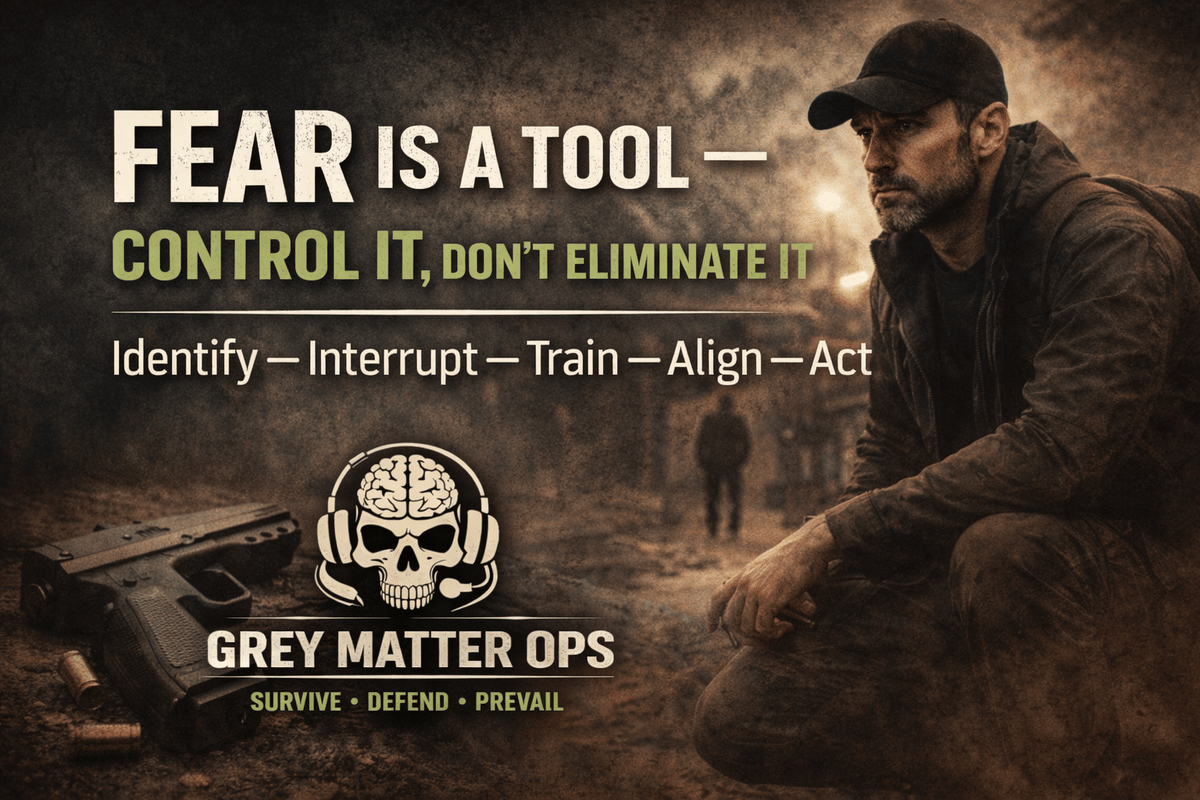
Fear Is a Tool — Control It, Don’t Eliminate It
The Grey Matter Ops Operational Doctrine for Fear Management
Fear is not weakness.
It is biological wiring designed for survival.
It sharpens awareness. It mobilizes energy. It prepares the body for action.
The objective is not to eliminate fear.
The objective is to regulate it before it degrades cognition and corrupts decision-making.
At Grey Matter Ops, the standard is simple:
Emotion is information. Discipline decides. Mission comes first.
I. UNDERSTAND THE FUNCTION OF FEAR
Fear originates in the amygdala — the brain’s early warning system. When a potential threat appears, the sympathetic nervous system increases heart rate, tightens muscles, and narrows attention.
This response is adaptive.
Research demonstrates that moderate arousal improves performance — until it crosses into cognitive degradation. When hyper-arousal sets in, fine motor skills deteriorate, perception narrows, and judgment suffers.
Fear is useful — until it is unmanaged.
The breakdown occurs when imagination overrides observation. When catastrophic projection replaces objective assessment. When urgency becomes impulsivity.
Your first responsibility is awareness.
II. TRAIN BEFORE FEAR ARRIVES
You do not rise to the occasion.
You default to your conditioning.
Stress Inoculation Training (SIT), developed by psychologist Donald Meichenbaum, shows that gradual exposure to stress builds psychological resilience. Repeated exposure reduces novelty. Reduced novelty reduces panic.
Training accomplishes three things:
Familiarizes the nervous system with arousal
Builds procedural memory under mild stress
Reduces shock during real events
This applies to:
Emergency planning
Boundary setting
Environmental scanning
Scenario rehearsal
High-stakes conversations
Preparation converts chaos into sequence.
Without training, fear feels overwhelming.
With training, fear feels familiar.
III. INTERRUPT & COMMAND — THE OPERATIONAL FEAR PROTOCOL
Fear is not the problem.
Uninterrupted fear is.
When a threat — real or perceived — appears, the amygdala activates before conscious thought. The sympathetic nervous system increases heart rate, narrows vision, and prioritizes survival speed over analytical depth.
This is efficient for immediate danger.
It is dangerous for decision-making if left unchecked.
Your objective is not suppression.
Your objective is regulation before hyper-arousal degrades performance.
Below is the operational sequence.
STEP 1: IDENTIFY THE SIGNAL (0–3 Seconds)
Indicators of rising arousal:
Sudden heart rate spike
Shallow breathing
Tunnel vision
Catastrophic internal dialogue
Urge to act immediately
This is the moment before cognitive degradation.
If unaddressed, imagination can override observation — a phenomenon often described in neuroscience as “amygdala hijack,” where emotional urgency bypasses deliberate reasoning.
The mission now is interruption.
STEP 2: THE 3-BREATH RESET (Manual Override)
This is not relaxation.
This is neurological control.
Execute immediately:
Inhale through the nose for 4 seconds
Hold for 4 seconds
Exhale slowly for 4 seconds
Repeat for 3 cycles
Slowing the exhale equal to or slightly longer than the inhale increases parasympathetic activation.
Why it works:
Controlled breathing stimulates the vagus nerve and reduces sympathetic dominance. It widens perceptual field and restores prefrontal cortex engagement.
Physiologically, you are signaling to your body:
“There is no immediate mortal threat.”
This is your reset switch.
STEP 3: WIDEN THE FRAME (Break Tunnel Vision)
Fear narrows attention.
Deliberately expand it:
Lift your chin slightly
Widen peripheral vision
Identify three neutral objects in your environment
Then transition from calming to operating:
Identify the nearest exit
Identify available space
Identify barriers or cover
This restores orientation and prevents fixation on imagined outcomes.
STEP 4: FACT-CHECK THE THREAT
Fear often attaches to interpretation, not reality.
Ask:
What do I actually see?
What evidence confirms danger?
What evidence contradicts it?
If physical symptoms persist (racing heart, adrenaline surge), reframe them:
“This is energy mobilization. My body is preparing me.”
Research on arousal reappraisal shows that interpreting stress signals as performance fuel improves execution and reduces anxiety impairment.
Energy is not the enemy.
Mislabeling it is.
STEP 5: DEFINE THE MISSION
Fear management exists for one reason:
Objective preservation.
In a civilian context, your mission might be:
Get my family safely to the exit
De-escalate without ego engagement
Leave the environment safely
Maintain composure under pressure
Fear without mission becomes panic.
Fear aligned to mission becomes focus.
STEP 6: ACTION RESTORES CONTROL
If you remain stationary too long, fear loops intensify.
Initiate controlled movement:
Step back to create space
Move toward an exit
Lower your voice
Adjust posture
Motor action feeds the nervous system new data.
Courage is not moral bravado.
It is functional movement under arousal.
Action interrupts rumination.
FAILURE MODE: WHEN FREEZE HAPPENS
Despite training, freeze may occur.
Indicators:
Mental blankness
Delayed response
Inability to speak
Physical immobility
If freeze occurs:
Move your feet first — even one step
Exhale forcefully
State a simple directive internally: “Move.”
Motor activation reboots cognitive processing. Do not wait for calm to return before acting.
Calm often follows motion.
POST-INCIDENT RESET (Adrenaline Recovery Phase)
When the mission ends, the body does not instantly normalize.
You may experience:
Shaking hands
Sudden fatigue
Emotional drop
Irritability
Cognitive fog
This is not weakness.
It is neurochemical discharge.
Operational Recovery Protocol:
Hydrate
Execute two slow breathing cycles
Walk for 2–5 minutes
Avoid immediate rumination
Delay major decisions for 30–60 minutes
Recovery is part of performance.
IV. NORMALIZE CONTROLLED DISCOMFORT
Avoidance strengthens fear.
Exposure reduces its authority.
Controlled exposure builds resilience:
Practice difficult but necessary conversations
Train physically under fatigue
Rehearse movement in safe environments
Conduct situational awareness drills in public spaces
Repeated exposure lowers novelty. Lower novelty reduces panic spikes.
Discomfort is not danger.
It is conditioning.
V. STUDY FAILURE AND SUCCESS
Fear feeds on uncertainty.
When analyzing failure:
Identify decision errors
Separate emotion from outcome
Extract repeatable lessons
When studying success:
Identify stable behaviors
Identify consistent thought patterns
Identify disciplined procedures
Success leaves patterns.
Failure leaves warnings.
Both reduce fear when studied deliberately.
VI. REFRAME WORRY
Worry is fear without structure.
It rehearses imagined defeat without producing actionable steps.
Interrupt it with three questions:
What specific problem am I solving?
What decision must be made?
What action can I take within 24 hours?
If no action exists, it is noise.
Replace rumination with preparation.
VII. MOVE UNDER AROUSAL
Fear may remain.
Heart rate may stay elevated.
Adrenaline may linger.
Action does not require emotional comfort.
Movement restores sensory dominance.
Movement feeds the brain new information.
Movement interrupts paralysis.
You do not wait for fear to disappear.
You move with discipline while it is present.
FINAL DOCTRINE
Fear is neither enemy nor master.
It is a signal.
If unmanaged, it produces:
Impulse
Distortion
Hesitation
Panic
If governed, it produces:
Focus
Preparation
Precision
Mission alignment
The nervous system is not your enemy.
It is equipment.
Train it.
Interrupt it.
Align it.
Deploy it in service of the mission.
Control it.
Do not eliminate it.
Remember: Awareness is Armour. For more tactical insights, subscribe to Red Dot Mindset.