
How to Recover After a High-Stress Event
By Grey Matter Ops™
⚠️ Notice
This article is for educational and situational-awareness purposes only.
Grey Matter Ops™ does not provide legal, medical, or psychological advice.
Always follow local laws and seek professional help when needed.
If you ever feel unsafe or overwhelmed, call or text 988 (U.S. Suicide & Crisis Lifeline).
Why Recovery Is Part of Readiness
Training for awareness and survival isn’t just about spotting threats or making fast decisions.
It’s also about what happens after.
The parking lot confrontation. The bar argument that nearly turned physical.
The moment someone followed you too closely for too long.
When the danger passes, your body doesn’t immediately know it’s over.
Adrenaline fades slowly, often leaving you shaky, foggy, or emotionally drained. That post-stress crash can distort memory and lead to poor statements or long-term anxiety.
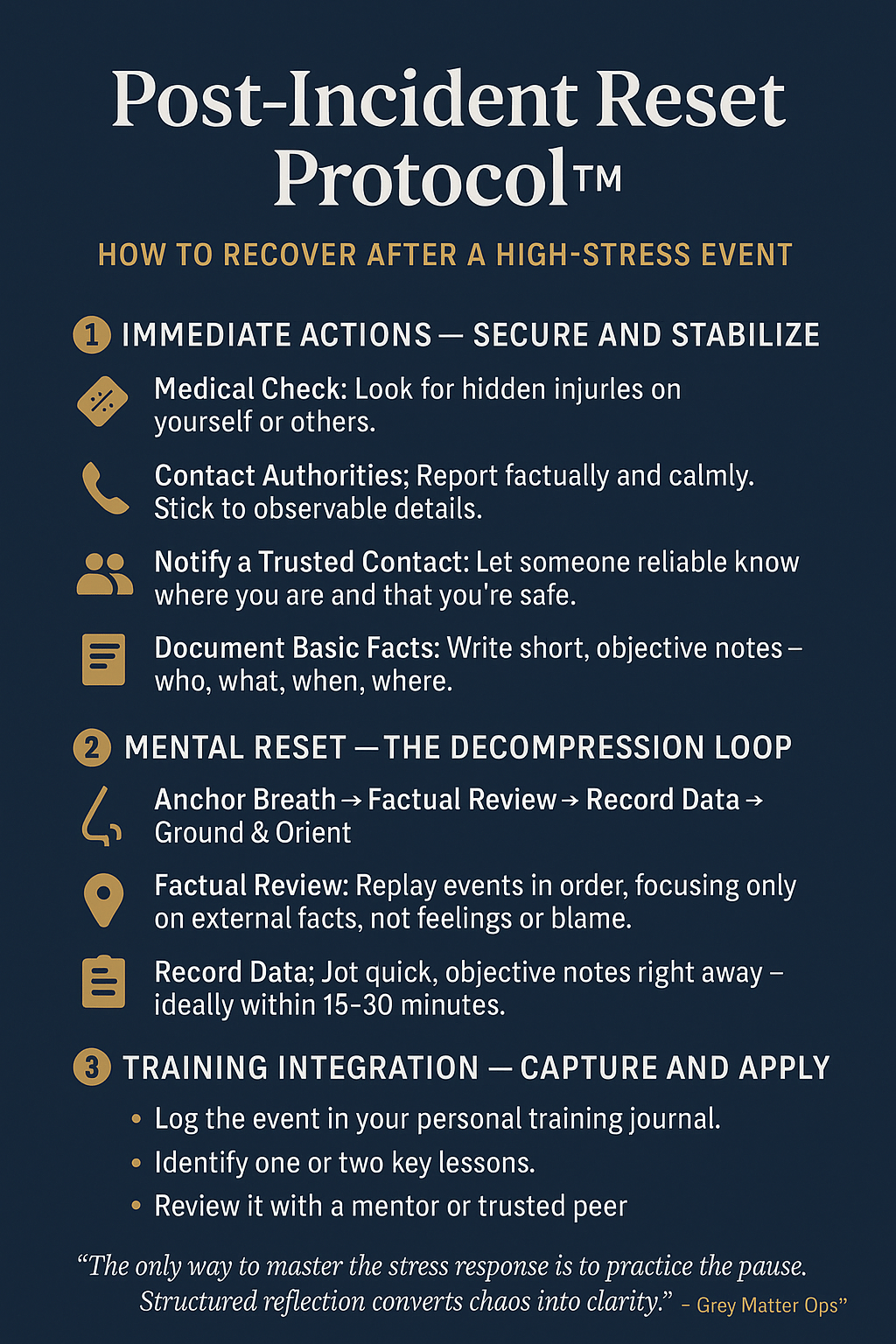
The Post-Incident Reset Protocol™ helps you regain calm, protect clarity, and capture accurate details before memory fades.
In short: it keeps you functional after the fight.
The Post-Incident Reset Protocol™ activates once the civilian is safe, the threat is no longer present, and the Grey Protocol™ has ended.
1️⃣ Immediate Actions — Secure and Stabilize
When the danger passes, your first job is to ensure safety and stability.
Checklist:
🩹 Medical Check: Look for hidden injuries on yourself or others. Adrenaline masks pain. Perform a quick self-check or “blood sweep” by running your hands over your body to feel for wetness, warmth, or bleeding you may not notice. Use simple, noninvasive motions — over arms, torso, legs — and stop if you feel pain or something abnormal.
📞 Contact Authorities:
Report what happened factually and calmly.
Stick to observable details — what you saw, what you heard, and what you did.
⚖️ Legal Note:
If the incident involved physical force or potential criminal charges, consider consulting an attorney before giving detailed statements.
You have the right to say, “I need to speak with a lawyer first.”
👥 Notify a Trusted Contact:
Let someone reliable know where you are and that you’re safe.
📝 Document Basic Facts:
Write short, objective notes — who, what, when, where, and how.
For “how,” record only factual, observable mechanics of the event (e.g., “He moved toward me,” “The object fell,” “The noise came from behind”), not interpretations, motives, emotions, or opinions. Avoid guesses — stick to what you directly observed.
“The first report you give defines the narrative. Calm facts are your best defense.” — Grey Matter Ops™
2️⃣ Mental Reset — The Decompression Loop
The body needs a deliberate signal to leave survival mode.
The Decompression Loop walks you through that process step-by-step by re-engaging your Parasympathetic Nervous System.
Cycle: Anchor Breath → Factual Review → Record Data → Ground & Orient
1. Anchor Breath
Slow, controlled breathing activates your body’s recovery system.
Try this pattern:
Inhale through your nose for 4 seconds
Hold for 2 seconds
Exhale through your mouth for 6–7 seconds
Repeat for 2–3 minutes
This rhythm activates the vagus nerve, which tells your brain the threat has ended. Within minutes, heart rate and muscle tension begin to normalize.
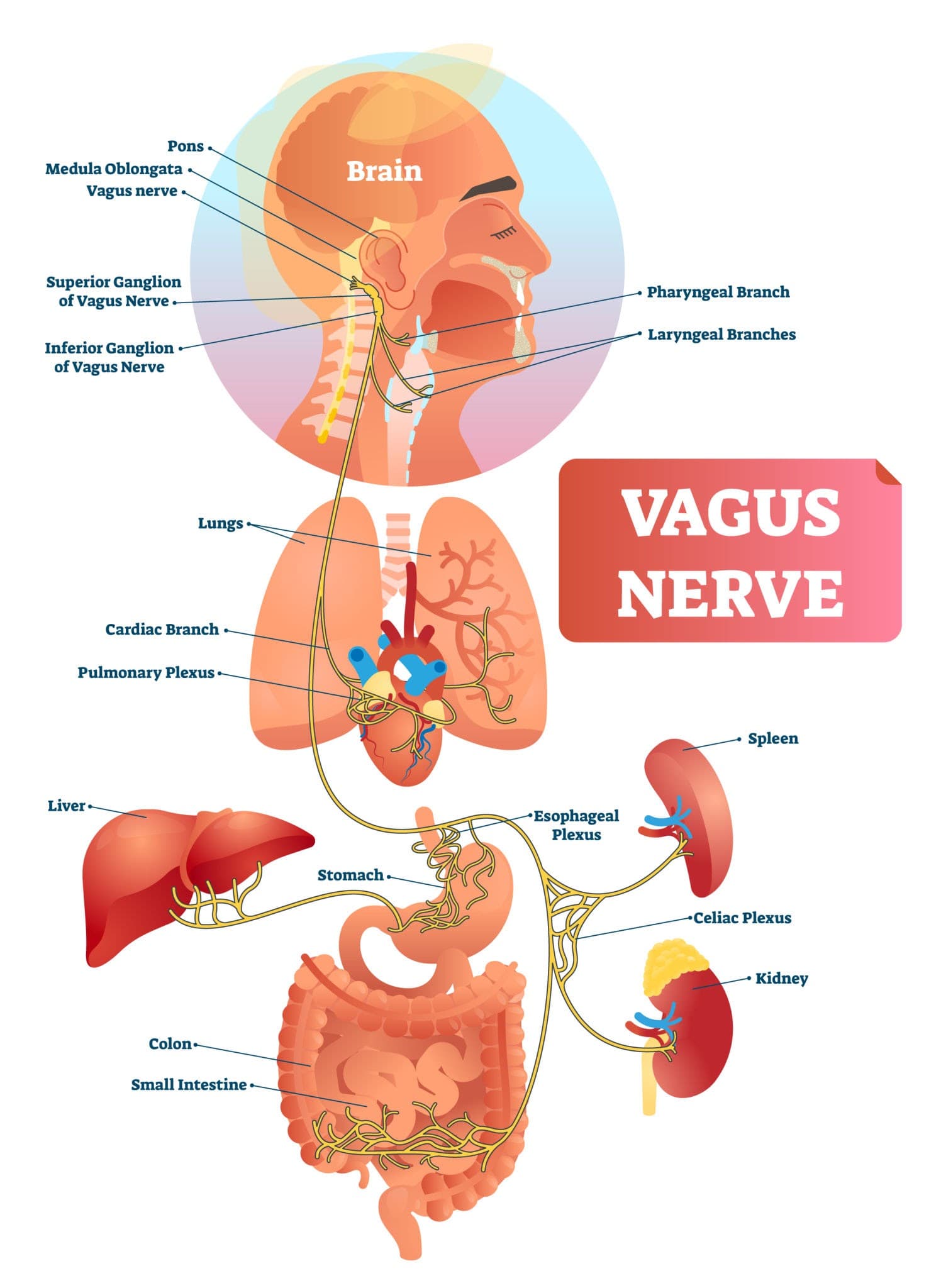
“The vagus nerve connects the brain to major organs, signaling the body to shift from fight-or-flight to calm.”
2. Factual Review
Replay events in order, focusing only on facts, not emotions or blame.
Ask yourself:
What environment was I in?
Who was present?
What cues or actions stood out?
What was my first move?
How did the sequence physically unfold?
(Only the observable mechanics — movements, positions, changes in environment. No interpretation or assumptions.)
Avoid asking “why” or “should I have…” yet — that comes later.
3. Record Data
Jot quick, objective notes right away — ideally within 15–30 minutes.
Include:
Date, time, and location
Physical descriptions (clothing, height, build)
Exact words spoken (yours and theirs)
Witnesses present
Environmental conditions (lighting, weather, sounds)
Use your phone’s voice recorder if writing isn’t possible.
Memory can degrade significantly within the first hour after high stress.
4. Ground & Orient
Deliberately bring your awareness back to the present.
Before beginning, make sure you have moved to a safe, stable location away from traffic, bystanders, or anyone connected to the incident.
Hydrate, notice the temperature of the room, the feel of your clothes, the scent in the air.
Simple sensory focus re-anchors your nervous system.
“The only way to master the stress response is to practice the pause. Structured reflection converts chaos into clarity.” — Grey Matter Ops™
❌ Common Post-Incident Mistakes to Avoid
Don’t post about it on social media (it can be used against you legally)
Don’t apologize or admit fault (even if you feel shaken)
Don’t suppress emotions entirely — delayed processing often backfires
Don’t drive if you’re trembling or disoriented
Don’t use alcohol or substances to “calm down”
3️⃣ Training Integration — Capture and Apply
Once you’ve stabilized and rested, turn the event into learning.
🗒️ Log the experience in your personal training journal.
🔍 Identify one or two lessons — cues you missed, habits that worked, or reactions to refine.
🤝 Review it with a mentor, instructor, or trusted peer if possible.
🧠 Mental Health Note:
If you experience persistent nightmares, hypervigilance, avoidance, or intrusive thoughts lasting more than two or three weeks, these may be signs of an acute stress response.
Speaking with a trauma-informed counselor or therapist is not weakness — it’s tactical maintenance.
“Recovery without reflection is just rest. Reflection with structure becomes mastery.” — Grey Matter Ops™
Why It Matters
The Post-Incident Reset Protocol™ closes the loop of readiness.
It’s not about reliving the event — it’s about reclaiming control after it.
By pairing physical recovery, mental decompression, and structured reflection, you transform a high-stress encounter into data you can train from.
That’s how professionals stay calm — and how ordinary people become protectors.
Train the Mind. Win the Fight.
Remember: Awareness is Armour.
Remember: Awareness is Armour. For more tactical insights, subscribe to Red Dot Mindset.