
By Mickey Middaugh, Founder, Grey Matter Ops™
Children should not grow up fearful.
But they should grow up aware.
Situational awareness is not just an adult skill. It is a life skill, and when it is taught correctly, it gives children something far more powerful than fear: it gives them confidence, clarity, and a plan.
At Grey Matter Ops™, we teach awareness as a practical discipline. For adults, that means recognizing exits, reading behavior, and staying mentally ahead of problems. For children, the principles are the same, but the language must be calm, age-appropriate, and actionable.
The goal is not to burden kids with adult fears. The goal is to help them build simple habits that make them safer, more confident, and more capable in everyday life.
The Safe Child Framework™
Parents do not need to turn their children into miniature security professionals.
They do need to teach them a few repeatable habits that work in stores, schools, restaurants, parks, airports, and crowded public spaces.
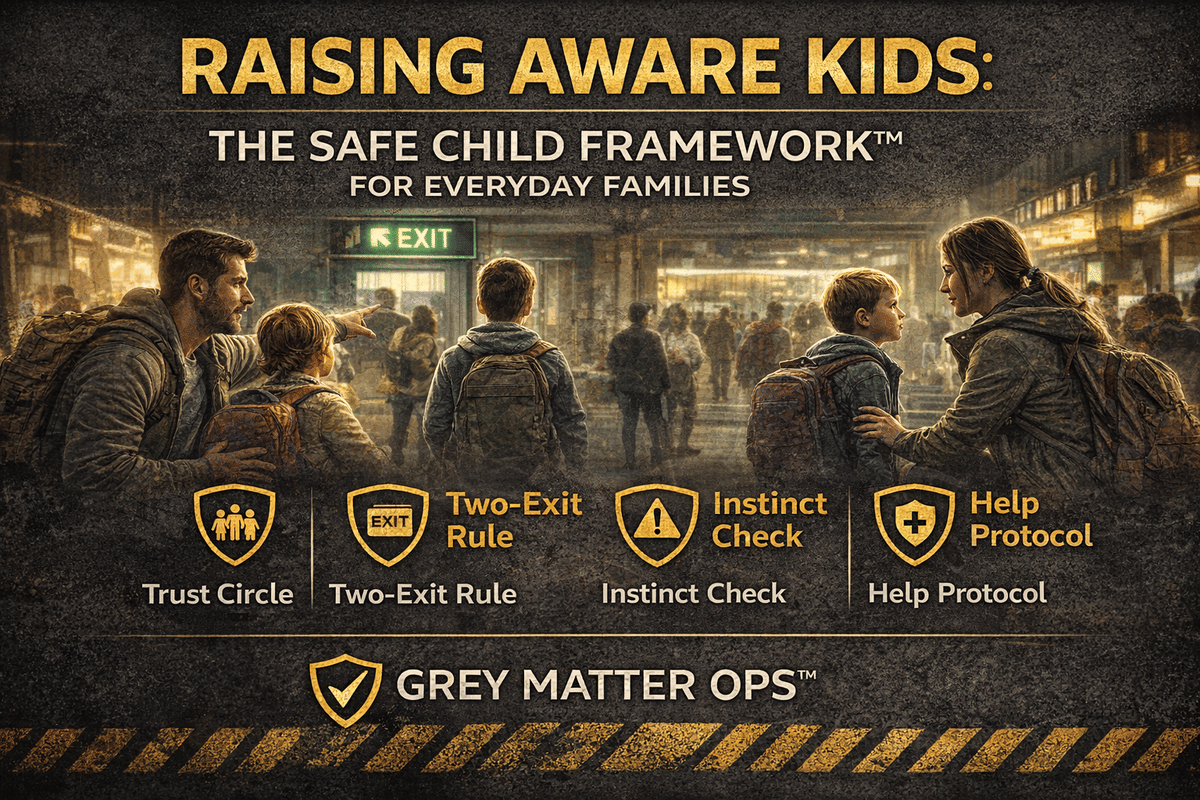
The Safe Child Framework™ is built around four practical ideas:
1. The Trust Circle
Children need to know who their safe people are before a stressful moment happens.
That starts with defining a clear circle of trusted adults. Not every friendly adult is a safe adult. Kids need simple, specific guidance.
Teach them:
who their trusted adults are by name and role
to stay within sight or earshot in public places
that they should tell a trusted adult immediately if something feels wrong
that family safety rules override social pressure or politeness
Children should never have to guess who they can turn to in a moment of uncertainty.
2. The Two-Exit Rule
One of the simplest awareness habits a child can learn is to notice how to get out.
Adults often overlook this. Children can be trained to do it naturally.
When entering a building, teach them to quietly notice:
where they came in
where the nearest exits are
where to go if they become separated
This does not need to feel heavy. In fact, it works best when it is taught casually.
You can make it a game in new places: “Show me two ways out.”
That one habit builds orientation, confidence, and calm under stress.
3. The Instinct Check
Children often sense discomfort before they can explain it.
Parents should not teach them to ignore that signal. They should teach them how to respond to it.
Give them permission to speak up when something feels off.
That might sound like:
“I do not like that.”
“I want to stay with you.”
“Something feels weird.”
Children do not need perfect language in a moment of discomfort. They need to know they will be taken seriously.
If we teach kids to override their instincts in order to be polite, we create hesitation where decisiveness should live.
If we teach them to report discomfort early, we help build trust in their own judgment.
4. The Help Protocol
Children should know exactly what to do if they get lost, separated, or scared in public.
Under stress, vague advice is not enough. They need a simple, rehearsed plan.
Teach them:
to stop moving and not wander farther
to go to a safe adult in an identified role, such as a store employee, teacher, or uniformed staff member
to use a simple phrase like, “I am separated from my parent and need help.”
to avoid leaving with an unfamiliar person unless it is part of a clear safety transfer to the right authority or employee
Children perform better when the plan has been practiced ahead of time.
Safety should never begin for the first time during the emergency.
Teaching Baseline Without Using That Word
One of the most practical things a parent can do is teach a child what “normal” looks like in a place.
That means helping them notice:
where families usually gather
where employees normally stand
what areas are open to the public
what behavior seems calm, ordinary, and expected
If a child can recognize what feels normal, they are better prepared to notice what feels wrong.
That is the beginning of awareness.
Behavior-Based Red Flags Parents Can Teach
Child safety education should remain behavior-based, not fear-based.
That means teaching children to notice actions that deserve attention rather than teaching them to fear everyone around them.
Age-appropriate examples include:
an adult asking a child to keep a secret from their parent
someone trying to separate them from the group
an unfamiliar adult asking for help in a way that feels wrong or inappropriate
someone ignoring the child’s “no” or personal space
an adult offering gifts, treats, or special attention to pull them away
The lesson is simple: if a behavior feels wrong, confusing, secretive, or isolating, the child should move toward safety and tell a trusted adult immediately.
That is not paranoia.
That is trained awareness.
How Parents Can Teach This Without Creating Fear
The tone matters as much as the lesson.
When parents teach awareness with calm repetition, children tend to absorb it as normal life skill development rather than as a reason to be anxious.
A few practical rules help:
keep the language simple
keep the tone calm
practice in everyday settings
reward speaking up
avoid dramatic worst-case-scenario lectures
Children do not need to carry adult-level threat awareness.
They need a few reliable habits that help them stay oriented, recognize discomfort, and seek help quickly.
Practical Awareness Habits for Families
The strongest safety training usually happens in small moments, not big speeches.
Parents can begin building awareness by practicing simple habits such as:
identifying a family rally point in crowded places
asking children to point out exits in restaurants or stores
reviewing who they can go to for help if separated
teaching them that they can always leave a situation that feels wrong
praising them when they notice details or speak up clearly
These drills take seconds, but over time they create a safer, more self-aware child.
Final Thought: Awareness Is a Gift, Not a Burden
Children should not grow up fearful.
But they should grow up aware.
Awareness gives them options.
It gives them language.
It gives them confidence.
And in uncertain moments, it gives them a plan.
That is not fear.
That is preparation.
Remember: Awareness is Armour™.
Train the Mind. Win the Fight.
Remember: Awareness is Armour. For more tactical insights, subscribe to Red Dot Mindset.