

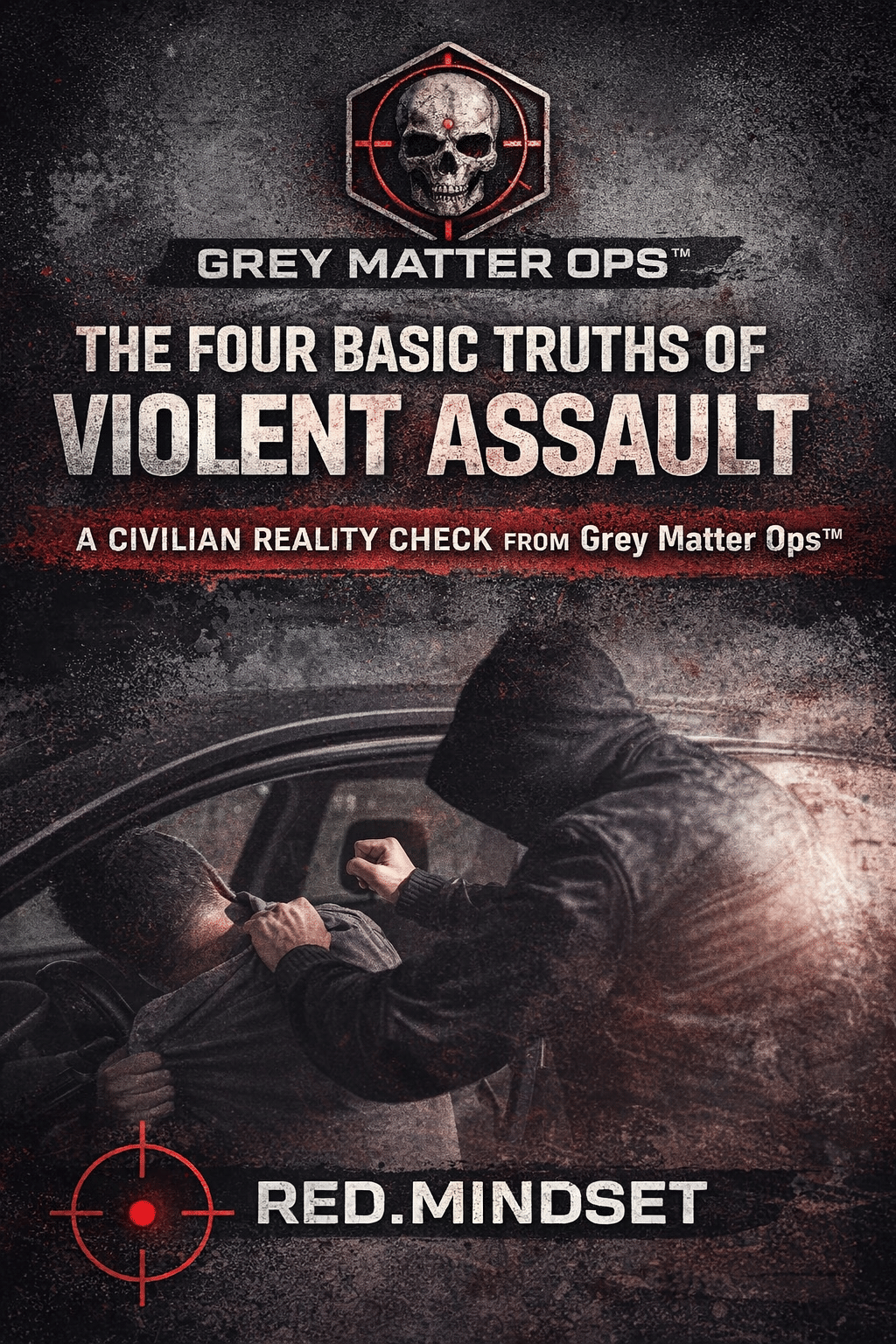
A Civilian Reality Check from Grey Matter Ops™
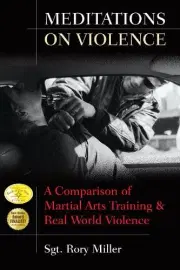
In his seminal work Meditations on Violence, Sgt. Rory Miller—a career corrections officer and subject-matter expert on real-world violence—identified four foundational truths about how assaults actually unfold. These truths are grounded not in theory or competition, but in direct observation of predatory violence as it occurs outside controlled environments.
At Grey Matter Ops™, we believe these insights are not just relevant to professionals—they represent essential ground truth every civilian should understand to navigate an unpredictable world more safely. What follows is our civilian-focused interpretation of Miller’s original framework, viewed through the Red Dot Mindset: awareness-first, prevention-oriented, and legally grounded.
This article does not modify or challenge Miller’s conclusions. It translates them—carefully and respectfully—into civilian-accessible doctrine.
Most people imagine violence as a confrontation.
Two people see each other.
Words are exchanged.
Postures square up.
Something happens.
That image is wrong—and dangerously so.
Real-world violence does not look like a fight. It looks like a problem arriving faster than your brain is ready to handle. Criminal assaults are not tests of skill or strength; they are predatory events designed to overwhelm a victim before they can react.
Understanding that reality starts with four uncomfortable truths.
These are not tactics.
They are not techniques.
They are conditions of failure—what violence looks like when awareness breaks down.
Doctrinal Note:
The four truths presented below originate with Sgt. Rory Miller (Meditations on Violence, Chapter 3.2). The interpretations and civilian applications that follow are original to Grey Matter Ops™ and the Red Dot Mindset framework.
Truth One: Violence Happens Closer Than You Expect
Most civilian self-defense advice assumes distance.
Real assaults erase it.
Criminals do not attack from conversational range. They attack from certainty range—close enough that the first strike is almost guaranteed to land. There is no wind-up, no warning step, no time buffer.
Distance equals time.
Criminals deny both.
This is why so many victims say, “It came out of nowhere.”
It didn’t. It just happened inside a range where reaction was already late.
Civilian takeaway:
If you are relying on reaction speed, blocks, or last-second movement, you are already behind the curve. Awareness must live before proximity is breached.
Truth Two: Violence Happens Faster Than You Can Process
Assaults are not exchanges.
They are floods.
Once initiated, violence comes as a rapid, continuous barrage designed to overwhelm the senses and shut down decision-making. There is no pause for reassessment. No rhythm. No back-and-forth.
This is why people freeze—not because they are weak, but because the speed exceeds their ability to process what’s happening.
Criminals don’t need precision.
They need momentum.
Civilian takeaway:
You will not “catch up” to violence once it starts. The goal is not to out-perform an attacker—it is to interrupt, disrupt, and escape as early as possible.
Truth Three: Violence Happens More Suddenly Than Training Allows
Surprise is not an accident.
It is the point.
Predatory violence depends on catching the victim mentally unprepared—focused on routine, distraction, or familiarity. That moment of normalcy is what makes the attack viable.
Training environments remove surprise by design. Real life does not.
Assaults happen while you’re:
Walking to your car
Standing in line
Checking your phone
Unlocking a door
Not when you’re “ready.”
Civilian takeaway:
Situational awareness is not paranoia—it is insurance against surprise. It buys time and probability, not certainty. You don’t need to predict violence. You need to notice when something no longer fits the environment.
Truth Four: Violence Happens With More Power Than You’re Conditioned For
Real assaults are not moderated.
There are no safety rules.
No controlled force.
No concern for injury—yours or theirs.
The first strike often lands. So do several more.
Pain feels different outside of training. Even experienced people can hesitate when reality doesn’t match expectation—not because they lack courage, but because the input is unfamiliar and overwhelming.
Civilian takeaway:
Survival does not require dominance. It requires function under pressure—moving, creating space, and exiting while injured, startled, or off-balance.
The Grey Matter Ops Perspective
These four truths are not meant to scare you.
They are meant to reset expectations.
For civilians, survival is not about “winning a fight.”
It is about not being there when the fight starts—and breaking contact when it does.
The Red Dot Mindset lives left of violence—before the moment things turn physical:
Recognizing proximity changes
Reading behavior, not appearances
Managing space, angles, and exits
Acting early, not heroically
In a civilian context, acting early means repositioning, setting verbal boundaries, disengaging, or leaving—not preemptively striking. It is about movement and decision-making, not escalation.
If you wait for certainty, violence has already begun.
Final Thought
These truths apply to predatory violence, not social or ego-driven conflict. They describe what happens when someone has already decided to harm another person and is acting to overwhelm them.
Violence favors the prepared predator—not because they are stronger or braver, but because they act earlier.
The civilian advantage is not technique.
It is awareness, positioning, and timing.
Train your eyes before your hands.
Train your decisions before your reactions.
That is the Grey Matter Ops way.
Primary Source Attribution
Miller, Rory. Meditations on Violence: A Comparison of Martial Arts Training and Real World Violence.
1st ed. Boston, MA: YMAA Publication Center, Inc., 2008.
Author: Sgt. Rory Miller (Corrections Officer)
Publisher: YMAA Publication Center, Inc.
ISBN-13: 978-1-59439-118-7
ISBN-10: 1-59439-118-1
Referenced Section: Chapter 3.2 — The Four Basic Truths of Violent Assault
Copyright: © 2008 Rory Miller
Printed in: United States of America
This article is for educational and situational awareness purposes only and does not constitute legal advice or tactical instruction. Readers are responsible for understanding and complying with all applicable laws in their jurisdiction.
Remember: Awareness is Armour. For more tactical insights, subscribe to Red Dot Mindset.

Mickey Middaugh