
Red Dot Mindset Series | Grey Matter Ops
The Unseen Battlefield: Public Spaces and Your Safety ⚠️
You're not paranoid; you're prepared. 💪
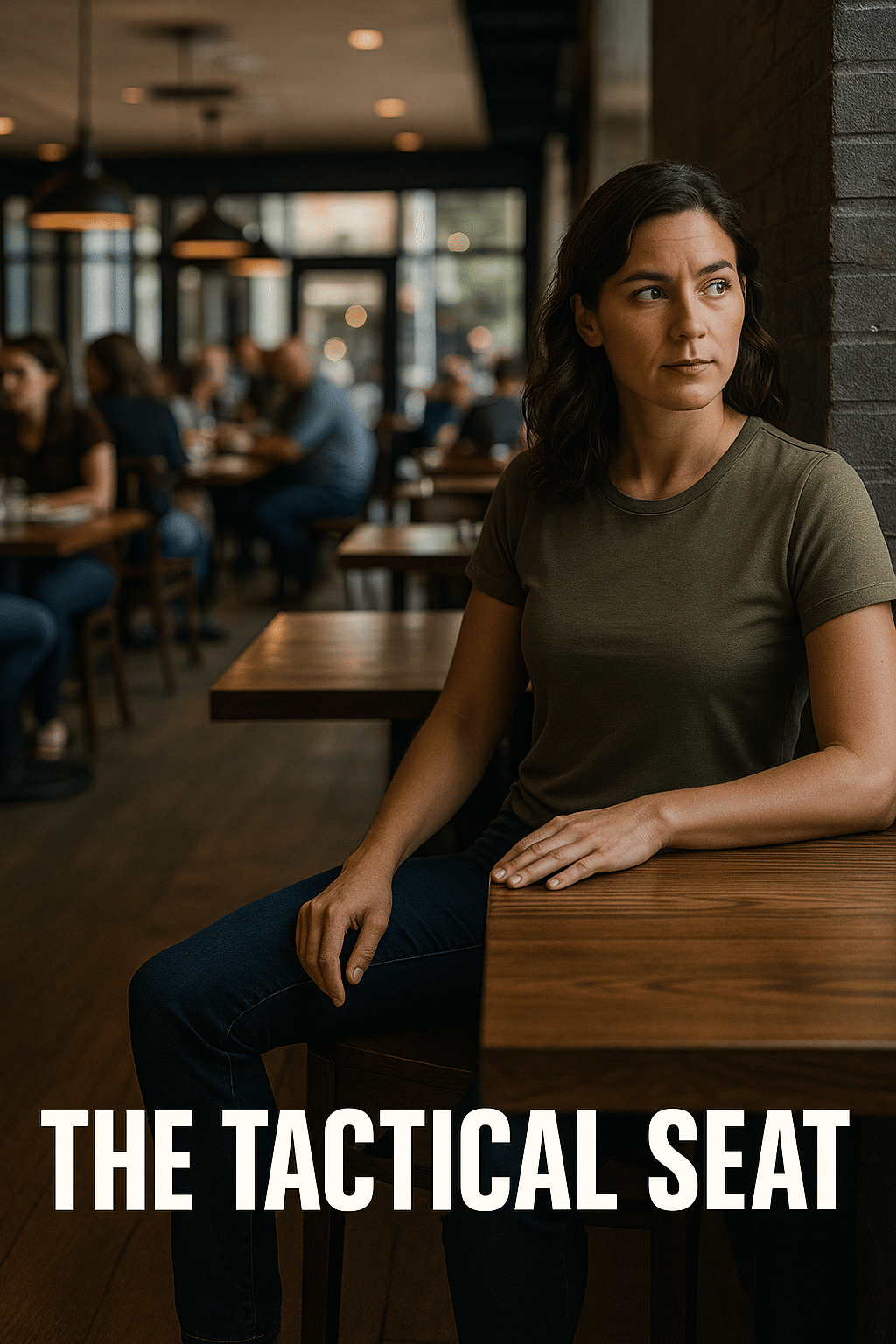
From a bustling restaurant to a quiet coffee shop, a movie theater, or a community meeting – the moment you enter, your environment dictates your potential responses. Your choice of seating isn't just about comfort; it's a critical, often overlooked, tactical decision.
At Grey Matter Ops, our mission is to empower civilians to operate "left of bang" – identifying pre-threat indicators and initiating decisive action before a crisis unfolds. Selecting the optimal seat in any public venue isn't driven by fear, but by a strategic, proactive mindset. It's about meticulously stacking the odds in your favor with deliberate, tactical awareness. 🎯
The Tactical Advantage: Why Your Seating Strategy is Paramount 🧭
Your seating selection directly impacts your capacity to:
Maintain Dominant Observation: Effectively monitor all ingress/egress points and critical areas. 👁️
Identify Pre-Threat Indicators: Spot anomalies and concerning behaviors before they escalate. 🚩
Ensure Unrestricted Egress: Control your personal movement path and avoid becoming trapped. 🏃♂️
Mitigate Crowd Funneling: Avoid being caught in chaotic, high-density panic zones. 👥
Facilitate Decisive Action: React under duress with immediate, unhesitating speed. ⚡
"When you position yourself like the complacent, you react like the complacent. And in a dynamic threat environment, that is invariably too late."
— Grey Matter Ops Training Doctrine
Key Tactical Criteria for Optimal Seating Selection ✅
Here's a rapid assessment framework to inform your critical seating choice:
1. Dominant Vantage Point: Back to the Wall, Eyes on the Room. 🛡️
Your absolute priority is uncompromised situational awareness.
Select a position that grants a panoramic view, encompassing all primary and secondary entrances/exits, as well as the majority of the public space. 🔭
Never expose your back to open areas or a thoroughfare. Avoid facing a blank wall, which blinds you to the room's dynamics. 🚫
Maintain a crucial standoff distance of several inches from any wall or solid structure. This space preserves your freedom of movement, allows for full rotational mobility, and prevents you from being "pinned." 🤸
Observation isn't just a tool; it's your primary defensive and offensive asset. Never compromise its integrity. 💥
2. Avoid the "X": Stay Clear of Primary Ingress/Egress Points. 🛑
Despite its perceived convenience, the primary entrance is a high-risk zone:
It serves as the most probable point of initiation for hostile actors. 🚪
It transforms into a lethal bottleneck during a mass exodus, trapping individuals in a "kill zone." 🚦
It is a high-exposure, low-cover area, offering minimal concealment or protection. 📉
Instead, strategically position yourself:
Adjacent to, but not directly obstructing, a secondary or tertiary egress point (e.g., kitchen service door, emergency exit, back corridor, restroom access). ➡️
Ensuring a redundant and unimpeded egress path – your escape route must be clear of obstacles and human traffic. ✨
3. Prioritize Mobility: Shun Confining Configurations. ↔️
Comfort is a liability if it compromises your tactical mobility.
Booths: Function as natural containment zones, severely restricting lateral and rearward movement. 🛋️
Deep Corners/Alcoves: Create tactical cul-de-sacs, limiting your visibility, escape vectors, and increasing your vulnerability to being cornered. 📐
Chairs with Armrests/Fixed Seating: Impede rapid egress and can hinder weapon presentation or defensive maneuvers. 🪑
Instead, favor positions that maximize your freedom of movement:
Freestanding tables: Positioned at the edge of walkways or open areas. 🍽️
Aisle-side or perimeter positions: Allowing for immediate movement into a main thoroughfare. 🚶♀️
Locations that facilitate unimpeded, rapid egress without requiring you to navigate over or around other patrons. 🚀
Remember: In a critical incident, comfort is a luxury you cannot afford if it comes at the expense of your tactical speed and maneuverability. 💨
4. Avoid the "Kill Zone": Steer Clear of the Room's Center. 🚫
The center of any public space represents a high-risk "kill zone" due to:
Maximal Exposure: You are exposed from all directions (360°), making you a primary target. 🎯
Extended Egress Distance: You are furthest from all available exits, increasing the time required to escape. ⏳
Crowd Entanglement: You are embedded within the densest part of the crowd, making rapid movement and disengagement exceptionally difficult. 🕸️
Limited Cover/Concealment: The center often provides the least amount of structural cover or concealment options. 🧱
Optimal positioning involves:
Maintaining proximity to a wall, pillar, or other substantial structure that can offer at least cover from direct fire or immediate concealment. This also provides a stable point of reference. 🏛️
Ensuring at least one, ideally multiple, egress routes are maintained within your active peripheral vision. 👀
5. Pre-Visualize Your Emergency Action Plan (EAP). 🧠
Before you commit to a seat, engage in rapid, proactive mental rehearsal:
The "What If" Scenario: Immediately ask yourself: "If a critical incident erupts now, what is my immediate course of action?" 🤔
Identify Redundant Egress: Pinpoint not just the primary exit, but all secondary and tertiary escape routes. Mentally map out your path to each. 🗺️
Locate Immediate Cover and Concealment: Identify structural elements (load-bearing walls, substantial counters, large, fixed furniture) that could provide ballistic cover or simply concealment from immediate observation. 🛋️
Formulate a 3-Step Escape Vector: Develop a concise, immediate action plan (e.g., "move to the bar, through the kitchen, out the back door"). Keep it simple and actionable. ➡️➡️➡️
This pre-visualization process isn't merely a drill; it's a critical component of mindset conditioning that actively combats the debilitating "freeze" response common in high-stress, dynamic environments. It primes your neural pathways for decisive action. 🚀
Beyond Position: Interpreting Behavioral Anomalies (Pre-Threat Indicators) 🧐
Situational awareness transcends mere spatial positioning; it is fundamentally about discerning anomalous human behavior. Cultivate a keen eye for subtle deviations from baseline. 🔍
Be acutely attuned to the following pre-threat indicators: 🚩
Target Glance/Scanning: Individuals whose gaze systematically sweeps the room, focusing on exits, security measures, or potential targets, rather than engaging with their companions or surroundings. 🕵️♂️
Environmental Incongruity: Clothing that is incongruous with the environment or weather (e.g., heavy coats/hoodies indoors in warm weather, sunglasses at night, backpacks worn tightly indoors). This can indicate an attempt to conceal identity, weapons, or suspicious items. 🧥🕶️
Verbal or Non-Verbal Escalation/De-escalation: Abrupt shifts in demeanor, such as sudden loud arguments, an individual becoming unusually quiet and withdrawn, or aggressive posturing. 🗣️🤫
"Hardening" Choke Points: Individuals loitering suspiciously near critical choke points like entrances, exits, restrooms, or service corridors, observing traffic flow. 🚶♀️
Anomalous Kinesics: Body language that is stiff, overly deliberate, excessively fidgety, or indicative of extreme anxiety or aggression. Look for a disassociation between upper and lower body movement, or "thousand-yard stares." 🧍♂️
The vast majority of threats exhibit observable, often subtle, behavioral cues. Your disciplined observation is the critical differentiator. 💯
Concise Tactical Seating Protocol: At A Glance 📋
Tactical Imperative | Strategic Rationale |
|---|---|
Face All Ingress/Egress | Maintain uncompromised visual control and early threat detection. 👀 |
Avoid Confined Spaces | Maximize immediate mobility and prevent entrapment. 🏃♀️ |
Position Near (Not At) Exit | Balance rapid egress access with reduced exposure. ➡️ |
Evade Central Exposure | Minimize 360° vulnerability and crowd entanglement. 🌐 |
Utilize Structural Cover | Limit blind spots and provide immediate ballistic protection/concealment. 🧱 |
Execute Mental Rehearsal | Pre-condition your mind to defeat the freeze response and enable decisive action. 🧠 |
Export to Sheets
Pro Tip: Assert Your Seating Preference 🗣️
Most hostesses are focused on table rotation, not your tactical safety. However, you possess the right to articulate your preference:
“Could we be seated at that table, please? I find I’m more comfortable and aware when I have a clear view of the room.”
Polite, direct, and assertive. The majority of staff will accommodate a reasonable request. If they cannot, it's an immediate prompt to reassess the venue's overall layout and make a judgment call on your continued presence. 🤔
Final Word from Grey Matter Ops 🌟
You’re not irrational for desiring awareness of your surroundings. You’re simply tactically disciplined. And true awareness isn't rooted in fear — it's the bedrock of preparedness. 🛡️
Choosing a seat isn't a triviality; it's a fundamental aspect of maintaining control, readiness, and a proactive mindset. This is the operational ethos of protectors. This is the Red Dot Mindset. 🔴
Train the Mind. Win the Fight. 🥇
Remember: Awareness is Armour. For more tactical insights, subscribe to Red Dot Mindset.