
Most articles about “winning a gunfight” are written through a military or entertainment lens. They’re loud, confident, and decisive—and that’s exactly why concealed carriers should read them carefully, not literally.
There are truths buried in those articles. Hard truths.
There are also assumptions that can get a civilian killed—or imprisoned.
Grey Matter Ops exists to separate reality from fantasy, and principles from propaganda.
This article breaks down what gunfight articles get right, what they dangerously get wrong, and how concealed carriers should interpret these ideas through a civilian, legal, and survivability-focused lens.
What Gunfight Articles Get Right
1. Violence Is Fast, Chaotic, and Unforgiving
Gunfight articles correctly highlight one thing:
There is no pause button.
Real-world violence:
Happens quickly
Overwhelms fine motor skills
Punishes hesitation
This aligns with Grey Matter Ops doctrine: unprepared minds freeze.
Preparation isn’t about speed—it’s about recognition and decisiveness.
2. Standing Still Gets You Hurt
Movement matters.
Many gunfight articles emphasize fire-and-movement tactics. While the team-based execution doesn’t translate to civilians, the underlying truth does:
A stationary human is an easy problem to solve.
For concealed carriers, this means:
Breaking contact
Moving off the line of attack (moving out of the attacker’s direct path)
Using distance and angles to reduce exposure
Movement is survival, not offense.
3. Cover Beats Courage
Despite Hollywood portrayals, bullets don’t care how motivated you are.
Gunfight articles are correct that:
Solid cover matters
Vehicles are not magical shields
Angles and positioning affect survivability
Grey Matter Ops expands this further: most civilians misunderstand cover entirely.
Concrete, engine blocks, and structural corners are tools—not props.
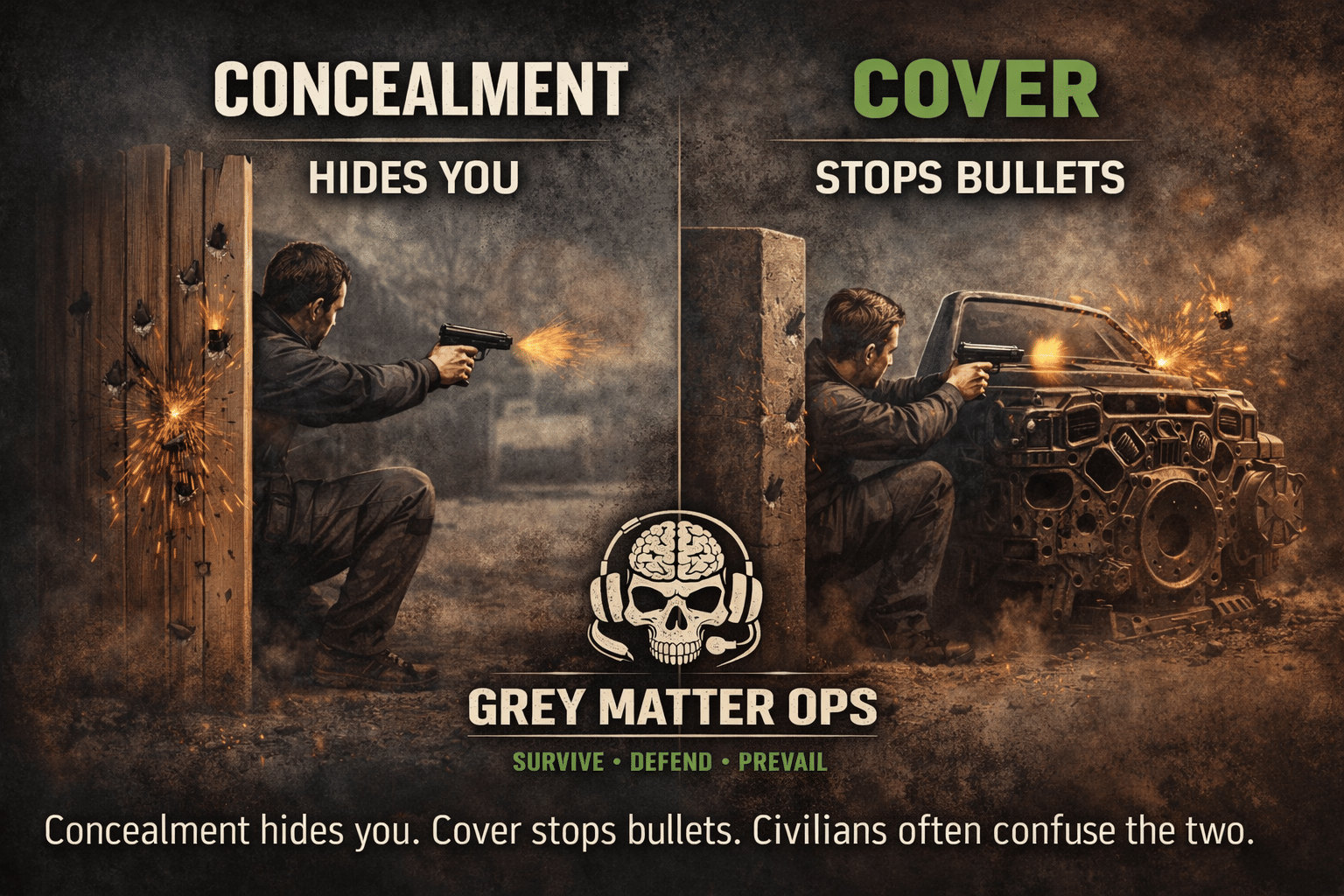
Concealment hides you. Cover stops bullets. Confusing the two is a common and dangerous civilian mistake.
4. Weapons Fail Under Stress
Mechanical failure is real.
Gunfight articles correctly point out:
Firearms jam
Magazines fail
Stress magnifies small errors
The civilian takeaway isn’t “carry more guns.”
It’s expect friction and plan movement, distance, and escape accordingly.
What Gunfight Articles Get Dangerously Wrong
1. The Goal Is Not to “Win”
This is the most dangerous myth.
Military gunfighting doctrine focuses on:
Mission completion
Dominance
Neutralization of threats
A concealed carrier’s goal is survival and lawful disengagement.
Winning, for a civilian, means:
You’re alive
You broke contact
You can justify every action legally and morally
Anything beyond that invites catastrophic consequences.
2. Team Tactics Don’t Apply
Many gunfight articles assume:
Multiple trained teammates
Coordinated movement
Suppressive fire (a military tactic meant to pin an enemy while teammates move)
Civilians are almost always:
Alone
With family or bystanders
In legally complex environments
Trying to apply bounding movements (team-based leapfrogging used by trained units) or suppressive fire as a civilian is not advanced—it’s reckless.
For civilians, your “team” is often a spouse, child, or bystander.
Protecting them changes movement, positioning, and decision-making entirely.
3. Aggression Without Context Is a Trap
Aggression in military doctrine serves a purpose.
Aggression without legal context destroys civilian self-defense claims.
Grey Matter Ops reframes aggression as:
Decisive action
Intentional movement
Rapid disengagement
Not pursuit.
Not domination.
Not escalation.
4. Gear Will Not Save You
Chest rigs, secondary weapons, and battlefield loadouts dominate gunfight articles.
Civilian reality:
You’re carrying concealed
You may be seated, trapped, or indoors
You won’t have time to “set conditions”
Survival comes from:
Awareness
Positioning
Early decision-making
Understanding when to disengage
Gear supports mindset—it never replaces it.
5. Legal Aftermath Is Almost Always Ignored
Gunfight articles stop at the last shot.
Grey Matter Ops doesn’t.
For civilians:
Every round has a lawyer attached
Witnesses matter
Video matters
Your behavior before, during, and after matters
A tactically sound decision can still become a legal nightmare if context is ignored.
Investigators and courts evaluate not only the shots fired, but your behavior, movement, and decision-making leading up to the encounter.
The Grey Matter Ops Civilian Translation
Instead of asking:
“How do I win a gunfight?”
A concealed carrier should be asking:
How do I recognize danger early?
How do I avoid being selected?
How do I break contact if threatened?
How do I survive legally, physically, and psychologically?
This is why Grey Matter Ops teaches:
Awareness-first decision-making
Environmental geometry (using walls, corners, vehicles, and space to your advantage)
Time-on-target reduction (minimizing how long you are exposed to danger)
De-escalation and escape as primary objectives
Final Thought
Gunfight articles aren’t useless—but they are incomplete.
They describe what violence looks like, not what civilians must live with afterward.
The concealed carrier’s edge isn’t superior firepower.
It’s discipline, judgment, and restraint under pressure.
That’s not flashy.
It’s survivable.
Grey Matter Ops Reminder
The best gunfight is the one you never enter.
The second-best outcome is leaving it alive and legally intact.
Remember: Awareness is Armour. For more tactical insights, subscribe to Red Dot Mindset.