
Most civilians are trained—mentally or physically—for violence that doesn’t actually exist.
They picture clean techniques, predictable attacks, and a moment where everything slows down and skill takes over. Real violence doesn’t work that way. It is fast, chaotic, emotionally overwhelming, and deeply unfair. The people who survive are rarely the ones who “perform” well. They are the ones who made better decisions earlier and stayed functional when everything went wrong.
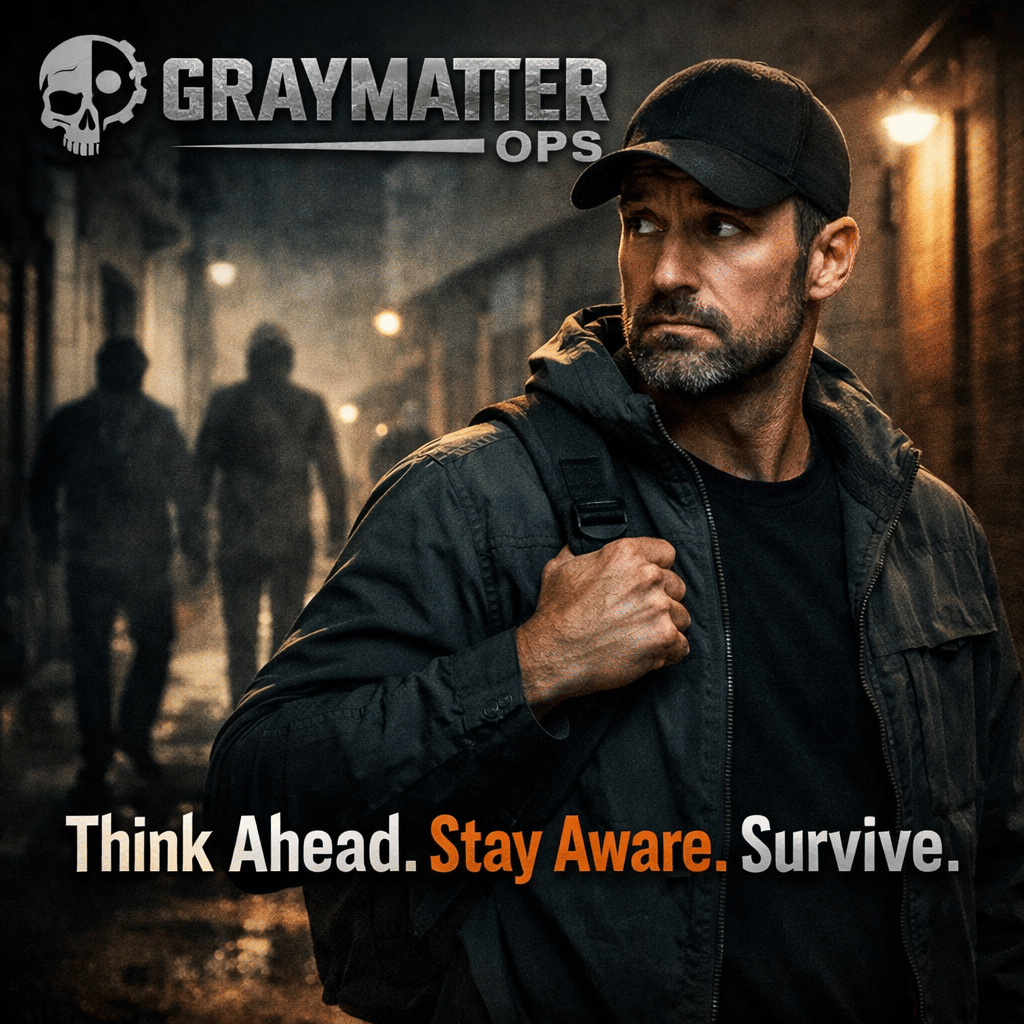
At Grey Matter Ops, our role is not to glorify violence or turn civilians into fighters. Our role is to translate hard-earned lessons from real-world violence into civilian-safe, awareness-first principles that prioritize avoidance, escape, and lawful decision-making.
Train for Reality, Not Demonstrations
You will not rise to the occasion in a violent encounter. You will default to your training.
That becomes a problem when training is built on unrealistic attack patterns, cooperative partners, or techniques that only work under calm conditions. Real attacks are fast, close, and chaotic. They do not pause so techniques can unfold in sequence.
Under stress, fine motor skills—small, precise movements like manipulating keys, buttons, or grips—rapidly degrade. Vision can narrow, hearing can drop out, and time perception can distort. What remains is whatever has been trained realistically and repeatedly.
For civilians, this does not mean training like a soldier or law enforcement officer. It means understanding that anything you rely on—movement, verbal skills, positioning, or tools—must work when your heart rate is elevated and your thinking is under pressure.
Training that ignores stress creates confidence without capability. Reality has a way of stripping that confidence instantly.
Mindset Is the First Survival Tool
Injury does not automatically end a threat—or your ability to survive it.
Movies teach us that one strike, one stab, or one gunshot ends everything. Real-world incidents repeatedly show otherwise. People can remain mobile, aware, and capable of escape even while injured.
The critical distinction for civilians is this: The goal is not to “win” a fight—it is to remain functional long enough to break contact, escape, or reach safety.
Panic collapses options. A survival mindset preserves them.
Maintaining that mindset means accepting fear and pain as possible elements of the moment rather than signals to give up. If you can keep thinking, you can keep choosing. If you can keep choosing, you retain the ability to disengage and survive.
Pre-Threat Thinking Wins Fights You Never Have
Most violence does not begin with the attack. It begins with opportunity.
Where you stand. Where you sit. Where you park. Who you allow close. Whether you notice something that doesn’t fit the baseline—what is normal for that place, at that time, under those conditions.
Pre-threat thinking is the habit of mentally checking your environment and asking simple questions:
What’s normal here? What isn’t? Where would I go if I needed to leave right now?
This is not paranoia. It is preparation.
Elevators, parking lots, gas stations, vehicles stopped in traffic, crowded public spaces—these are common environments where early awareness allows civilians to disengage before force ever becomes necessary.
What You Have Is What You Fight With
When something goes wrong, you do not get to pause and choose new options.
You will have whatever is on you, whatever is within reach, and whatever you can competently control under stress. Tools do not replace judgment or skill. In fact, unfamiliar or poorly chosen tools often increase risk rather than reduce it.
For civilians, anything relied upon for personal safety—whether purpose-built or improvised—must meet four standards:
You can access it under stress
You can maintain retention (keep control of it during movement or physical contact)
You can use it competently
You can justify its use within the law
In extreme, life-threatening emergencies—such as an active shooter or an imminent threat of serious bodily harm—survival may require environmental resourcefulness. This means recognizing that objects in your immediate environment may become temporary tools to help you create distance, disrupt a threat long enough to escape, or reach safety.
This is not about aggression, domination, or prolonged engagement. It is about permission under necessity—using what is immediately available when delay increases risk to life and no safer option exists. Property can be replaced. Lives cannot. That said, actions taken in these moments will still be evaluated later under standards of reasonableness and necessity.
Improvised tools are often imperfect. Many fail the standards of retention or competent use under stress, which is why they should never be viewed as a primary solution. Their purpose is not to “win” a fight, but to buy time, create movement, and facilitate escape when escape is otherwise blocked.
What is considered “legally defensible” varies widely by city, state, and country. Awareness of local law is part of responsible preparation. Carrying—or using—something you do not understand legally or practically can turn a survivable situation into a legal or personal catastrophe.
Situational Awareness Is an Active Skill
There are no permanently safe places.
Safety is temporary and conditional. It depends on awareness, positioning, and the willingness to move when conditions change. Situational awareness is not constant scanning or suspicion—it is maintaining a working understanding of what is happening around you.
Where are the exits? Who is unusually close? What behavior does not fit the environment? Where would you move if you needed to disengage immediately?
Awareness buys time. Time buys options. Options keep civilians out of situations they never needed to be in.
Study Behavior, Not Stereotypes
Threats are identified by actions, not appearances.
Violence is often preceded by boundary testing—small behaviors that probe reactions, such as invading personal space, ignoring social cues, escalating tone, or applying pressure to comply. These behaviors matter more than labels or assumptions.
Trusting intuition does not mean acting recklessly or aggressively. It means recognizing patterns and observable behaviors early enough to disengage. The goal is not confrontation. The goal is distance, movement, and safety.
Waiting for certainty often means waiting too long.
Survival Means Knowing When to Leave
Winning a violent encounter means going home alive.
Avoidance is not cowardice. It is discipline. Staying to prove something closes exits and increases risk. Ego-driven decisions reduce options exactly when options matter most.
For civilians, the priority is simple: avoid when possible, disengage early, and defend only when there is no other option. If force becomes unavoidable, the objective is not dominance—it is creating the opportunity to escape.
There is no reset button after violence. Every decision carries consequences long after the moment ends.
Lone Wolves Don’t Win in the Real World
Movies celebrate solo heroes. Reality does not.
Numbers matter. Coordination matters. Mutual support improves awareness, deterrence, and survivability. Even highly trained individuals are vulnerable alone.
For civilians, this means planning with family members, understanding group movement, and recognizing that survival improves when people communicate and support one another—especially during stress.
Escape is easier with help. Awareness is stronger when shared.
Closing: Experience Is the Teacher—Preparation Is the Translator
Most civilians will never experience the kinds of violence that shape lessons like these—and that is a good thing. But they do not need firsthand trauma to learn from it.
They need translation.
They need to understand how real violence unfolds, how stress affects thinking, and how early decisions prevent late consequences. Civilian survival is not about aggression. It is about awareness, restraint, and lawful judgment.
That is the purpose of Grey Matter Ops: helping civilians think clearly early—so they are never forced to think fast when it is already too late.
This article is educational in nature. It does not provide legal or medical advice and is not a substitute for professional training. Laws governing self-defense, personal safety tools, and use of force vary by jurisdiction.
Remember: Awareness is Armour. For more tactical insights, subscribe to Red Dot Mindset.