
“Many of us spend more time away from home than at home.”
— Brett McKay, The Art of Manliness [6]
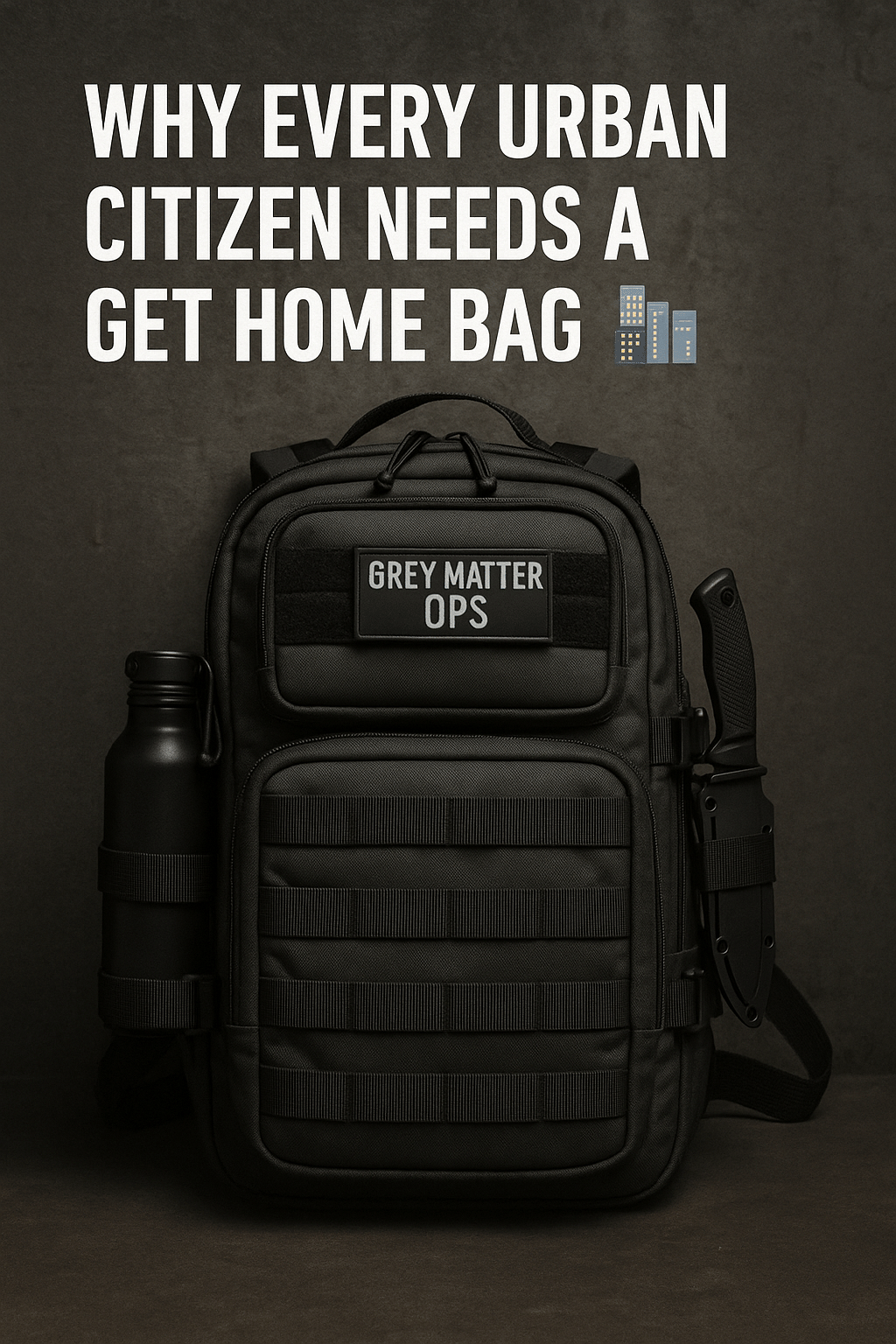
We secure our homes with locks, lights, and alarms. But what happens when a crisis strikes and you're miles away—on the highway, in a high-rise office, or just out running errands? That’s precisely why the Get Home Bag (GHB) exists: it’s your tactical lifeline when standard routes or support systems fail.
🔍 Real-World Scenarios That Prove the Point:
🌪️ Natural Disasters: Earthquakes, floods, blizzards, or blackouts can cripple transit systems and communications, leaving you stranded.
🔥 Civil Unrest: Protests, riots, or sudden outbreaks of violence can shut down entire neighborhoods and roadways [4].
⚠️ Infrastructure Failures: A cyberattack on the power grid, a widespread cell network outage, or a hazmat leak may force you to move fast—without help coming.
🚧 Major Accidents: A train derailment, highway pile-up, or factory explosion could block traditional exits, forcing you to detour on foot.
🚙 Everyday Failures: Sometimes it's a dead battery in a dead zone, or an ambulance delay. One Redditor shared that they’ve used their GHB more to help others in car accidents than for themselves, proving its versatility [5].
In all these cases, conventional support systems may fail. Self-reliance becomes your primary advantage—and your GHB is your edge.
🧠 What to Pack: Expert-Endorsed Urban GHB Essentials
Your GHB must be lightweight, discreet, and efficient. Experts from Ready To Go Survival, Premier Body Armor, and Inside Safariland recommend building for 12–72 hours of sustained movement through disrupted environments [1, 3, 4, 6].
🔻 Tiered Breakdown by Function:
💧 1. Hydration: Your First Priority
“You can only survive around 3 days without water.” — Premier Body Armor [4]
Water Bottle (Stainless Steel) – Durable and boil-ready [1]
Water Filter – Sawyer Mini or LifeStraw for urban water sources [1, 5]
Purification Tablets – Lightweight backup purification method
🍫 2. Food: Lightweight, High-Calorie Fuel
MREs / Survival Bars – No prep, high-calorie, long shelf life [5]
Trail Mix, Jerky, Dried Fruit – Energy-dense and compact
🗺️ 3. Navigation Tools (When Tech Fails)
Laminated Paper Maps – Mark routes between home, work, and rally points [3, 6]
Compass – Still useful in the urban grid
Solar Charger / Power Bank – To maintain communication if networks survive
🔦 4. Communication & Light
Fully Charged Phone – Still your first-line comms tool
Backup Battery / Power Bank – To extend device uptime
Headlamp or Flashlight – High-lumen, hands-free preferred [3, 6]
Whistle – Signals distress without straining your voice [3]
Hand-Crank Radio – Emergency broadcasts when the grid is down [1, 3]
🩹 5. First Aid & Hygiene
“The goal… is a trauma kit.” — Inside Safariland [3]
IFAK or Trauma Kit – Tourniquet, gauze, compression bandages
OTC Medications – Pain relief, anti-diarrhea, blister care (moleskin is essential)
Prescription Meds – Minimum 72-hour supply
Sanitizer, Wipes, TP – For hygiene and morale
N95 Mask – For dust, smoke, and airborne pathogens [4, 6]
🧥 6. Shelter & Weather Protection
Emergency Blanket (Mylar) – Heat retention and shelter option [3, 6]
Rain Poncho / Waterproof Shell – Staying dry is critical
Work Gloves – Broken glass, debris, and rough surfaces [3]
Change of Clothes – Weather-appropriate, non-restrictive
Wool Socks – Dry or wet, they reduce blisters and retain heat [5]
🛠️ 7. Tools & Self-Defense
Multi-tool – Compact utility for dozens of tasks [1]
Paracord – Versatile cordage for repairs and shelter [3]
Mini Roll of Duct Tape – Quick fixes and emergency use [3, 6]
Cash (Small Bills) – For vending machines or small purchases if systems fail [1]
Self-Defense Item – Pepper spray, blade, or firearm (Know your laws. Train for your tools.) [4, 6]
🧘 8. Psychological Tools
Comfort Item – Book, photo, or cards for stress relief
Notebook & Pen – Notes, maps, lists, or messages
⚡ Final Word: Preparedness Is Not Paranoia
A Get Home Bag is not about fear—it’s about freedom through readiness.
As survival author Jonathan Hollerman suggests, those who prepare for minor emergencies (blackouts, protests, grid disruptions) build the mental and physical resilience for major ones. If you can handle the small stuff, you’ll be better prepared for the big stuff.
By maintaining a well-built GHB, you’re not planning for doomsday. You’re planning to get back to your sanctuary—on foot if needed—equipped with the mindset and gear to prevail.
Remember: Awareness is Armour. For more tactical insights, subscribe to Red Dot Mindset.