
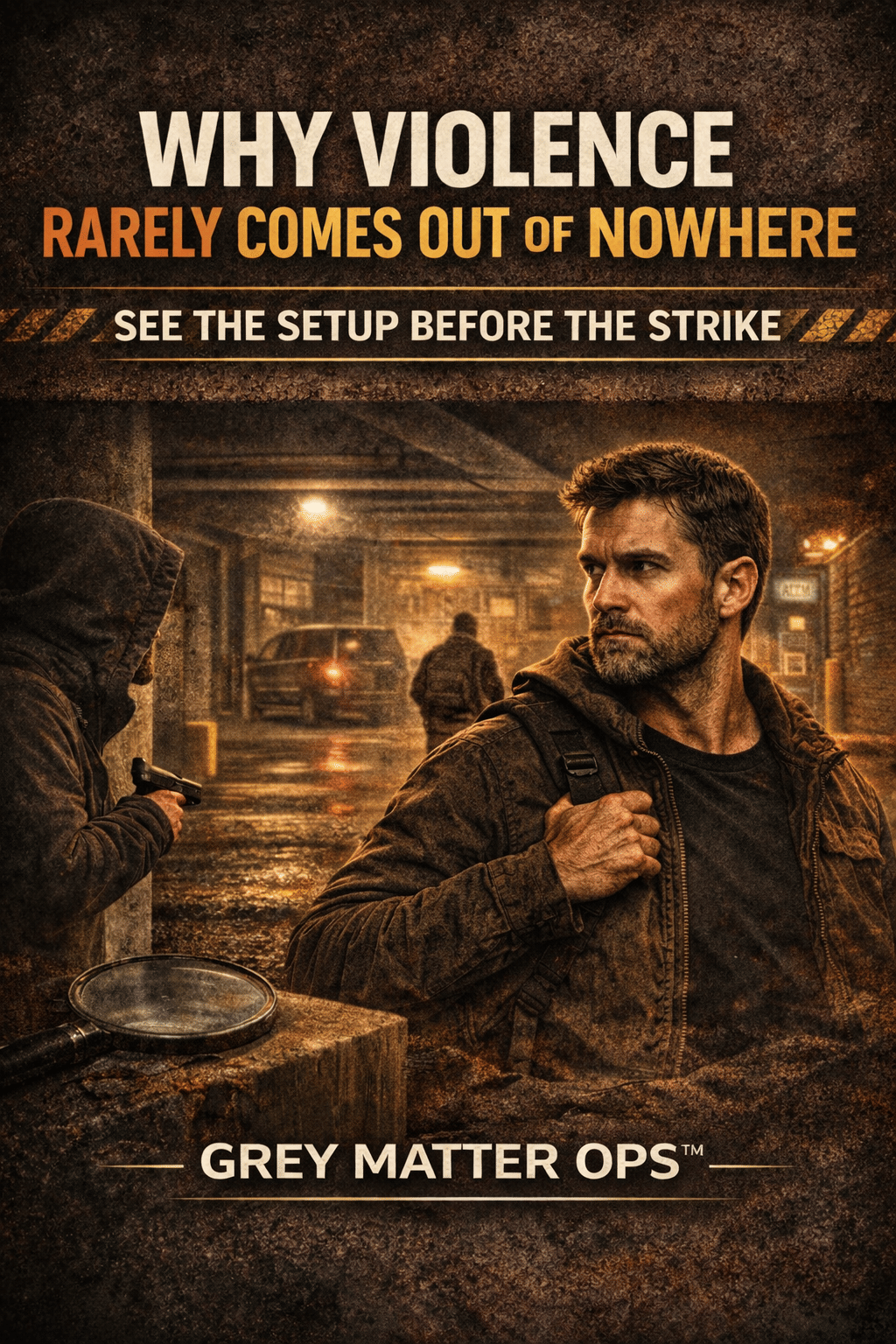
A Grey Matter Ops Guide to Seeing the Setup Before the Strike
THE OBJECTIVE
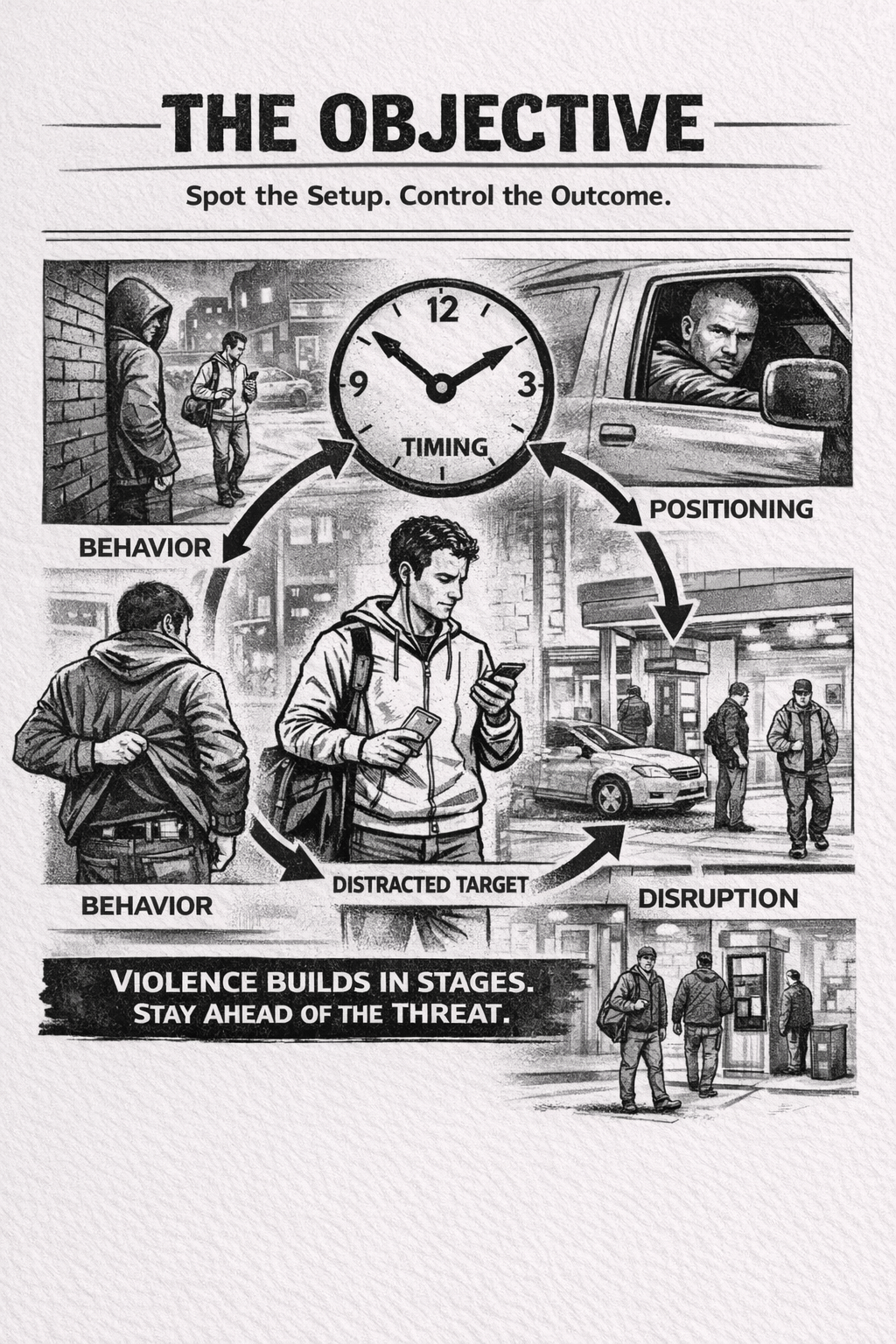
Learn to recognize the setup phase of danger before it reaches contact range, so you can make cleaner decisions, create distance, and stay in control.
Most people think violence begins at the moment something physical happens. The shove. The grab. The sudden approach. The hand inside the waistband. The person who appears to come out of nowhere.
But in the real world, violence rarely comes out of nowhere.
More often, it builds in stages. It leaks clues through timing, positioning, behavior, and environmental disruption before the first overt act ever takes place.
That is why situational awareness matters. Not because it makes you paranoid. Not because it turns everyday life into a threat hunt. And not because it guarantees you will never face a bad situation.
It matters because awareness gives you something most people surrender without realizing it:
Time.
And in personal safety, time is often the difference between options and consequences.
At Grey Matter Ops, we do not teach awareness as a vague idea or a personality trait. We teach it as a disciplined process. The goal is not to stare down every stranger or move through life on edge. The goal is to read the rhythm of an environment, recognize when something breaks that rhythm, and make decisions early enough that you are not forced into worse ones later.
Prepared, not paranoid.
Alert, not alarmed.
Calm enough to think, switched on enough to move.
THE INTELLIGENCE: Why the Setup Phase Matters
Criminals, opportunists, and unstable actors may differ in motive, but they often share one common requirement:
They need conditions.
They need distraction.
They need access.
They need a target who is late to recognize what is happening.
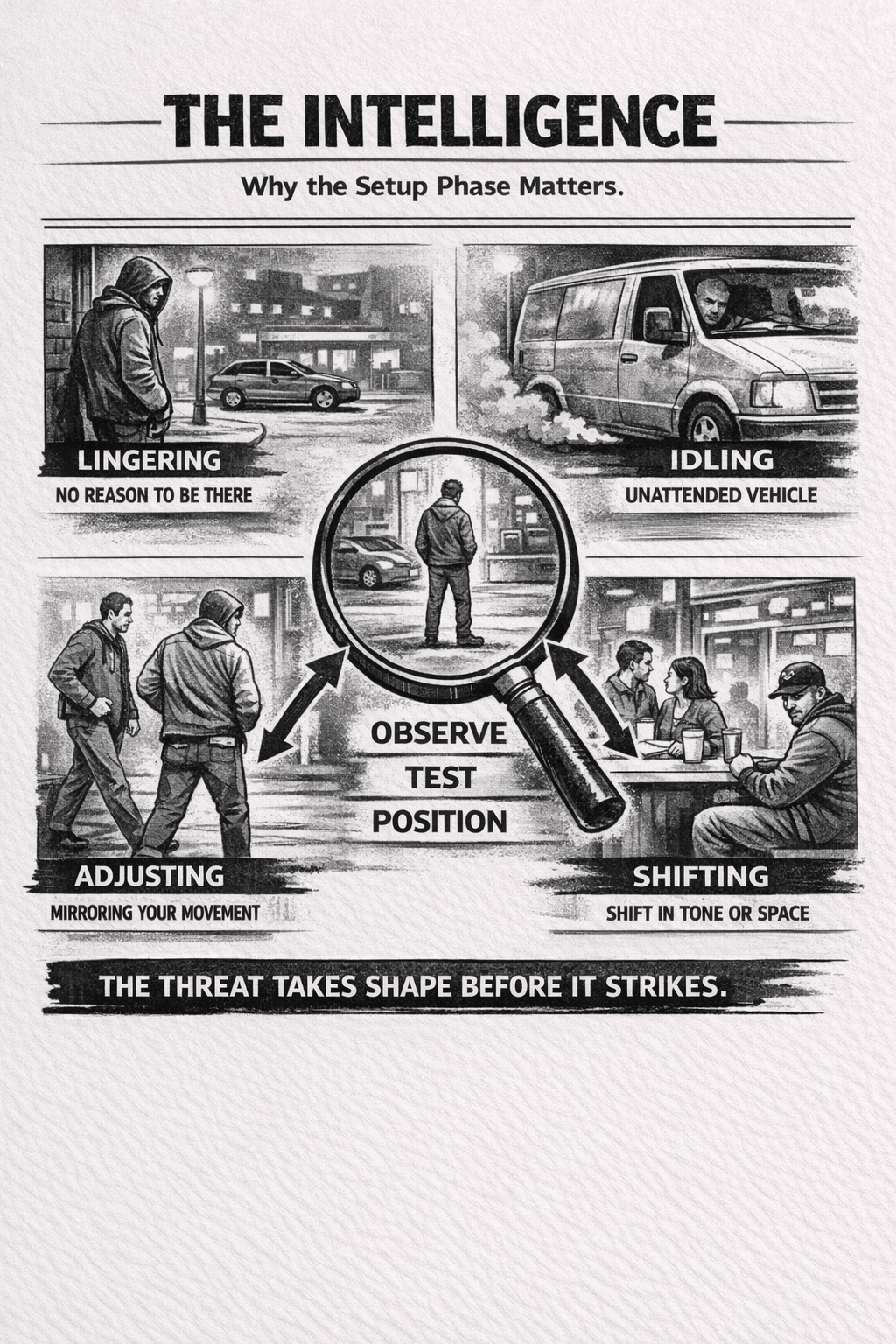
That is why many bad encounters do not begin with the attack. They begin with observation, testing, positioning, and subtle attempts to close the gap without triggering alarm.
A person lingers where there is no reason to linger.
A vehicle idles without a clear purpose.
Someone adjusts their movement when you adjust yours.
A conversation, crowd, or space changes tone for reasons you cannot immediately explain.
Individually, those details may be meaningless. Together, they may be the early architecture of a problem.
Most people miss this phase because they are waiting for a clear signal of danger. They want certainty before they act. They want the moment to become obvious.
That is how initiative is lost.
By the time a situation looks dangerous to everyone, it is usually more dangerous than it needed to be.
The better skill is learning to detect the setup while it is still forming.
BASELINE FIRST: The Rhythm of the Environment
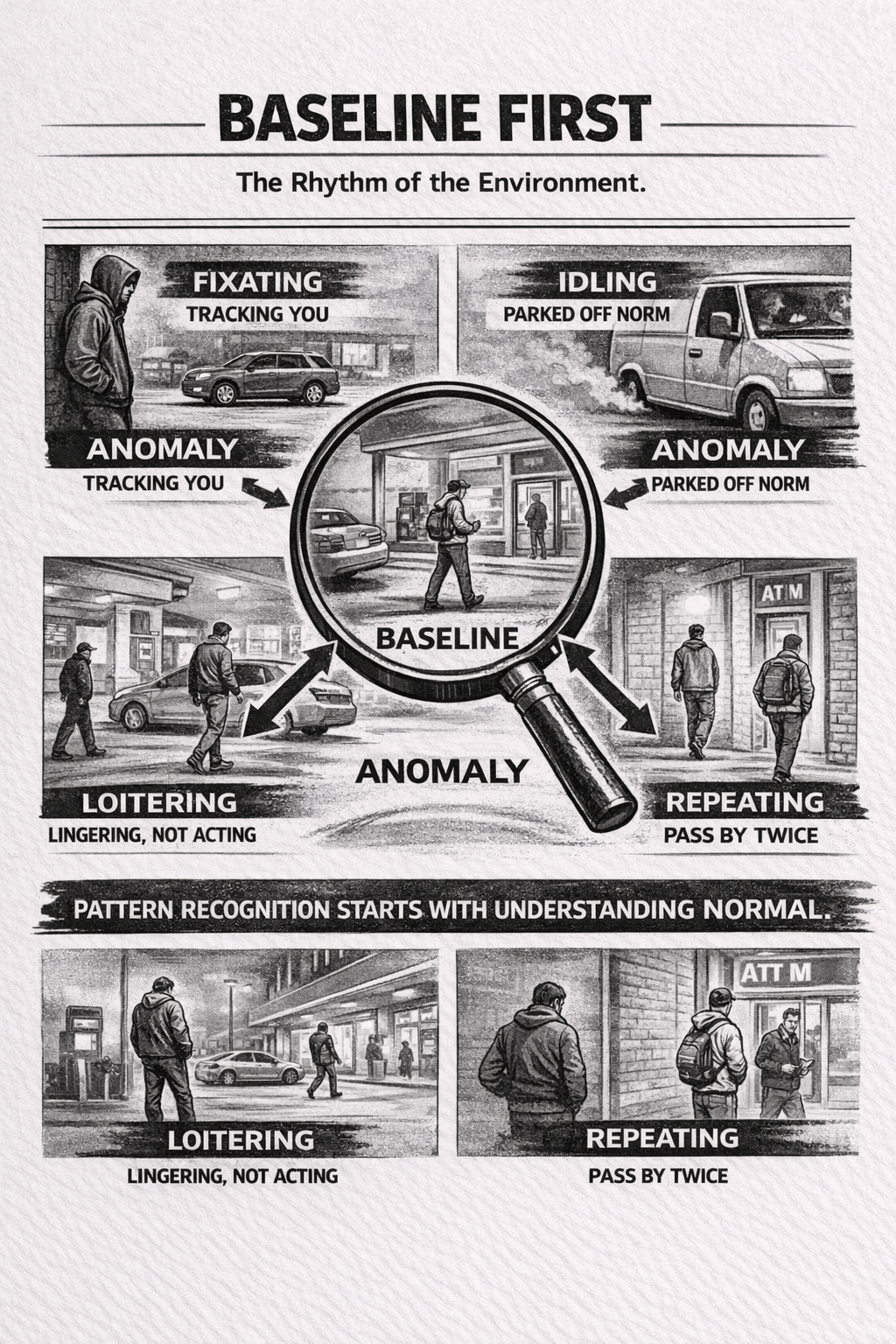
Every environment has a baseline.
A baseline is the normal rhythm of a place at a given moment. It includes how people move, where they gather, what pace makes sense, what noise level fits, how traffic flows, and what behavior belongs there.
Before you can recognize a problem, you need to understand what normal looks like.
This is where many people get situational awareness backward. They start by hunting for threats. That approach burns energy, creates false alarms, and often causes people to fixate on the wrong details.
Professionals do the opposite.
They establish the baseline first.
In a parking lot, the baseline may be people moving directly to and from vehicles, short pauses for loading bags, occasional idling, and steady foot traffic toward entrances or exits.
In a gas station, the baseline may be brief stops, predictable movement around pumps, visible transactions, and people minding their own business.
In a hotel hallway, the baseline may be quiet transit, room access, and short, purposeful movement.
Once you understand the rhythm, anomalies become easier to spot.
An anomaly is not automatically a threat. It is something that deserves another look.
A person standing still in a moving crowd.
A repeated pass by the same location.
A gaze that tracks you instead of scanning naturally.
A vehicle parked to control your driver-side access.
A person who seems busy but is actually managing distance and angle.
One anomaly is data.
Two anomalies deserve focused attention.
Three anomalies form a pattern that requires a decision and, in many cases, movement.
That is the shift.
Situational awareness is not about assuming the worst. It is about noticing when behavior stops matching the environment.
THE REAL PROBLEM: Most People Are Late to Their Own Recognition
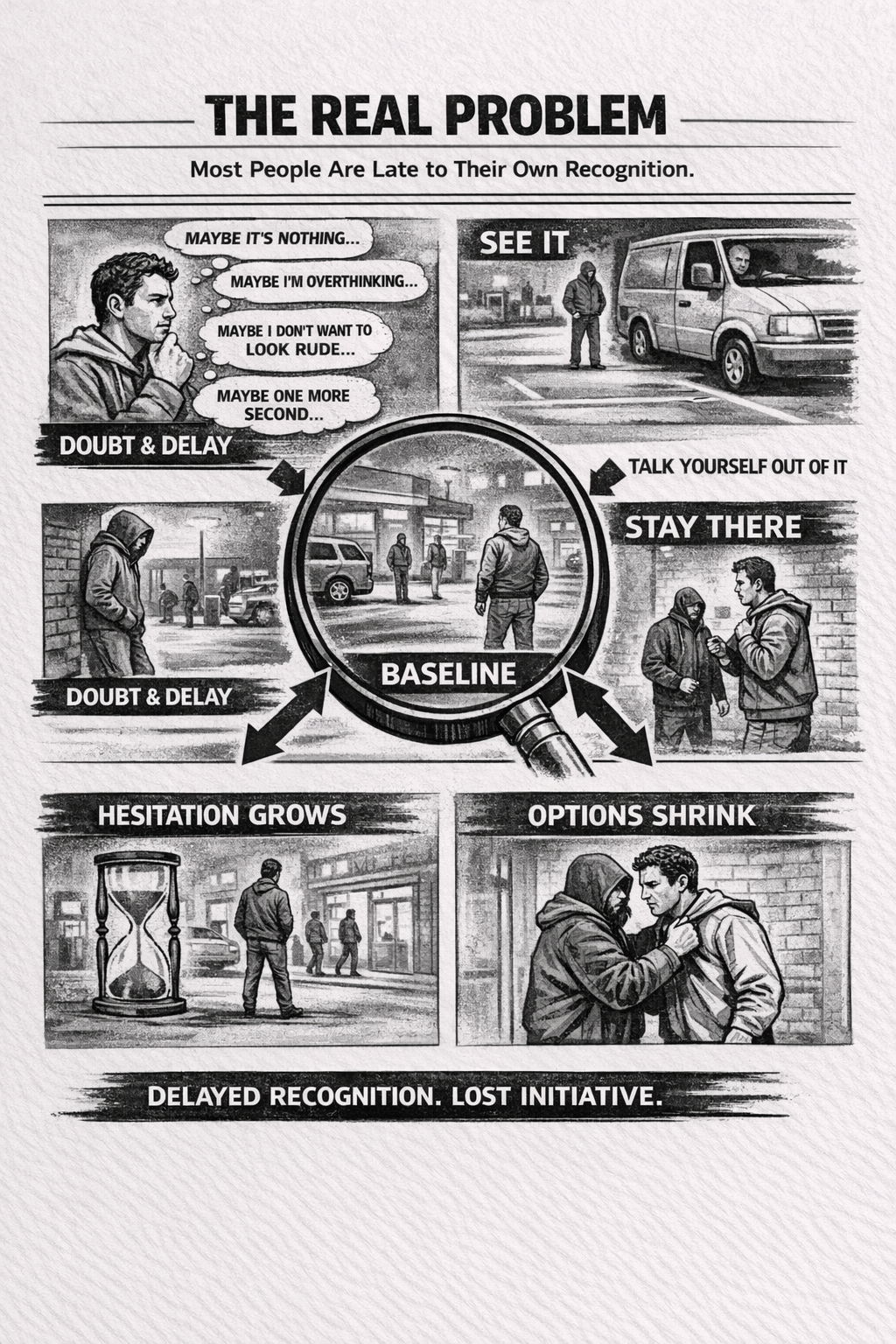
The average person is not defeated by a lack of courage. More often, they are defeated by delay.
They see something that feels off, then talk themselves out of it.
Maybe it is nothing.
Maybe I am overthinking it.
Maybe I do not want to look rude.
Maybe I should wait one more second and see.
That internal hesitation is where many preventable problems gain ground.
The issue is not always that people fail to notice. Often, they notice just enough to feel uncomfortable, but not enough to trust themselves. They remain in place, mentally negotiating with their own instincts while the window for easy action closes.
That is why Grey Matter Ops focuses so heavily on the processing side of awareness.
Observation alone is not enough.
If awareness does not lead to a decision, it is only delayed recognition.
THE GREY MATTER OPS LENS: See the Pattern, Not Just the Person
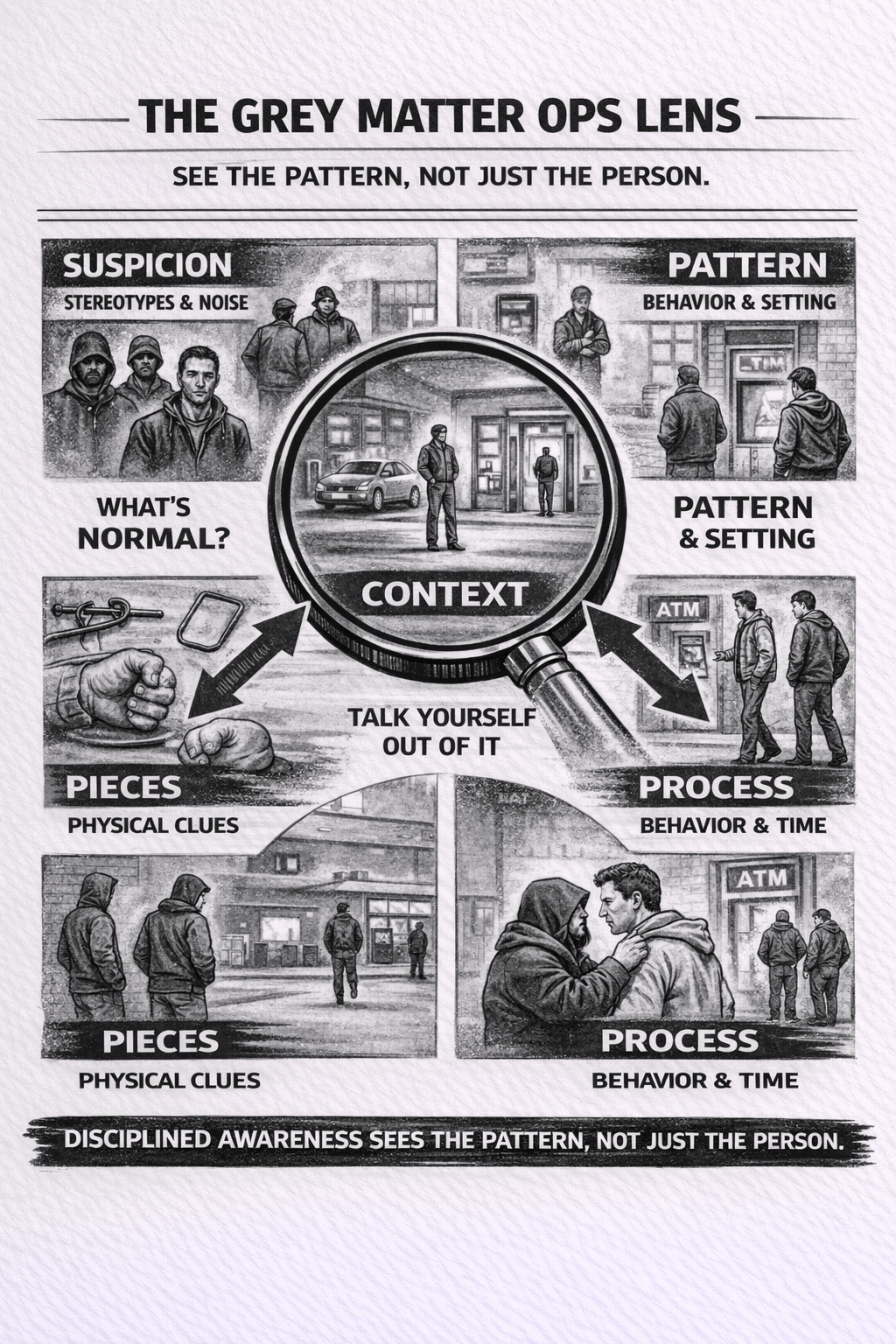
One of the fastest ways to get situational awareness wrong is to reduce it to crude suspicion.
That is not discipline. That is noise.
The better question is not, “Who looks dangerous?”
The better question is:
“What pattern is developing here, and does it fit the environment?”
That is a very different mindset.
It shifts you away from stereotypes and toward behavior. Away from vague discomfort and toward observable context. Away from scanning everyone equally and toward processing what actually matters.
That is also why the strongest awareness work is not about memorizing a giant checklist of physical cues. A clenched fist, a bladed stance, or nervous pacing may matter, but those details only mean something inside a larger picture.
Grey Matter Ops doctrine is stronger when it asks:
What is normal here
What changed
What does that change mean
What options do I still have right now
That is not paranoia. That is disciplined pattern recognition.
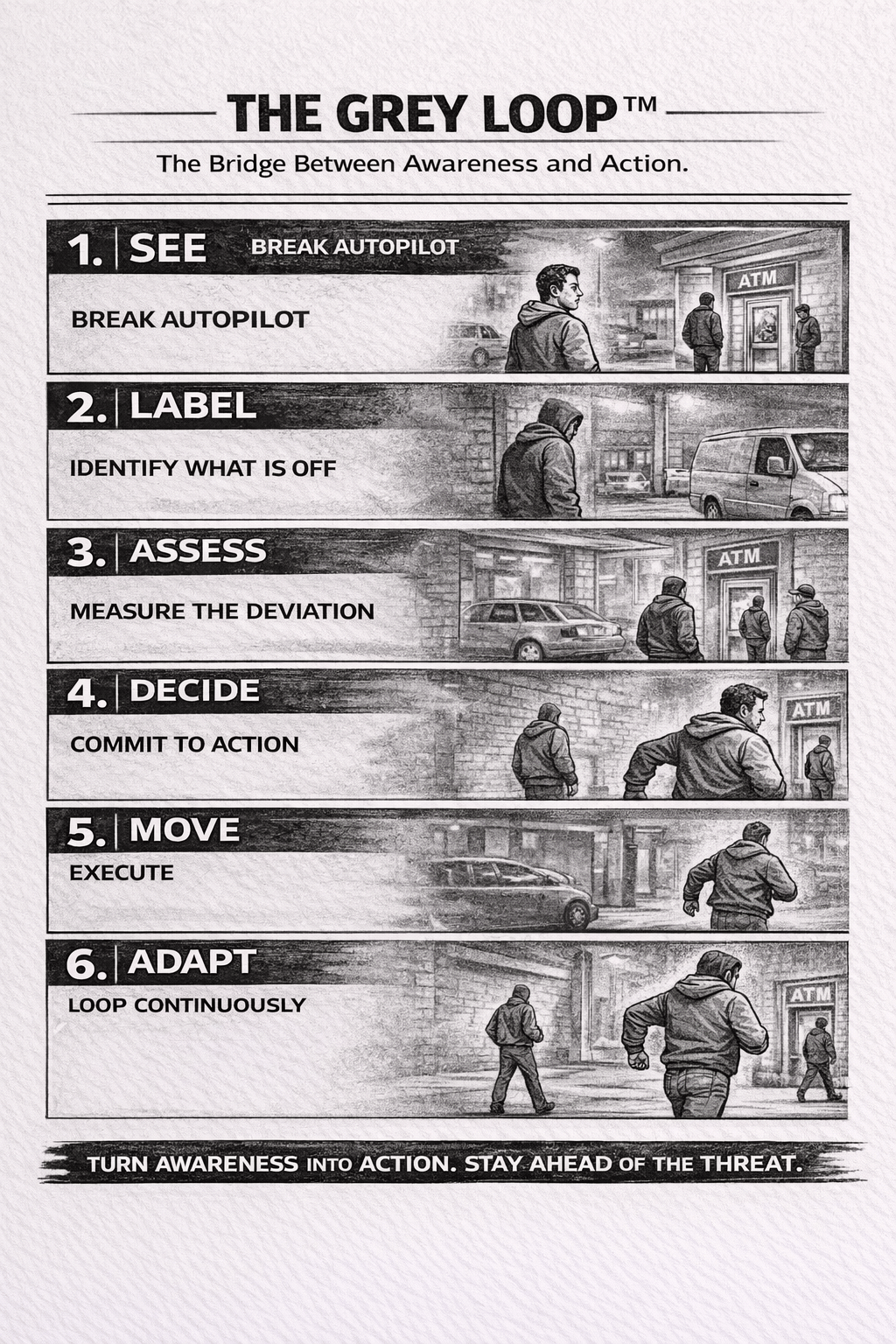
THE GREY LOOP™: The Bridge Between Awareness and Action
This is where most awareness content stops too early.
It teaches people to notice things, but not how to move from recognition to action.
That is why The Grey Loop™ matters. It was built to break hesitation under stress and convert awareness into decisive motion through six linked phases:
SEE → LABEL → ASSESS → DECIDE → MOVE → ADAPT
You do not need to run the full doctrine in your head word for word every time you step into a parking lot. But the philosophy behind it belongs here because it solves the exact gap that gets civilians in trouble.
1. SEE
Break autopilot.
Lift your eyes. Breathe. Transition from task fixation to deliberate perception.
Most people do not enter danger unaware because they lack intelligence. They enter unaware because they are mentally somewhere else. Their body is in the environment, but their attention is still on the phone call, the shopping list, the children, the meeting, the text, or the drive home.
Awareness starts by returning to the environment you are actually standing in.
2. LABEL
Identify what is off.
This is where baseline becomes useful. You are not labeling a person as bad. You are labeling a deviation.
That vehicle should not be positioned there.
That person should not still be lingering there.
That movement pattern does not match the rest of the crowd.
That interaction is drawing too much of my attention for a reason.
Naming the anomaly gives your brain something concrete to work with.
3. ASSESS
Compare baseline versus reality.
What is happening versus what should be happening here
How close is it
What are the exits
What barriers exist
What direction gives me advantage
Is this getting more stable or less stable
This is not a courtroom analysis. It is a rapid environmental assessment.
4. DECIDE
Commit before the problem commits for you.
This is where many people stall. They want perfect clarity. But under stress, perfect clarity is rare. You usually need a clean option, not a perfect one.
Create distance.
Move toward light.
Shift toward people.
Re-enter the building.
Change direction.
Put a vehicle, barrier, or counter between you and the concern.
The purpose is not to win a moment socially. The purpose is to preserve initiative.
5. MOVE
Movement breaks the script.
Predatory behavior relies on compliance, access, timing, and control. Purposeful movement disrupts that formula. Even a small change in angle, distance, or direction can collapse someone else’s setup.
Movement is not panic. It is problem-solving.
6. ADAPT
Reassess continuously.
Every move gives you new information.
The person disengages. Good. Keep moving.
The vehicle follows. New problem. Reassess.
The person changes direction once you make eye contact and shift position. Good data. Continue.
Awareness is not static. Neither is the environment.
THE PRACTICAL TEST: Are You Seeing the Setup Early Enough?
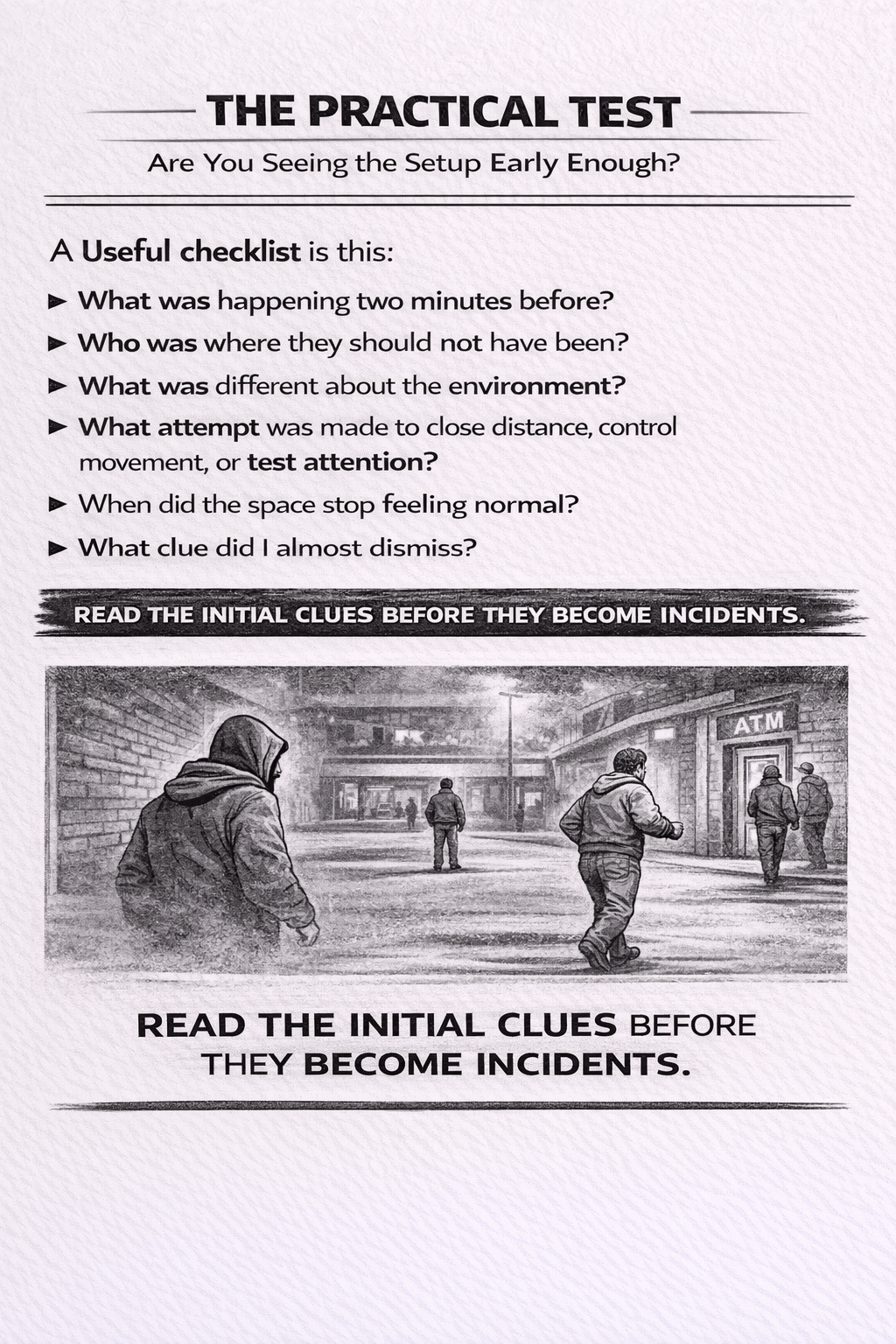
A useful self-check is this:
When you picture a bad encounter, where does the story begin in your mind
If it begins at the physical act, you are probably still thinking too late.
A more useful timeline starts earlier.
What was happening two minutes before
Who was where they should not have been
What was different about the environment
What attempt was made to close distance, control movement, or test attention
When did the space stop feeling normal
What clue did I almost dismiss
That is where real prevention lives.
Violence does not always announce itself. But it often rehearses itself first.
The civilian who learns to recognize that rehearsal is much harder to surprise.
WHAT PEOPLE CALL INTUITION
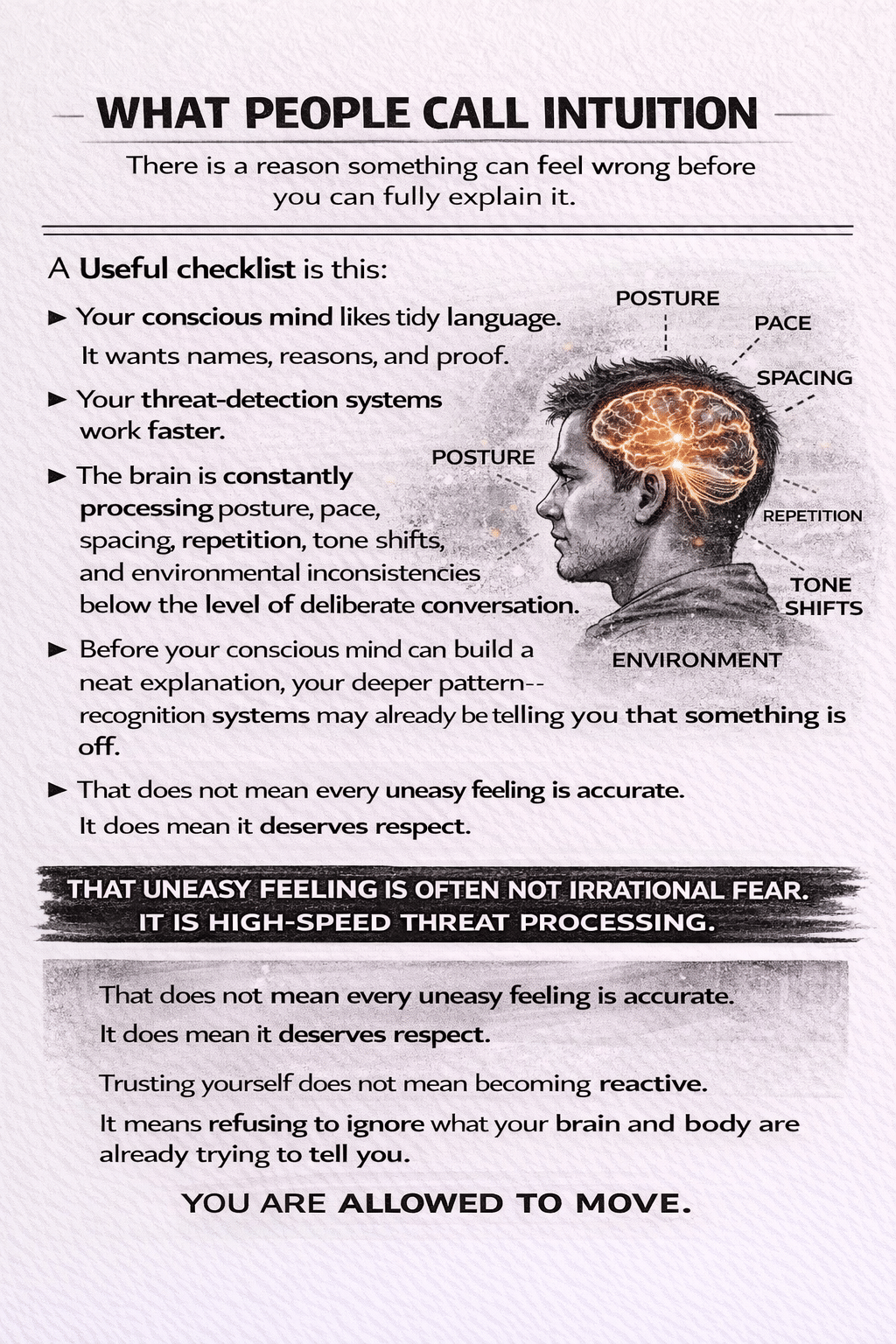
There is a reason something can feel wrong before you can fully explain it.
Your conscious mind likes tidy language. It wants names, reasons, and proof.
Your threat-detection systems work faster.
The brain is constantly processing posture, pace, spacing, repetition, tone shifts, and environmental inconsistencies below the level of deliberate conversation. Before your conscious mind can build a neat explanation, your deeper pattern-recognition systems may already be telling you that something is off.
That uneasy feeling is often not irrational fear. It is high-speed threat processing.
That does not mean every uneasy feeling is accurate. It does mean it deserves respect.
You do not have to justify every protective decision to a stranger in the moment. If something feels off, and your observations support that feeling even partially, you are allowed to move.
Embarrassment is recoverable.
Lost initiative is expensive.
Trusting yourself does not mean becoming reactive. It means refusing to ignore what your brain and body are already trying to tell you.
EVERYDAY APPLICATION: Where This Shows Up in Civilian Life
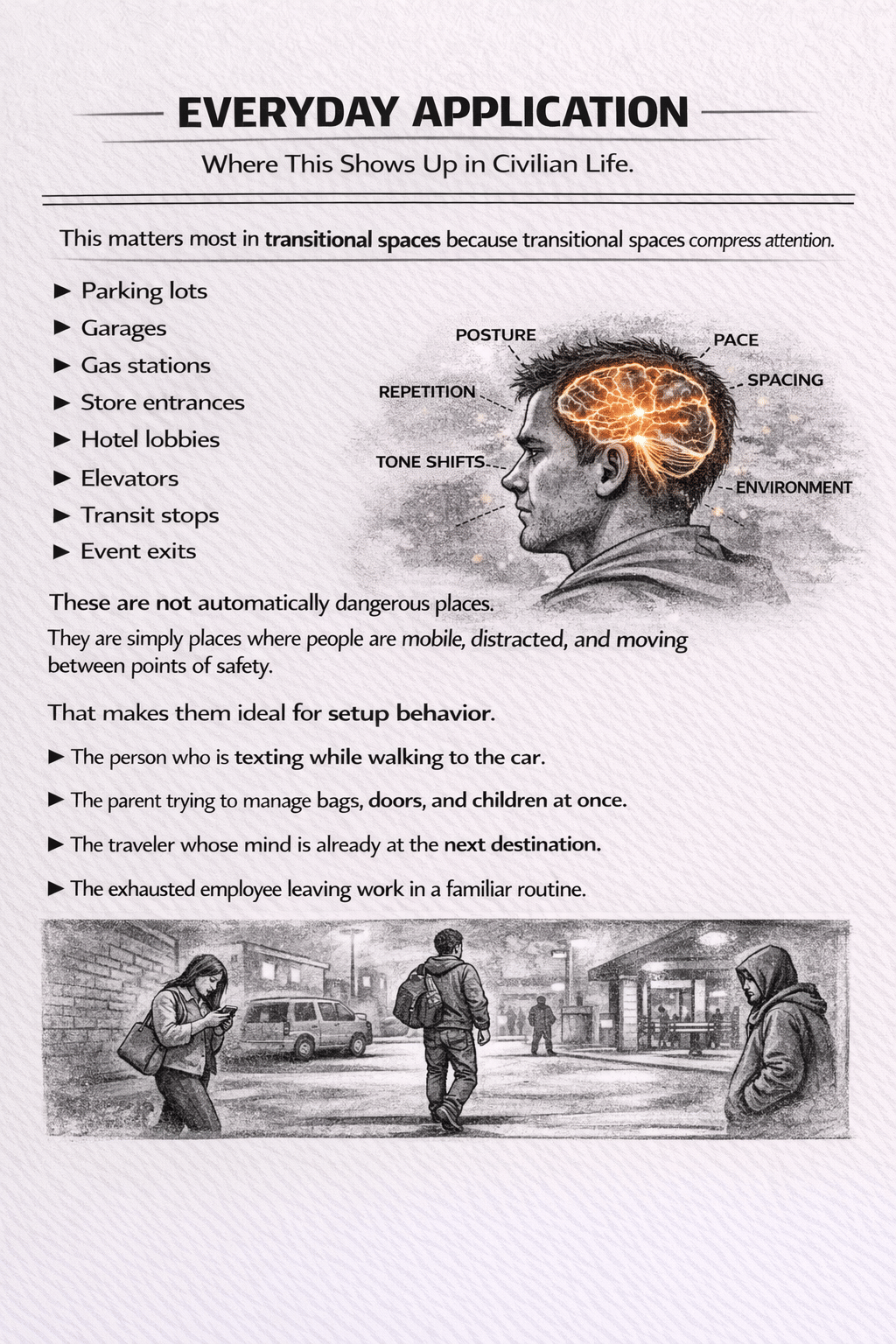
This matters most in transitional spaces because transitional spaces compress attention.
Parking lots
Garages
Gas stations
Store entrances
Hotel lobbies
Elevators
Transit stops
Event exits
These are not automatically dangerous places. They are simply places where people are mobile, distracted, and moving between points of safety.
That makes them ideal for setup behavior.
The person who is texting while walking to the car.
The parent trying to manage bags, doors, and children at once.
The traveler whose mind is already at the next destination.
The exhausted employee leaving work in a familiar routine.
This is where normalcy bias is strongest. Familiar spaces make people mentally casual. But routine is often what predators study.
The correction is not to become tense.
The correction is to become deliberate.
A SIMPLE GREY MATTER OPS CHECK
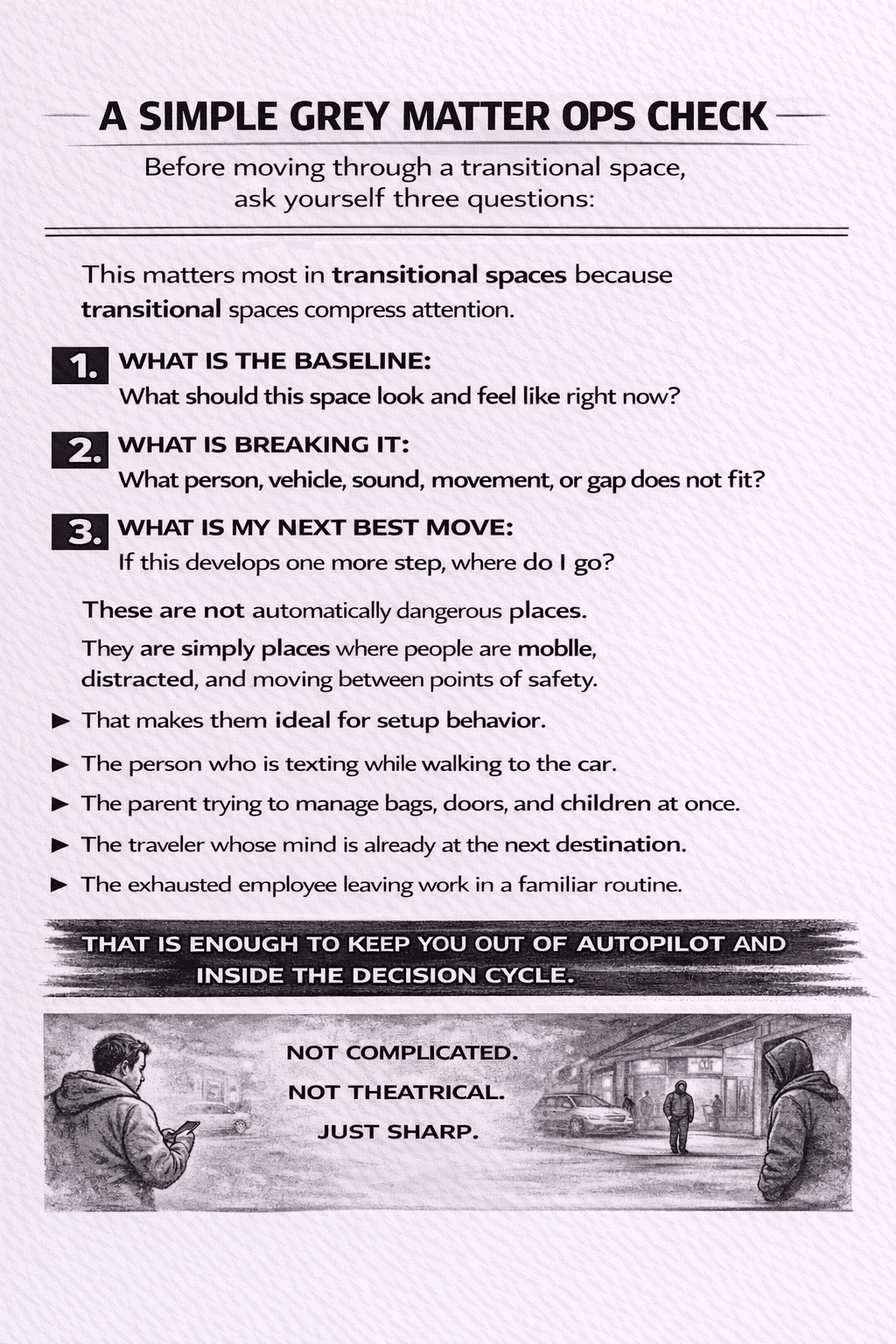
Before moving through a transitional space, ask yourself three questions:
What is the baseline
What should this space look and feel like right now
What is breaking it
What person, vehicle, sound, movement, or gap does not fit
What is my next best move
If this develops one more step, where do I go
That is enough to keep you out of autopilot and inside the decision cycle.
Not complicated.
Not theatrical.
Just sharp.
THE DEBRIEF
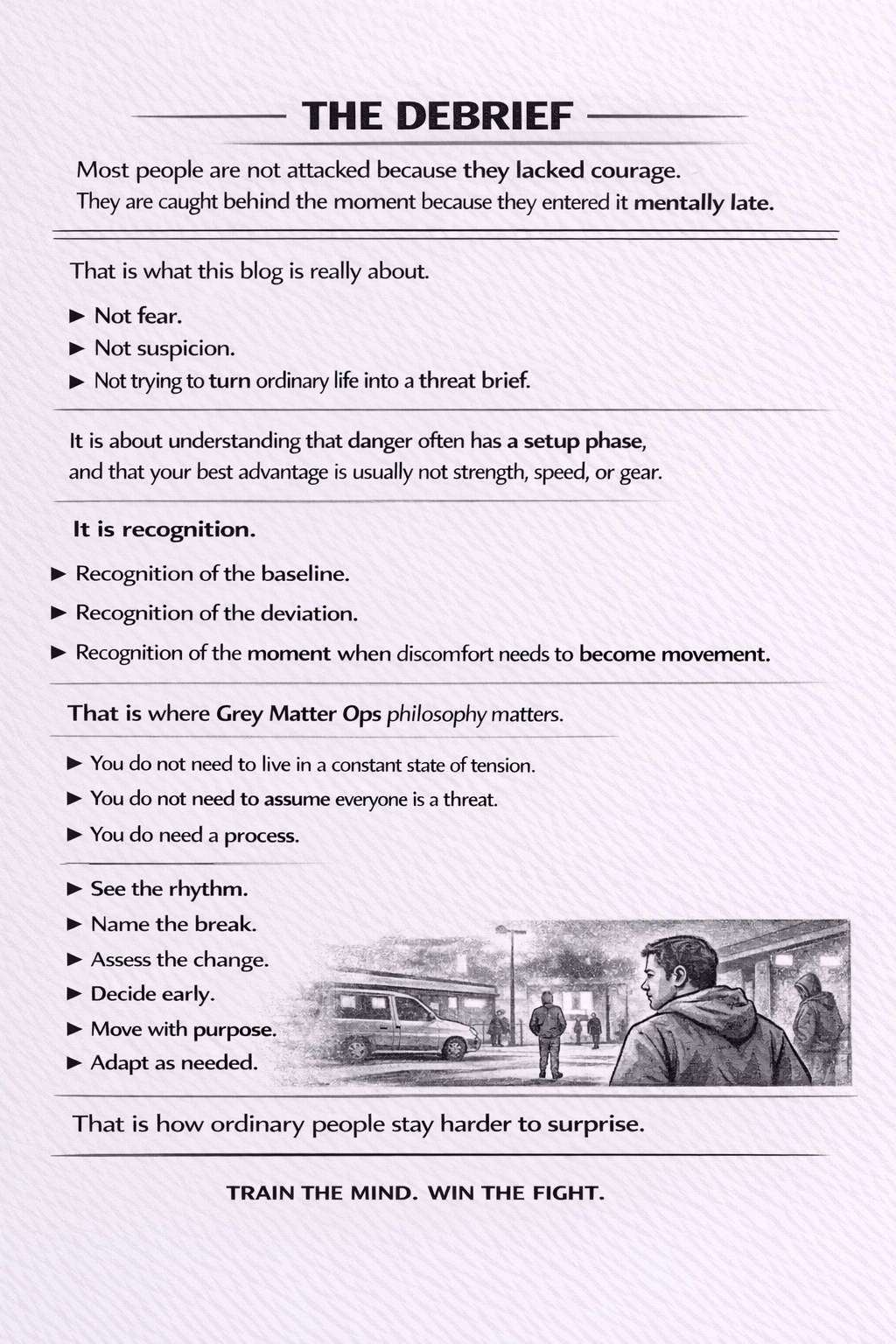
Most people are not attacked because they lacked courage. They are caught behind the moment because they entered it mentally late.
That is what this blog is really about.
Not fear.
Not suspicion.
Not trying to turn ordinary life into a threat brief.
It is about understanding that danger often has a setup phase, and that your best advantage is usually not strength, speed, or gear.
It is recognition.
Recognition of the baseline.
Recognition of the deviation.
Recognition of the moment when discomfort needs to become movement.
That is where Grey Matter Ops philosophy matters.
You do not need to live in a constant state of tension.
You do not need to assume everyone is a threat.
You do need a process.
See the rhythm.
Name the break.
Assess the change.
Decide early.
Move with purpose.
Adapt as needed.
That is how ordinary people stay harder to surprise.
Train the Mind. Win the Fight.
Remember: Awareness is Armour.
Remember: Awareness is Armour. For more tactical insights, subscribe to Red Dot Mindset.