
Introduction
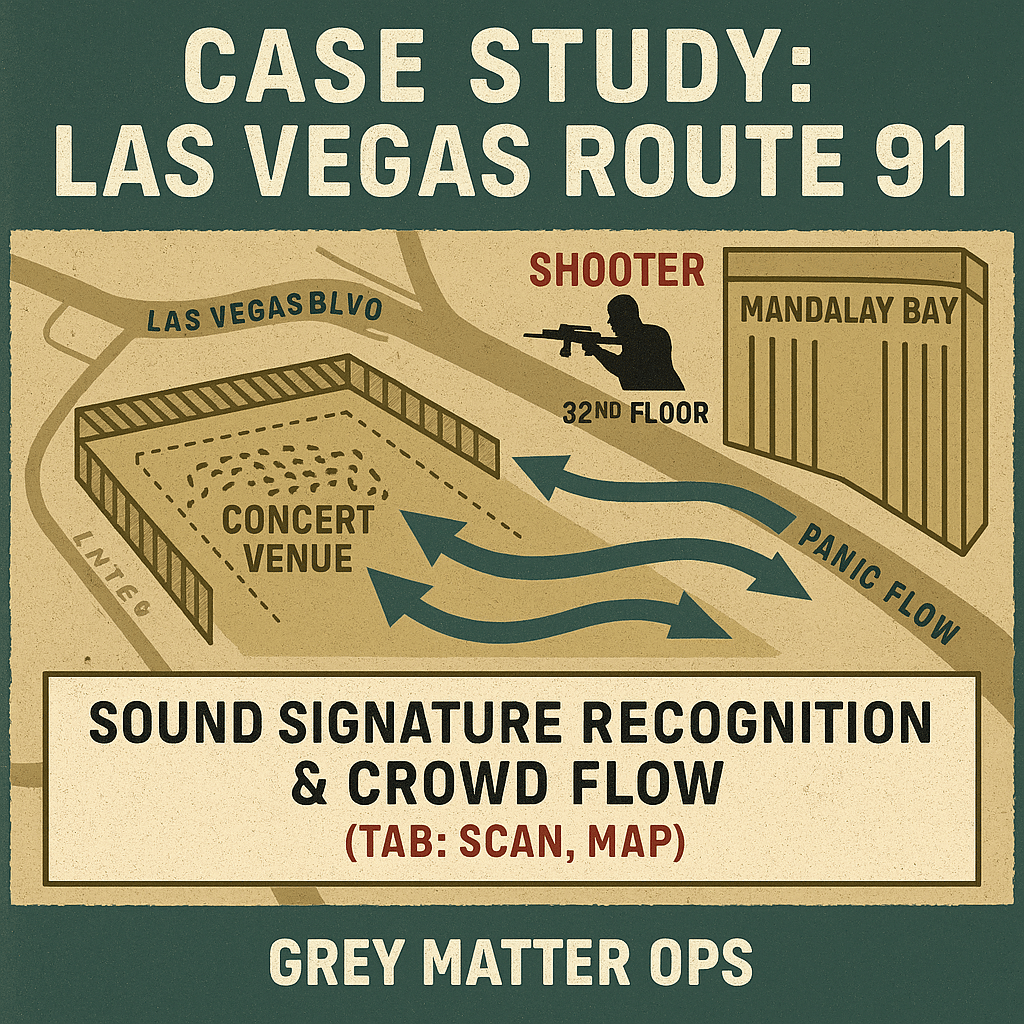
On October 1, 2017, a mass shooting occurred at the Route 91 Harvest music festival in Las Vegas, Nevada. The attack, launched from an elevated position on the 32nd floor of the Mandalay Bay Hotel, resulted in 58 immediate fatalities (with two additional deaths attributed in later years) and over 850 injuries. With over 22,000 attendees, this event represents a critical case study in civilian vulnerability exposure—highlighting breakdowns in awareness, movement under fire, and real-time threat recognition.
This case study applies the Tactical Awareness Blueprint (TAB) to examine sound signature recognition, crowd flow under fire, and survivability lessons for civilians in high-density, open-air environments.
Sound Signature Recognition
One of the primary confusion factors was the auditory environment. The shooter employed multiple semi-automatic rifles, some fitted with bump stocks, altering the cadence of fire.
Auditory Distortions:
Echoes from surrounding buildings and open venue structures.
Overlapping noise from crowd panic, live music, and amplified stage audio.
Rapid, irregular fire cadence (9–11 rounds per second), frequently mistaken for fireworks.
Duration: Sustained fire lasted over 10 minutes—far longer than typical fireworks bursts (30–60 seconds).
Tactical Note:
Most civilian ears, untrained in weapons acoustics, struggled to localize the sound source. Many attendees moved toward the line of fire, misled by echo distortion.
TAB Relevance:
Scan: Civilians lacked baseline audio awareness in a live environment.
Map: Failure to orient to elevated positions disrupted sound localization.
Assess: Confusion kept civilians stuck in Condition White (unaware) or Grey (confused/reactive).
Act: Inability to distinguish gunfire from fireworks delayed decisive action.
Crowd Flow Analysis
The Route 91 venue layout magnified chaos once panic erupted.
Choke Points & Funnel Zones (TAB: Scan, Map):
Fences, security gates, and vendor tents created rigid egress channels.
Entry gates became choke points when reverse flow surged.
Many attendees were trapped against perimeter fencing or trampled during mass surges.
For a deeper dive into how choke points shape survival in urban terrain, see our blog:
Choke Point Mastery: Identifying and Navigating High-Risk Terrain in Urban Environments.
Movement Failures (TAB: Assess, Act):
No secondary exits marked or reinforced.
No rally points or staff communication once fire began.
Attendees attempted cover behind metal barricades and speaker towers—insufficient against high-angle fire.
Contrast Survivors (TAB: Map, Act):
Some survivors escaped by climbing over or cutting perimeter fencing.
Lateral movement across rows, rather than with the crowd, enabled faster dispersal.
Those who broke contact early and moved diagonally to hard cover reduced exposure time.
These survivors instinctively applied multiple TAB principles simultaneously—demonstrating how integrated training compounds survival advantage.
Environmental & Communication Factors:
Nighttime conditions, lighting, and visual clutter degraded situational awareness.
Cell networks overloaded, preventing coordination and delaying emergency calls.
Law enforcement response was swift but hampered by confusion over shooter location, reinforcing civilian self-reliance during the first critical minutes.
Why It Matters
The failures at Route 91 weren’t random—they were predictable results of human behavior under extreme stress in a complex environment. By studying these vulnerabilities through the lens of the Tactical Awareness Blueprint, civilians can train to avoid repeating them. Preparation turns chaos into survivability.
These failures reinforce the need for structured readiness training. For a full breakdown of the Tactical Awareness Blueprint framework, see our guide:
🧠 Target Awareness Blueprint – Civilian Edition
Key Tactical Lessons
Train to Identify Anomalous Sound Signatures (TAB: Scan & Assess)
Fireworks do not repeat at mechanical intervals. Gunfire cadence is distinct.
Drill with audio comparisons to build recognition under stress.
Pre-Identify Exits and Alternate Routes (TAB: Map)
On entry, locate multiple egress paths—even if unmarked or unconventional.
Mentally rehearse how you would break from the crowd.
Recognize and Avoid Choke Zones (TAB: Scan & Map)
Large crowds near fences, vendor booths, or gates are survival liabilities.
Position yourself closer to lateral or secondary escape paths.
Prepare for Communication Failure (TAB: All Phases)
Cell networks fail under mass stress.
Pre-establish rally points with family/group.
Carry backup methods (whistle, light, offline map).
Flow Over Freeze + Override Physiological Response (TAB: Assess & Act)
Movement under fire—lateral or diagonal—is survival.
Train to override freeze response and prioritize distance from fire vector.
Recognize involuntary stress reactions (auditory exclusion, tunnel vision). Counter with controlled breathing to recenter focus.
Stay Grey, Scan Constantly (TAB: Continuous Loop)
Enter events in Grey (semi-alert) mode.
Constant scanning maintains baseline, spots anomalies, and shortens reaction time.
Tactical Drills for Civilians
Progress through these drills in sequence—master sound recognition and venue mapping before advancing to stress-based scenarios.
Sound Profiling Drill: Compare recordings of fireworks vs. rifle fire (AR-15, AK variants). Train under cognitive load by listening while walking, talking, or in a noisy environment.
Venue Mapping Drill: When entering a stadium, arena, or theater, immediately identify at least two alternate exits. Practice doing this before you get comfortable or distracted.
Choke Point Walkthrough: Practice moving through stairwells or narrow hallways under timed conditions. Train to break from the herd with lateral or diagonal movement.
Freeze Break Drill: Practice three-step reset under stress: breathe, scan, move laterally. Note physical stress cues (tunnel vision, auditory exclusion).
Communication Blackout Drill: Practice group coordination using only visual signals and pre-set rally points, simulating a cell tower failure.
Low-Light Navigation Drill: Train moving through darkened spaces with a flashlight, paying attention to shadow, reflection, and concealment.
Before You Go: Final Checklist
Every tactical plan begins with a simple checklist. Before your next event, run through this mental list:
Venue Check: Where are my two exits?
Audio Check: What’s the ambient sound? What would an anomaly sound like?
Group Check: Who am I with, and where’s our rally point?
Gear Check: Do I have a phone, a light, a whistle?
Closing
The Route 91 Harvest Festival is a critical case study in mass-casualty survival. Failures in sound identification, spatial awareness, communication, and crowd movement exposed civilians to preventable danger.
Grey Matter Ops emphasizes that survivability is not improvisation—it is preparation, pattern recognition, and performance under stress. By applying the Tactical Awareness Blueprint, civilians can shift from passive participants to active survivors in any high-density environment.
Call to Action:
Ready to build your tactical awareness foundation? Start with Grey Matter Ops’ TAB methodology and venue assessment protocols to sharpen your skills before the next event.
Ready to build your tactical awareness foundation? Start with Grey Matter Ops’ Target Awareness Blueprint and venue assessment protocols to sharpen your skills before the next event.
Source Highlights
▌FBI Behavioral Analysis Unit, Las Vegas Review of the Mass Shooting at the Route 91 Harvest Festival (2019)
▌Clark County After-Action Review (2018)
▌LVMPD After-Action Report (2018)
▌FEMA Mass Casualty Incident Response Guidelines (2017)
▌DHS Active Shooter Resources & Case Studies (2017–2019)
Remember: Awareness is Armour. For more tactical insights, subscribe to Red Dot Mindset.