
Reading the Terrain Before Trouble Starts
⚠️ Notice
This article is for educational and situational-awareness purposes only.
Grey Matter Ops™ does not provide legal, medical, or law-enforcement advice.
Always follow local laws and contact emergency services (911 in the U.S.) if you face immediate danger.
Your safety comes first. When uncertain, disengage and seek help.
────────────────────────────────────────
Why It Matters
Most people look at their environment — trained protectors learn to read through it.
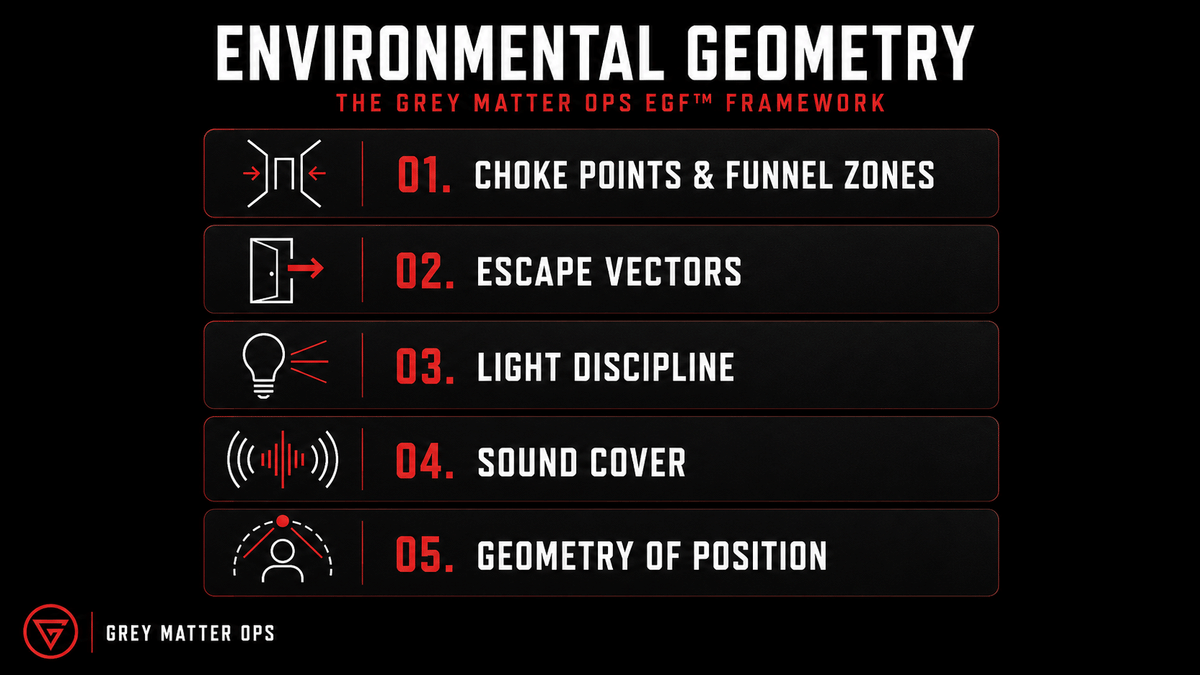
The Environmental Geometry Framework™ (EGF) teaches civilians to interpret space the way protectors do: noticing where movement compresses, where sound carries, and where exits disappear.
It transforms vague “awareness” into spatial intelligence — the skill of understanding how terrain shapes risk and opportunity in real time.
Whether you're parking at night, walking downtown, or exiting a stadium, geometry influences behavior long before a threat becomes visible.
────────────────────────────────────────
1️⃣ Choke Points & Funnel Zones
A choke point is any location where movement is restricted and sideways escape is limited — doorways, stairwells, hallways, elevators, or narrow walkways. Recognizing these zones early buys you time and distance to react.
A funnel zone forces multiple people through a confined opening, compressing movement and reducing options even further. The key distinction: funnel zones involve crowd flow, while choke points restrict individual movement.
RECOGNIZE: Places where you must move single-file or cannot sidestep.
ASSESS: Determine how many people can move through at once and whether you have maneuvering room.
PLAN: Identify two exits or alternate paths before committing to a position.
MOVE: Avoid lingering. Stay mobile or position near a secondary route.
Example — Leaving a Concert Venue: Crowds compress toward limited exits. Move along the perimeter, track barriers, and angle at 45 degrees to the flow to maintain maneuvering space.
“Geometry dictates opportunity. Position decides outcome.” — Grey Matter Ops™
────────────────────────────────────────
2️⃣ Escape Vectors
A plan that only exists in your head isn’t a plan — it’s luck. Identifying escape vectors ensures you retain control of your movement options.
Before you sit, stand, or settle anywhere, identify at least two escape paths: a primary and a backup.
RECOGNIZE: Entrances, corridors, service doors, open spaces.
ASSESS: Look for obstacles — furniture, crowds, blocked walkways, parked cars, bottlenecks.
PLAN: Establish a regroup point or phrase if separated from family or companions.
MOVE: Position yourself so you can exit quickly if needed.
Accessibility Note: When traveling with children, elders, or mobility devices, verify accessible routes before committing to a location.
Example — Parking Garage: Before walking to your vehicle, identify the nearest stairwell, ramp, and open-air exit in case an elevator becomes unsafe or congested.
────────────────────────────────────────
3️⃣ Light Discipline
Light is a double-edged blade. It can expose you — or protect you.
RECOGNIZE: Where light creates visibility or shadows — doorways, parking lots, alleys, windows.
ASSESS: Determine whether you are illuminated, silhouetted, or concealed.
PLAN: Learn your common routes during daylight to reduce reliance on artificial lighting later.
MOVE: Control your signature — dim screens, avoid standing fully backlit, and use a compact flashlight if needed to momentarily disrupt an aggressor’s vision while creating distance to disengage.
Example — Walking to Your Car at Night: Stay inside pools of moderate light, avoid being framed in bright doorways, and keep your light source angled low until needed.
“Awareness isn’t fear — it’s contrast control.” — Grey Matter Ops™
────────────────────────────────────────
4️⃣ Sound Cover
Noise can betray you — or protect you. Effective sound management helps you blend, mask movement, or disengage quietly.
RECOGNIZE: Ambient noise sources — HVAC, traffic, crowds, music.
ASSESS: Determine whether sounds will reveal your approach, your exit, or your position.
PLAN: Keep devices silent and secure loose gear that might rattle.
MOVE: Never wear earbuds in transitional spaces; they reduce your auditory awareness and limit your ability to detect early warning cues.
Example — Apartment Stairwell: Soft-soled shoes and silenced devices keep your profile low while ambient hallway noise masks your movement.
────────────────────────────────────────
5️⃣ The Spatial Mindset
Situational awareness isn’t only about people — it’s about patterns of space. EGF teaches you to see environments as dynamic terrain shaped by three conditions:
Compression — where movement bottlenecks.
Isolation — where you cannot be seen or heard.
Exposure — where you are fully visible or backlit.
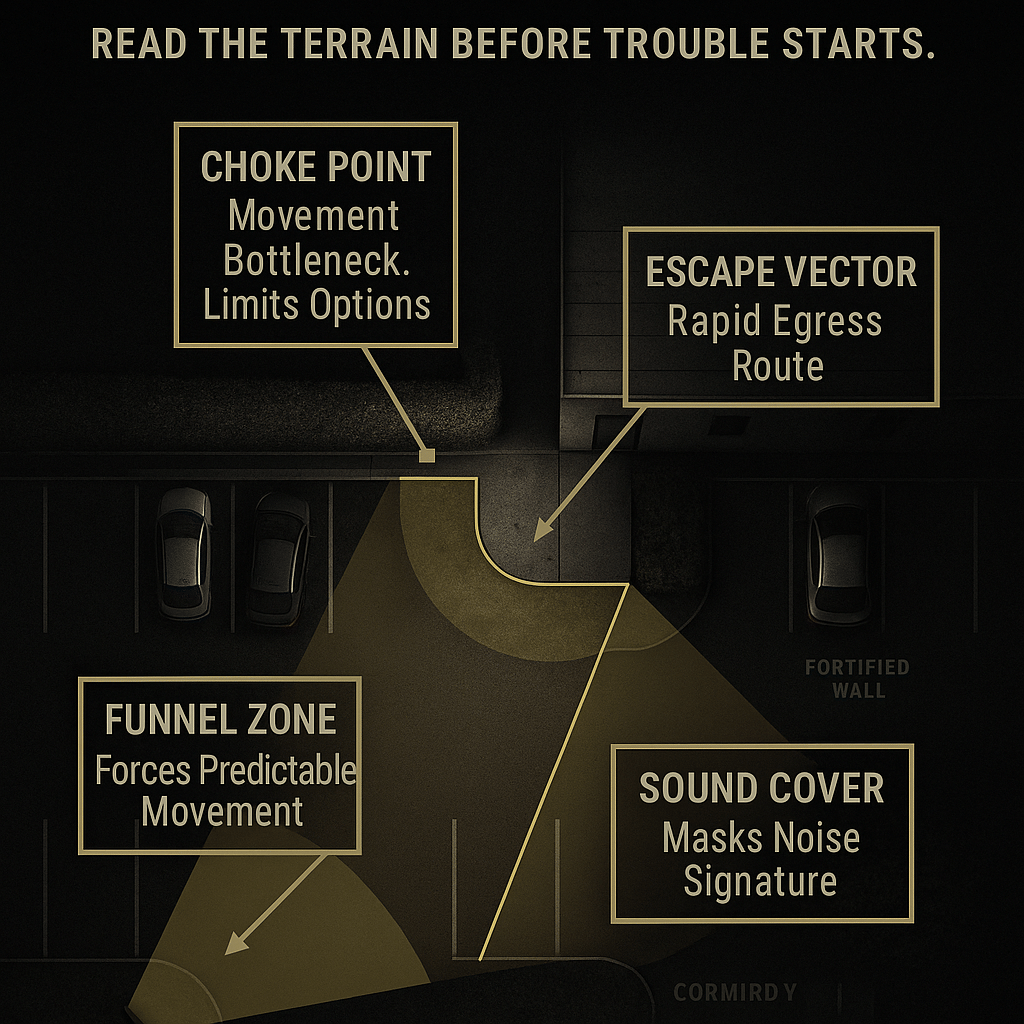
These elements shift based on time, motion, density, and lighting. The spatial mindset allows you to treat every environment as a living map, not a static background.
────────────────────────────────────────
Key Takeaway
Mastering environmental geometry gives civilians the ability to move like professionals: calm, deliberate, and one step ahead.
Reading space correctly prevents entrapment, strengthens confidence, and gives early warning before trouble forms.
EGF helps you make the environment work for your safety — not against it.
Train the Mind. Win the Fight.
Remember: Awareness is Armour.
Remember: Awareness is Armour. For more tactical insights, subscribe to Red Dot Mindset.