
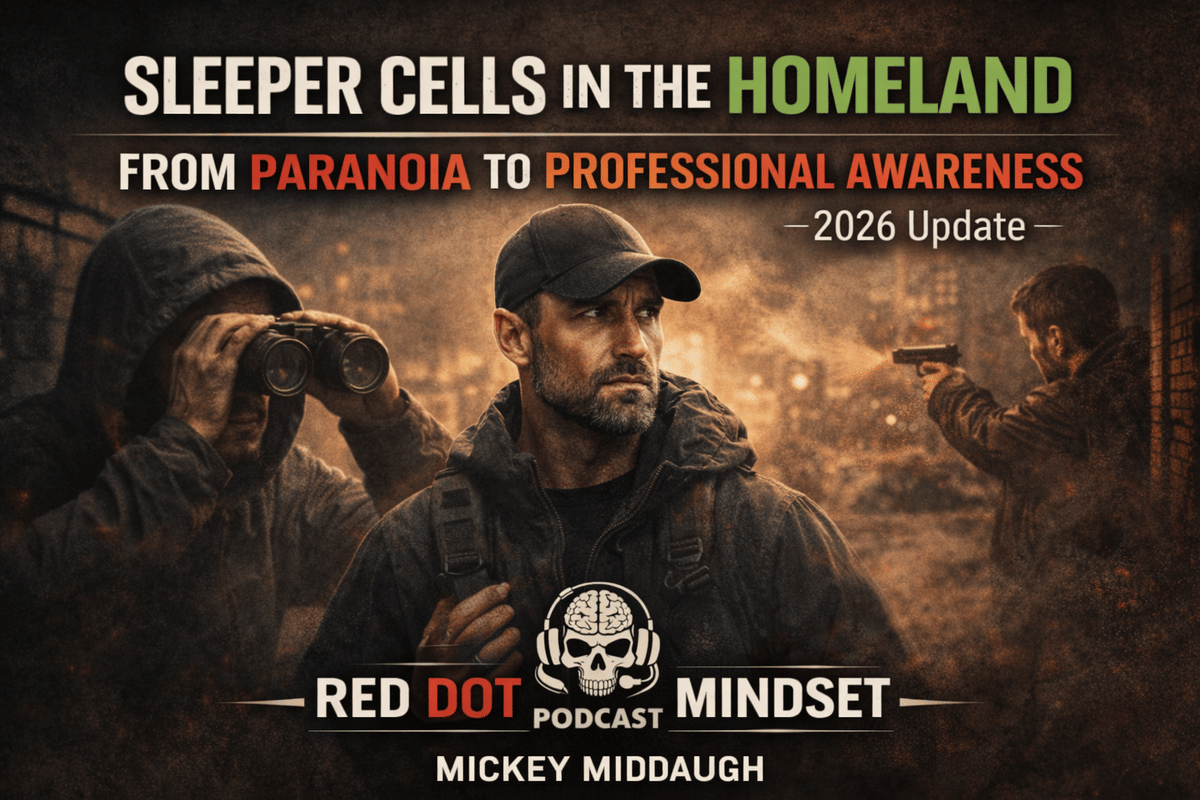
In June 2025, the Red Dot Mindset podcast examined a topic that rarely receives calm, practical discussion: sleeper cells operating quietly inside the United States.
The episode explored how these networks function and why situational awareness matters for civilians. Since that episode aired, global tensions have continued to evolve. The February conflict involving Iran and its regional adversaries—combined with the earlier 2025 strikes on Iranian nuclear facilities—has renewed discussion about potential retaliation, proxy activity, and homeland security vigilance.
For civilians, these developments do not signal imminent danger. But they do reinforce why understanding how threats develop—and how situational awareness works in everyday environments—remains important.
But before speculation or fear takes over, one principle matters most.
The Golden Rule
Elevated awareness does not mean imminent danger.
It means understanding how threats develop so you can stay observant without becoming fearful. For civilians, the goal is not “spy-hunting.” The goal is awareness, observation, and responsible reporting.
Preparedness should always replace panic.
What a Sleeper Cell Actually Is
A sleeper cell is not the Hollywood version of a masked strike team waiting for secret instructions.
In the real world, sleeper cells are typically individuals or small groups who quietly integrate into society for long periods before becoming operational.
They work ordinary jobs, build routines, and blend into everyday life. This professional normalcy is their primary defense.
Only later—sometimes triggered by geopolitical events or direction from a network—do they transition into active roles.
Those roles may include:
• Surveillance and reconnaissance – identifying vulnerabilities
• Logistics support – securing housing, vehicles, or equipment
• Cyber activity – probing infrastructure systems or networks
• Physical action – sabotage of infrastructure or attacks on crowded venues
Tactical Truth
Success for a sleeper depends on blending in.
That means threat detection must always focus on behavior, never on identity, race, religion, or nationality.
The GREYLINE™ Awareness Model
Grey Matter Ops teaches a four-phase awareness framework that allows civilians to process their environment without cognitive overload.
1. Baseline
First identify what “normal” looks like in a location.
Observe:
• Typical crowd flow
• Employee behavior
• Entrances and exits
• The general rhythm of the environment
If you do not understand what is normal, you cannot recognize what is wrong.
2. Anomaly
Next identify behavior that breaks the baseline.
In today’s environment, anomalies may be physical or digital.
Examples include:
• Unusual filming of cameras, security barriers, or access points
• Repeated timed entries or exits resembling rehearsals
• Probing locked doors or staff-only areas
• Drones or unusual technical equipment operating near critical infrastructure
One unusual action may mean nothing.
Patterns are what matter.
3. Evaluation
Before jumping to conclusions, ask:
Is there a reasonable explanation for what I observed?
Is it a contractor performing maintenance?
A tourist who is simply lost?
This step prevents unnecessary alarm and keeps awareness professional rather than reactive.
4. Action
If the behavior appears legitimately concerning, follow a simple rule:
Observe → Document → Report
Do not confront the individual.
Document what you observed.
Report the behavior to appropriate authorities and move yourself to a safer position if necessary.
Observation and reporting are the civilian role. Intervention is not.
Behavior-Based Red Flags
No single behavior automatically signals malicious intent.
However, clusters of the following behaviors may warrant reporting:
• Mapping: photographing or diagramming security infrastructure
• Stationary observation: loitering near critical infrastructure sites such as power stations, water facilities, or transit hubs
• Pattern testing: appearing repeatedly during shift changes or security rotations
• Tactical staging: leaving bags or vehicles in unusual or concealed locations
Again, context and patterns matter more than isolated observations.
Your 30-Second Reporting Template
If you need to report suspicious activity, clear information helps authorities respond faster and more accurately.
Think of yourself as a high-fidelity witness. Focus on observable behavior and concrete details.
First: Decide Where to Report
Call 911 if there is an immediate threat, crime in progress, or danger to life.
Submit a tip to law enforcement or federal reporting systems if you observe suspicious pre-incident behavior with no immediate danger.
The Four Things Dispatch Needs
When reporting, try to provide four key pieces of information.
WHO
Physical description of the person or people involved. Focus on things that are difficult to change:
height and build
gender
tattoos, scars, or distinctive features
unique walking pattern or posture
Clothing can help, but it can change quickly.
WHAT
Describe the specific behavior you observed.
Example:
Weak description
“He’s acting strange.”
Better description
“He bypassed two ‘Authorized Personnel Only’ signs and is photographing the security gate hinges.”
Focus on actions, not assumptions.
WHERE
Give the exact location and direction of travel.
Use landmarks if possible:
“North entrance of the mall”
“Near the ticket kiosks”
“Leaving the parking garage toward Main Street”
GEAR / VEHICLE
If equipment or vehicles are involved, describe them:
bags or equipment
vehicles and license plates
distinctive markings, damage, or bumper stickers
Small details often help law enforcement identify the correct person or vehicle.
Final Step
End your report clearly.
Example:
“I am currently at the east entrance of the stadium and in a safe location. I can stay available if officers need more information.”
Professional reporting reduces confusion and helps responders arrive with the right context.
Practical Awareness Habits for Civilians
Preparedness lives between the extremes of paranoia and complacency.
A few simple habits dramatically improve situational awareness.
The Two-Exit Rule
Whenever entering a building or venue, identify at least two exits.
Understand Crowd Flow
Observe bottlenecks and funnels where crowds naturally compress.
Family Rally Points
When attending events with family or friends, establish a meeting point outside the venue in case of separation.
These small habits require only seconds but can significantly improve personal safety.
Final Thought: Awareness Is Armour™
Sleeper cells succeed when societies become distracted or complacent.
Calm, professional observation disrupts that advantage.
You are not looking for enemies.
You are simply training your mind to notice what others overlook.
Preparedness is not paranoia.
It is awareness.
Train the Mind. Win the Fight.
Grey Matter Ops™
🎧 Sleeper Cells in the Homeland: Hidden in Plain Sight and What Every Civilian Needs to Know
Red Dot Mindset Podcast
Remember: Awareness is Armour. For more tactical insights, subscribe to Red Dot Mindset.