

Predators Walk Among Us — Know the Difference, Stop the Cycle
Predators don’t just exist in the wild. They walk among us — in parking lots, on sidewalks, and sometimes behind the wheel of a car waiting near your daily stop. Understanding the two primary types of human predators isn’t just helpful — it’s survival-critical.
At Grey Matter Ops™, we teach civilians how to identify, avoid, and counter predatory behavior before it escalates into violence. This article draws on key insights from Sgt. Rory Miller (author of Meditations on Violence) and integrates them into the Target Awareness Blueprint™ (TAB) — Grey Matter Ops’ proprietary situational awareness protocol. TAB teaches civilians how to preempt violent encounters, break the attack cycle, and deselect themselves before they’re chosen.
For a deeper dive into attacker psychology and victim selection, see:
• How Criminals Think: Decoding Attacker Behavior and Victim Selection
The Attack Cycle: When Predators Hunt
Every violent encounter begins long before fists fly or weapons are drawn. Predators follow a five-stage attack cycle:
Look – Scanning for potential victims
Choose – Selecting based on perceived vulnerability
Stalk – Following or approaching to test boundaries
Close – Getting within striking distance
Complete – Executing the assault or theft
Different predator types execute this cycle differently. Grey Matter Ops trains civilians to identify which type they’re facing — because your response strategy changes depending on the predator’s motive.
For practical drills that sharpen detection skills, see:
• Situational Awareness: The Skill That Keeps You Alive
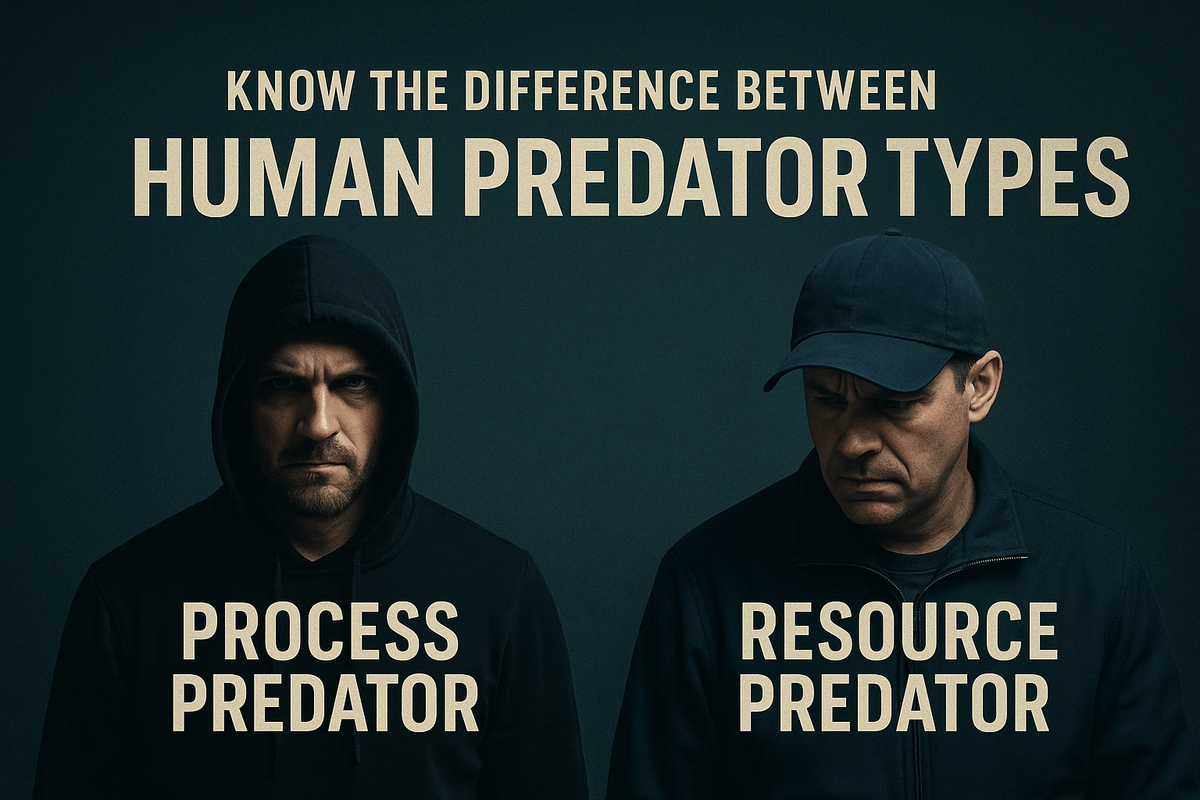
Process Predators — They Crave Violence
“They don’t want your wallet — they want you. Process predators enjoy control, pain, and domination.” — Sgt. Rory Miller
Process predators don’t want valuables. They want an experience: control, fear, torture, and often murder. These are the serial rapists, killers, and sadists who seek prolonged, private interactions with victims.
Signs you’re facing a process predator
Attempts to move you to a secondary crime scene
Home invasion with no theft motive
Unwarranted restraint or gagging
⚠️ Critical Warning: If someone attempts to move you to a second location, assume a process predator — fight to escape immediately.
Process Predator Response (TAB + SCT Method™)
Scan: Identify attempts at isolation or movement.
Counter: Break patterns; change routines; draw attention.
Take Action: Harden perimeter (locks, lights, reinforced entries). If cornered — immediate counterforce.
Scenario guidance:
• Target Awareness Blueprint – Civilian Edition (episode)
Resource Predators — They Want a Score
Resource predators are motivated by gain: muggers, carjackers, burglars, pickpockets. They’re opportunistic, risk-averse, and want maximum return with minimal effort.
Typical behaviors
Threats or intimidation for valuables
Avoidance of prolonged conflict
Quick withdrawal once they get what they want
Compliance can reduce risk — but not always. If violence escalates, be prepared to act decisively.
Resource Predator Response (TAB + SCT Method™)
Scan: Watch hands and faces in transitional spaces (parking lots, ATMs).
Counter: Use verbal refusal scripts and pre-planned ready stances.
Take Action: Trust your intuition — disengage early, avoid freeze.
Build awareness drills with:
• Stay Sharp: Mastering Awareness with the Cooper Color Code
Crime Data Backs the Model
FBI UCR data shows property crimes (theft, burglary, larceny) vastly outnumber violent crimes (murder, rape, aggravated assault). Most crimes civilians face are resource-driven — but when a process predator appears, stakes are exponentially higher. You can recover stolen property. You cannot recover from a planned process predator attack.
For decoding social vs. asocial violence patterns, see:
• Master the Four Pillars of Social Conflict — The Grey Matter Ops Guide to Staying Left of Bang (episode)
60-Second Predator Assessment
Answer quickly — these fast checks save time and lives.
Are they attempting to isolate you? → [Process]
Are they focused on visible valuables? → [Resource]
Do they seem to enjoy your discomfort? → [Process]
Are they rushing and nervous? → [Resource]
Are they trying to move you elsewhere? → [Process]
Pull Quote: “Process predators want your fear. Resource predators want your wallet. Your response must match the threat.”
Stop the Cycle Before You’re Chosen
Prevention is the best defense. Apply TAB to disrupt the attack cycle early:
LOOK: Appear alert, walk with purpose, scan exits.
CHOOSE: Break routines, vary timing, reduce predictability.
STALK: Spot tailing, sudden turns, prolonged proximity.
CLOSE: Create distance, use verbal commands, shift to defensive posture.
Reinforce safety layers with:
• The Four Layers of Defense: Build a Mindset That Holds When It Matters Most
The Grey Matter Ops Philosophy
This predator framework aligns with Grey Matter Ops™ philosophy: tactical readiness isn’t paranoia — it’s preparation. By understanding predator psychology and applying structured frameworks like TAB, Grey Line™, and the Awareness Continuum™, you move from reactive to proactive — from victim to hard target.
Takeaway: Understand predator psychology and you gain the upper hand. Whether facing a resource-driven mugger or a process-motivated sadist, survival hinges on this principle:
“You’re not paranoid. You’re prepared. The difference is what keeps you breathing.”
Use it. Train it. Drill it. Live it.
Download & Learn
🚨 Download the Target Awareness Blueprint™ — Free Now
The civilian tactical guide that’s already saving lives. Includes Grey Line™, Awareness Continuum™, SCT Method™, and more.
• Download the Target Awareness Blueprint™
Featured in: Red Dot Mindset™ Podcast Episode 18 — Predator Psychology: The Science of Survival
Legal Notice
This content is educational only. Always comply with local, state, and federal laws before carrying or deploying personal-protection tools.
Remember: Awareness is Armour. For more tactical insights, subscribe to Red Dot Mindset.
Primary Source Attribution
Miller, Rory. Meditations on Violence: A Comparison of Martial Arts Training and Real World Violence.
1st ed. Boston, MA: YMAA Publication Center, Inc., 2008.
Author: Sgt. Rory Miller (Corrections Officer)
Publisher: YMAA Publication Center, Inc.
ISBN-13: 978-1-59439-118-7
ISBN-10: 1-59439-118-1
Copyright: © 2008 Rory Miller
Printed in: United States of America
Remember: Awareness is Armour. For more tactical insights, subscribe to Red Dot Mindset.

Mickey Middaugh