When danger strikes, your brain has already made its first decision—in milliseconds.
The question isn’t whether you’ll respond, but whether that response will protect you or paralyze you.
Freezing under stress is one of the most misunderstood survival responses. It’s often mislabeled as weakness or cowardice. In reality, the freeze response is hardwired human biology—and when left untrained, it can cost lives.
The Anti-Freeze Protocol™ exists to change that.
With the right framework and deliberate practice, civilians can learn to recognize freeze early, interrupt it decisively, and convert paralysis into purposeful movement.
Why Freezing Happens
Stress hijacks the brain.
When a threat appears suddenly, the amygdala—the brain’s alarm system—overrides the prefrontal cortex, which governs reasoning and deliberate choice. This shift floods the body with adrenaline, narrows perception, and can lock the body into immobility.
Researchers and experienced trainers have identified several distinct forms of freeze:
Physiological Freeze
Marc MacYoung (The Professional’s Guide to Ending Violence Quickly) described this as a metabolic shift. It often appears as trembling, stiffness, or momentary loss of fine motor control when adrenaline spikes.
Mental Freeze
This includes:
Non-cognitive freeze: complete blanking or dissociation
Cognitive freeze: overthinking, looping options, or “analysis paralysis”
Criminologist Lonnie Athens referred to this as “working from the wrong blueprint.”
Social Freeze
Rory Miller (Facing Violence) identified:
Cognitive social freeze: hesitation over what is socially permitted
Pure social freeze: paralysis caused by norms, authority, or context (“This can’t really be happening here.”)
These distinctions matter. Not all freezes are fatal.
A brief, intentional pause to assess can be tactical. The danger is an unrecognized freeze that lingers, consuming precious seconds.
Grossman’s Framework: Expanding the Survival Model
Traditional survival psychology focused on the Three F’s:
Fight
Flight
Freeze
Military psychologist Lt. Col. Dave Grossman expanded this model to reflect real-world human behavior:
Fight — Engage the threat directly
Flight — Escape from danger
Posture — Display dominance or bluff strength
Submit — Yield in hopes of survival
Freeze — The initial interruption before action
In practice, freeze often appears first, even if only for a fraction of a second. The body then searches for a viable path forward. Training determines whether that transition happens smoothly—or not at all.
Real-World Example: Las Vegas, 2017
During the Route 91 Harvest Festival shooting, many victims initially froze. Confusion over whether the sounds were fireworks or gunfire delayed action. Survivors who moved immediately—seeking cover, breaking out of choke points, or flowing with the crowd—demonstrated significantly higher survival odds.
The lesson is stark:
Waiting for perfect information is deadly.
The Anti-Freeze Protocol™ trains civilians to act decisively on incomplete information.
The Anti-Freeze Protocol™
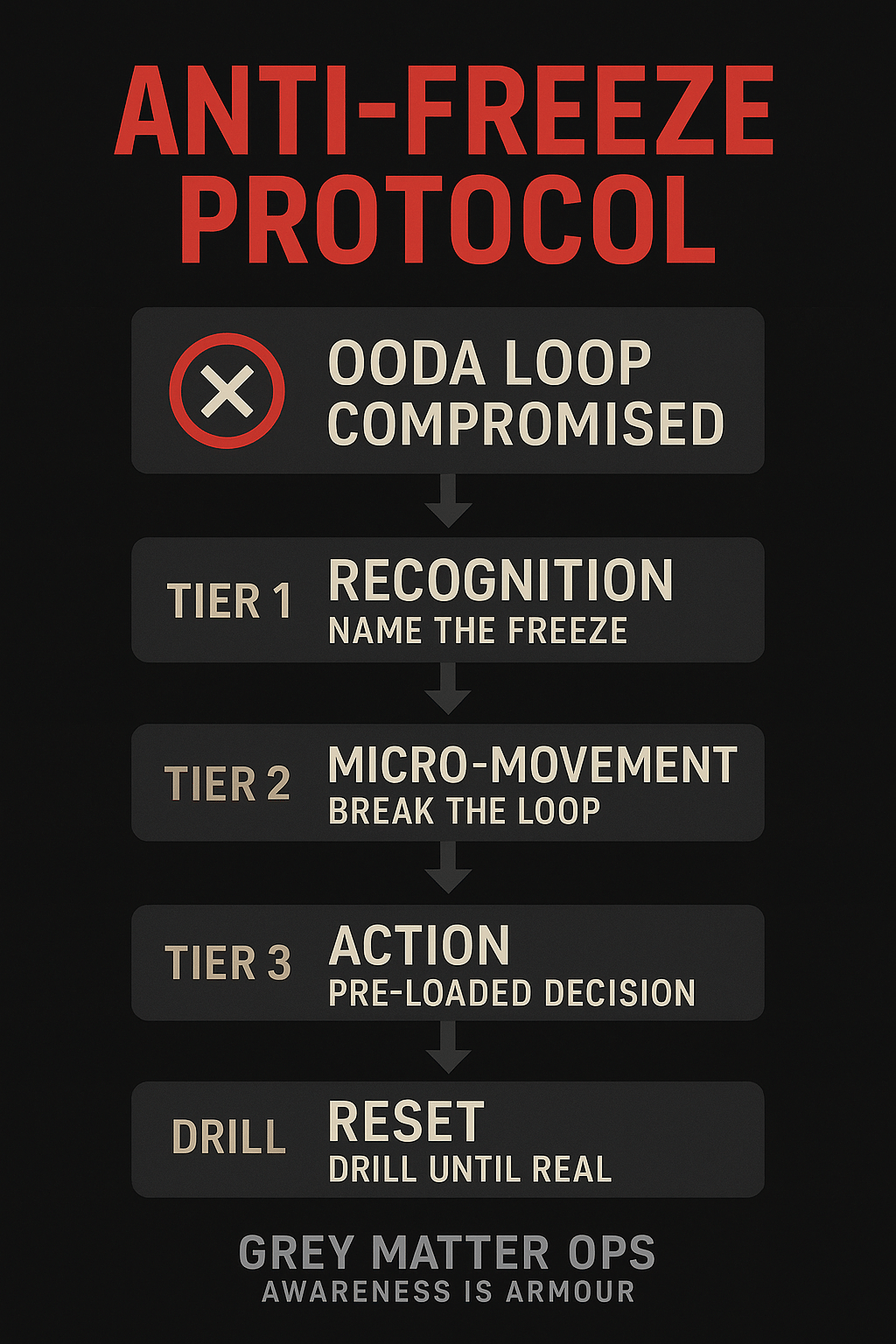
A 4-Tier Movement Conversion Routine
Grey Matter Ops developed this system to convert paralysis into motion under stress. Each tier operates within a compressed time window, forcing the brain to re-engage.
1. Recognition Tier (0–2 seconds)
Acknowledge the freeze: “I’m locked—break it.”
Naming the state reactivates cognition.
2. Micro-Movement Tier (2–3 seconds)
Execute a small action: shift weight, move a finger, verbalize.
The objective is to disrupt total immobility.
3. Action Tier (3–5 seconds)
Transition into a pre-loaded action: cover, movement, escape route, or defensive posture.
These scripts must be trained in advance.
4. Flow Tier (Beyond 5 seconds)
Once moving, keep moving.
Re-enter the OODA Loop (Observe–Orient–Decide–Act) and adapt continuously.
This progression inoculates the brain against paralysis, ensuring milliseconds of freeze don’t become fatal seconds of inaction.
Key Tactical Takeaways
Framework: Classic Three F’s + Grossman’s additions = a five-part survival system
Critical Insight: Some freezes buy time; others steal lives—training teaches the difference
Neuroscience: Freeze is amygdala dominance, not weakness
Solution: Micro-movement and pre-loaded actions bypass frozen circuits
Application: Disaster scenarios and ambush scenarios require different preparation strategies
Appendix: Anti-Freeze Protocol™ — Quick Reference
Step 1: Recognition
Say it: “I’m freezing.”
Acknowledge immediately.
Step 2: Micro-Movement
Move a finger, shift stance, verbalize.
Break total lock.
Step 3: Action
Execute the first trained script.
Examples: drop-step, sprint to cover, verbal command.
Step 4: Flow
Commit fully.
Cycle the OODA Loop until the threat resolves.
Related Reading
The Tiered Tactical Routine: Daily Habits That Keep You Left of Bang
Case Study: Las Vegas Route 91 — Sound Signature Recognition & Crowd Flow (TAB)
Your Next Step
Start small. Set a random daily alarm. When it goes off, deliberately pause—then immediately run the 4-Tier Anti-Freeze Protocol™.
Ask yourself:
“What would I do right now if danger appeared?”
This simple drill begins building the neural pathways that could save your life.
Remember: Awareness is Armour. For more tactical insights, subscribe to Red Dot Mindset.