

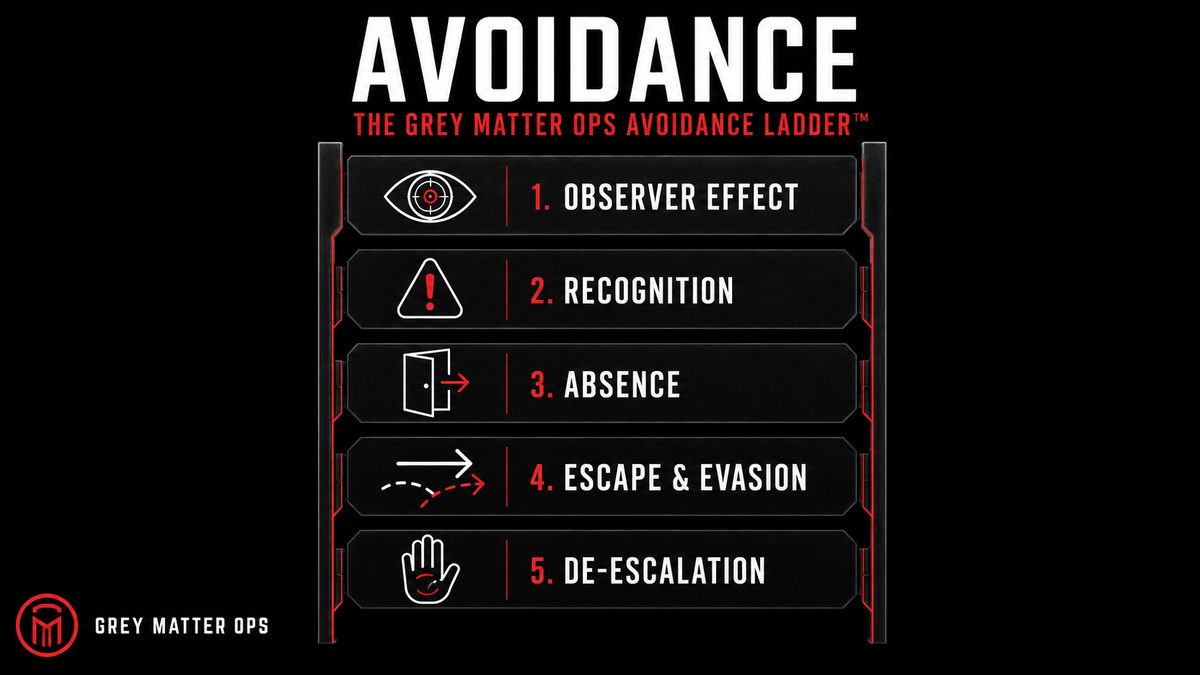
Why This Ladder Matters
The best fight is the one you never have to attend. Whether you’re stepping out of your apartment, cutting through a parking garage, or meeting someone new, the Grey Matter Ops Avoidance Ladder gives you a disciplined way to prevent problems before they start. It turns awareness into action—calmly, clearly, and without bravado. 🎯
THE OBSERVER EFFECT: YOUR FOUNDATION 👀
Carriage before content.
Carriage is how you move, look, and carry yourself. Content is what you say or do.
People read your carriage before any conversation starts.
How you carry yourself broadcasts capability and attention long before a word is spoken. Head up, purposeful gait, phone down, eyes out.
This visible alertness does two things: It quietly deters selection by offenders who read nonverbal vulnerability cues, and it sharpens early detection of trouble. It’s not paranoia; it’s presence.
RECOGNITION: BASELINE + ANOMALY = DECISION 🔎
Ask: what’s normal for this place right now? That’s your baseline.
Notice what breaks the pattern—an anomaly. Decide and act without talking yourself out of your gut feeling.
Examples of anomalies:
Lingering near exits: no clear purpose, unusual stillness or scanning
Subtle blocking: people shaping your path or access to doors
Loose encirclement: multiple individuals coordinating movement
Time/place mismatch: late-night presence in typically low-traffic zones
Digital situational awareness:
Limit live-location sharing: turn off passive broadcasts on apps
Meet in staffed spaces: public, camera-covered venues for first meetings
Use check-ins: share plans/timelines with a trusted contact
ABSENCE: YOUR MOST POWERFUL MOVE 🚪
When recognition says something is off, leaving early is the strongest play. Pre-commit that social awkwardness doesn’t get a vote.
This is Tactical Civility—respectful, firm choices that prioritize safety.
Credit on PINS (Pre-Incident Indicators)
“Pre-Incident Indicators” are drawn from Gavin de Becker’s work in The Gift of Fear (1997). We adapt these signals for civilian use within the Grey Matter Ops framework.
Read more: The Gift of Fear 📘 • Protecting the Gift 👨👩👧👦
PINS (Gavin de Becker)
Forced Teaming: instant “we” to lower your guard
Charm & Niceness: overdone friendliness as manipulation
Too Many Details: overselling a simple point to convince
Typecasting: “You’re not rude, are you?”—labels to push compliance
Loan Sharking: unasked favor → felt obligation
The Unsolicited Promise: “I won’t hurt you” (unprovoked assurance)
Discounting the Word “No”: ignoring boundaries and pushing past them
Pre-Commit Rule:
If the baseline breaks or a PIN appears, you leave. No debate.
Exit micro-scripts (neutral, firm):
“Not for me—” I’m heading out.
“Can’t talk right now—” deadline.
“No. I’m leaving now.”
ESCAPE & EVASION (E&E): WHEN YOU CAN’T LEAVE 🏃♂️🧭
If absence isn’t possible, prioritize movement to safety. E&E aligns with the ALERRT Center’s Avoid–Deny–Defend civilian response model and the FBI’s Run. Hide. Fight. guidance, with avoid/run prioritized when safe.
E&E takes priority over verbal engagement when movement is available. If you can create distance or reach safety through movement, do so immediately.
Essential E&E habits:
Two-Exit Scan: identify two ways out in every space
Cover Index: cover stops threats (brick, concrete, engine block); concealment only hides (drywall, curtains, bushes)
Pathing: move cover-to-cover; avoid funnels and dead ends
Buddy Lead-Out: “Follow me,” point, then move
Vehicles & crowds:
Vehicles: pull-through park; doors locked; leave a tire’s width at stoplights; if blocked/disabled, abandon to hard cover and keep moving 🚗🛡️
Crowds: move with the flow while angling toward staffed exits; avoid getting trapped in the center
Communications:
Call 911 from cover: give location, description, direction of travel; hang up if staying on the line increases risk ☎️
The Avoidance Ladder governs everyday threat avoidance; in confirmed active-shooter events, the Avoid | Deny | Defend model applies.
DE-ESCALATION: CREATING A WINDOW TO DISENGAGE 🫱🛡️
De-escalation is Proactive Disengagement—the final off-ramp before things get physical. The goal isn’t to “win” an argument; it’s to create a brief window to disengage and leave.
De-escalation is used only when movement is temporarily restricted and exists to support escape—not to resolve or manage a threat.
Use:
Time: slow the interaction
Distance: create/maintain space
Cover: use barriers when available
Communication: visible palms, calm neutral tone, one simple request (“Please step back.”)
Red lines (don’t de-escalate here):
Weapon + closing distance
Multiple coordinated aggressors
Clear pre-attack cues: clenched fists, repeated target glances, bladed stance ⚠️
PHASE FAILURE (RAPID SWITCHING) 🔄
If one step isn’t viable, switch immediately to the next. Recognition → Absence → E&E → De-escalation isn’t rigid; it’s a decision ladder under stress.
This flexibility does not imply equal risk between phases; it reflects rapid prioritization based on access to movement, distance, and safety.
VIGNETTE: LATE-NIGHT, MULTI-LEVEL GARAGE 🅿️
You clock two people near your car, moving in a way that doesn’t fit the baseline. Observer Effect keeps your head up and your pace steady. Recognition flags the anomaly; you don’t debate it.
Absence: pivot toward the attended exit.
If movement is blocked, E&E: shift to cover, plot your path, and—when safe—call 911 from cover with location, description, and direction of travel.
Use brief, calm language only to buy seconds and space for the exit.
That’s the ladder, applied in real time.
WHY THIS WORKS 📊
A randomized, stepped-wedge evaluation in Louisville found 28% fewer use-of-force incidents, 26% fewer citizen injuries, and 36% fewer officer injuries after ICAT (Integrating Communications, Assessment, and Tactics) training—a law-enforcement program focused on decision-making and communication under stress.
These findings reflect law-enforcement outcomes; Grey Matter Ops applies the underlying communication and decision-making principles—not the authority, tools, or tactics—to civilian avoidance and disengagement.
We adapt those structured principles for civilian life—quietly, clearly, and realistically.
GMO WEEKLY CHALLENGE 📅
Week 1 — PINS & anomalies: log two “off” cues daily; practice one exit line
Week 2 — E&E baselines: make the Two-Exit Scan and Cover Index automatic everywhere you go
Week 3 — De-escalation scripts: rehearse three simple lines with correct posture and space
Week 4 — Full rep: mentally walk Recognition → Absence → E&E → De-escalation in a few what-if scenarios
TAKEAWAY ✅
Start today with one habit: the Two-Exit Scan—every room, every time. Small choices compound into confidence.
Further Reading 📘
Gavin de Becker — The Gift of Fear: Survival Signals That Protect Us from Violence
Gavin de Becker — Protecting the Gift: Keeping Children and Teenagers Safe (and Parents Sane)
CTA (Single, Direct) 🔗
Listen to the podcast episode:
The Grey Matter Ops Avoidance Ladder: Win Without Fighting
Remember: Awareness is Armour. For more tactical insights, subscribe to Red Dot Mindset.