
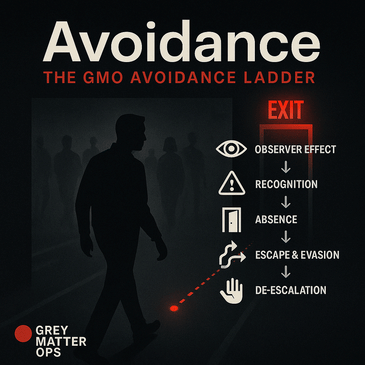

Developed by subject-matter expert Mickey Middaugh (retired U.S. Air Force Security Forces Senior NCO; founder of Grey Matter Ops), this episode delivers the GMO Avoidance Ladder—a civilian-ready framework for proactive safety and situational awareness.
The Avoidance Ladder teaches how to:
Apply the Observer Effect to project visible alertness.
Use Recognition with Baseline → Anomaly → Decision.
Practice Absence, guided by Pre-Incident Indicators (PINs) identified by Gavin de Becker.
Execute Escape & Evasion (E&E) aligned with ALERRT’s Avoid–Deny–Defend and the FBI’s Run, Hide, Fight model.
Deploy De-escalation as a last off-ramp for proactive disengagement.
We also reference evidence from PERF’s ICAT evaluation in Louisville, which documented:
28% fewer use-of-force incidents,
26% fewer citizen injuries, and
36% fewer officer injuries.
These results underscore why structured, tactical frameworks save lives.
Start simple: adopt the Two-Exit Scan—every room, every time—and follow the 4-week challenge to hard-wire awareness habits.
🧠 Tactical Brief: The Avoidance Ladder — Turning Awareness into Action
Developed by: Grey Matter Ops™ (Mickey Middaugh, USAF Security Forces, Ret.)
Episode Context: Red Dot Mindset™ – Early threat detection and proactive disengagement for civilians
Objective: Teach civilians to recognize pre-threat indicators, trust intuition, and disengage before escalation — using structured awareness and behavioral control.
🎯 Mission Objective
The best fight is the one you never attend.
The Avoidance Ladder trains awareness, projection, and action — ensuring you see it coming, step away early, and never become the target.
⚙️ Why It Matters
Most people ignore early warnings because they doubt their instincts or fear being impolite.
Predators exploit hesitation. Awareness isn’t paranoia — it’s prevention.
This system helps civilians project confidence, identify danger signals, and disengage with precision.
Directive: Learn to see first, decide fast, and disappear smart.
1️⃣ Step 1: The Observer Effect
Carriage before content — how you appear matters.
Posture upright, phone down, stride purposeful.
Make eye contact (scan, don’t stare).
Keep hands visible, not buried.
Offenders often pick based on body language and nonverbal cues.
Outward alertness = immediate deterrent.
2️⃣ Step 2: Recognition
Baseline → Anomaly → Decision.
Baseline: What’s normal in your environment?
Anomaly: What deviates from it?
Decision: Trust your instinct. Act on anomalies — don’t overthink them.
Examples:
Parking garage at noon ≠ midnight.
Two or more acting in coordination in a quiet area.
A vehicle slowly shadowing your path.
Digital Parallel:
Disable live location sharing.
Meet in public, staffed spaces.
Tell a contact where you’re going and when you’ll check in.
3️⃣ Step 3: Absence
Best tactic: Don’t be there when trouble starts.
Pre-Incident Indicators (PINs) from Gavin de Becker, The Gift of Fear:
Forced teaming
Excessive charm
Too many details
Typecasting
Unsolicited promises
Ignoring “no”
Response:
When a PIN shows up — leave immediately.
No debate. No guilt. No apology.
Micro-scripts:
“Not for me, I’m heading out.”
“No. I’m leaving now.”
Each word is a command decision, not an invitation to negotiate.
4️⃣ Step 4: Escape & Evasion (E&E)
Civilian adaptation of Avoid | Deny | Defend (ADD) and Run | Hide | Fight.
Priority = Evacuate early.
Micro-drills:
Two-Exit Scan: Always know two ways out.
Cover Index: Differentiate between cover (stops threats) and concealment (only hides).
Pathing: Avoid funnels, move cover-to-cover.
Vehicle: Park pull-through, keep doors locked, leave maneuver room at stops.
Crowds: Angle toward staffed exits; avoid the center.
5️⃣ Step 5: De-Escalation
Goal: Disengagement, not debate.
Tactics:
Maintain time, distance, and cover.
Voice calm, palms visible, posture neutral but ready.
Example line: “Please step back.”
De-escalation fails when:
Weapon visible + closing distance.
Multiple aggressors coordinating.
Pre-attack indicators (clenched fists, target glances, bladed stance).
If those appear → revert to E&E or prepare to defend.
🧩 Practice: The Grey Matter Ops™ Weekly Challenge
Week 1: Spot two PINs daily. Rehearse one exit script.
Week 2: Practice two-exit scans and cover index in every environment.
Week 3: Drill three calm, neutral de-escalation lines with posture.
Week 4: Run full scenario: Recognition → Absence → E&E → De-Escalation.
🎯 Key Takeaway
The Avoidance Ladder converts awareness into preventive control.
Project confidence (Observer Effect)
Spot anomalies (Recognition)
Leave early (Absence)
Move first (E&E)
Talk only when safe (De-Escalation)
Result: Potential threats become non-events.
This isn’t fear—it’s tactical foresight.
📚 Source Acknowledgements
Gavin de Becker, The Gift of Fear (1997)
ALERRT — Avoid | Deny | Defend framework
Grey Matter Ops™ — Awareness Continuum, The Grey Protocol™, and The Grey Line™
Red Dot Mindset™ — Civilian tactical mindset training and situational awareness podcast series
Grey Matter Ops™ — Train the Mind. Win the Fight.
Stay Grey. Stay Ready.
Remember: Awareness is Armour™.