
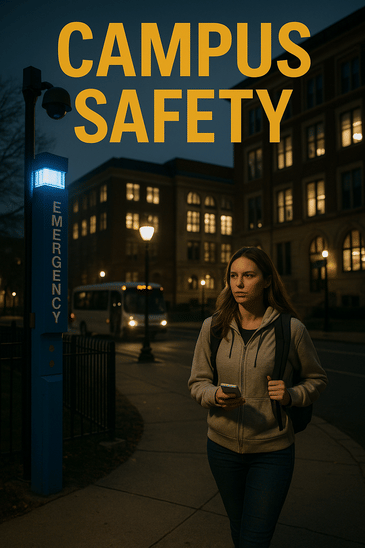

First Year, First Defense isn’t your typical campus orientation talk. This episode goes beyond packing lists and dorm check-ins to focus on what really matters—personal safety, mindset, and tactical readiness. Using SCAD in Savannah, Georgia, as our case study, we break down real-world threats facing students—especially introverts—and show how to build a mental playbook before danger ever appears.
From mapping your urban crime footprint to mastering rideshare safety, avoiding financial scams, and protecting your digital identity, this episode equips students with the tools to thrive, not just survive. Whether you’re starting college or sending someone you love, this is your essential tactical briefing for campus life.
🛡️ Tactical Brief: First Year, First Defense — Staying Safe on Urban Campuses
Developed by: Grey Matter Ops™ (Mickey Middaugh)
Episode Context: Red Dot Mindset™ – Urban campus readiness for new students (SCAD used as example; principles apply to any campus)
Objective: Give first-year students—especially introverts—a simple, repeatable playbook to live left of bang on and around urban/suburban campuses.
⚙️ Mission Overview
Prepared, not paranoid. Safety = trained habits + smart choices, not fear.
Context over headlines. Neighborhood stats vary block-to-block; campus safety “bubble” (police, access controls, cameras, shuttles) changes the on-ground picture.
Leverage your strengths. Introvert observation skills are a tactical advantage.
1) Pre-Arrival Prep (Day-0 Actions)
Clery Report: Pull your school’s Annual Security Report (ASR) and daily crime log; learn on-campus vs. adjacent area patterns.
Map the Safety Net: Mark campus police, blue-light phones, 24/7 desks, patrol routes, and all SafeRide/late-night shuttle stops.
Mental Rehearsal: Walk the map (virtually or in person). Identify well-lit routes between dorm, classes, library, and dining.
2) On-Campus Layers (The “Institutional Safety Bubble”)
Controls: Swipe/card access, cameras, patrol presence (24/7 common), emergency phones, SafeRide to ~late night.
Your Task: Default to inside the bubble after dark; when off-campus, plan re-entry points (nearest patrolled building/stop).
3) Movement & Mobility Protocols
Rideshare (Non-negotiables)
Verify before entry: Match make/model/license and ask the driver: “Who are you picking up?” (you do not say your name first).
Back seat, belongings in hand. No earbuds. Share live trip with a trusted contact.
Keep convo neutral. No personal schedule/home details.
Bike (If you must ride)
Route: Well-lit, designated paths only; no shortcuts through alleys/parks.
Gear: U-lock (not cable), lights/reflective, no headphones.
Access: Phone reachable (not buried) for quick call to campus security/911.
Decision rule: After dark or fatigued → SafeRide beats biking.
4) Digital & Financial Security (High-Yield Wins)
Digital Camouflage: Turn off geotagging; delay posts; never publish dorm number, class schedule, or routine routes.
Scam Shield:
Urgent tuition/aid messages → Pause, verify, act via the official portal/phone you look up yourself.
No gift cards/wires/“processing fees” for scholarships.
Accounts: Unique passwords + 2FA everywhere; fully log out on shared devices; back up coursework (cloud + external).
5) The Introvert Edge (Make It a Force Multiplier)
Use small talk as a tool, not a personality rewrite—stay approachable, not isolated.
Safe-zone mental map: Quiet study nooks, staffed buildings, security office—pre-select “fallbacks.”
Micro-journal: 3 lines/day to capture anomalies and reinforce intuition.
Trust your gut over social pressure; courtesy never outranks safety.
6) The Grey Protocol (When Something Feels Off)
Observe (no assumptions): What do you see/hear/feel?
Prepare (no panic): Breathe, choose options (distance, alert, safer location).
Act (no hesitation): Commit—move, call, enter staffed space, cross the street.
7) Threat Calibration — Decision Tree
🟡 Suspicious: repeat sightings/odd vehicle → Log, adjust pace/path, discreet photo if safe.
🟠 Concerning: following/circling/blocking exits → Create distance, enter staffed area, alert someone; use refusal script: “I don’t know you. Stay back.”
🔴 Threatening: weapon/aggression/cornering → Call 911, make noise (“HELP! CALL 911!”), move to safety.
Rule: Better to overreact early than freeze late.
8) Weekly Sustainment (Left-of-Bang Habits)
One variation/week (route/time/venue).
One micro-drill/week (60-sec Scan rep, refusal script aloud).
Monthly: Review risk profile; run a family/roommate rally-point check; privacy audit.
Always: Quietly share location with at least one trusted contact when out.
9) Quick-Start Checklist (Do These Today)
Turn off social geotags; enable 2FA.
Save campus police and SafeRide numbers as favorites.
Walk the blue-light/stop map between your top 5 locations.
Memorize the rideshare question: “Who are you picking up?”
Install a safety app (e.g., trip sharing/quick alert) and set your trusted contacts.
🎯 Key Takeaways / Mission Application
Plan the ground. Maps reduce fear and shorten response time.
Control transit risk. Verification, visibility, and monitored rides cut exposure.
Guard the data. Digital camouflage prevents patterning and scams.
Use your edge. Quiet observation is a superpower—pair it with decisive action.
Reps build confidence. Small weekly drills make safety second nature.
📚 Source Acknowledgements
Red Dot Mindset™ Podcast: “First Year, First Defense — Staying Safe on Urban Campuses.”
Grey Matter Ops™ Frameworks: Target Awareness Blueprint™, The Grey Protocol, The Grey Line (Awareness Continuum).
Campus Safety Practice: Clery Act reporting; typical campus measures (patrols, access control, emergency phones, cameras, SafeRide).
(Episode notes used SCAD/Savannah as example; principles apply universally.)
Grey Matter Ops™ — Train the Mind. Win the Fight.
Remember: Awareness is Armour™.