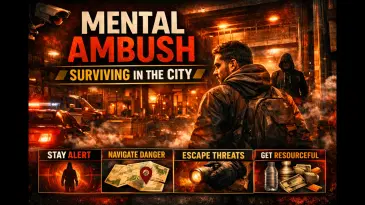

In this episode, we expose the hidden battlefield that matters most — the one inside your mind. Before tools, tactics, or physical techniques ever come into play, your mindset determines whether you freeze, panic, hesitate, or move with purpose.
We break down how fear, stress, and indecision can be weaponized against you, and how to counter them with awareness, intuition, mental rehearsal, and decisive action.
Drawing from Gavin de Becker’s The Gift of Fear, Colonel Jeff Cooper’s Color Code, and Colonel John Boyd’s OODA Loop, this episode explores how to recognize pre-attack indicators, operate from Condition Yellow, manage the freeze response, and think clearly when pressure rises.
You’ll learn how sharpening intuition, mastering awareness, and developing mental agility can turn your mind into your strongest defensive tool in any environment — from crowded streets to parking lots, gas stations, public spaces, and everyday encounters.
Your mind is your first line of defense.
Train the Mind. Win the Fight.™
🧠 Tactical Brief: Mental Ambush — Sharpening Your Mind for Urban Survival
Developed by: Mickey Middaugh — Founder, Grey Matter Ops™ | Tactical Mindset & Civilian Preparedness
Series: Red Dot Mindset™ Podcast Deep Dive
Mission Motto: Train the Mind. Win the Fight.
🎯 Mission Objective
Develop a street-ready mental operating system that detects danger early, resists panic, and drives decisive action under pressure.
⚠️ Threat Picture
Urban environments create distraction, compression, and opportunity. Noise, crowds, phones, earbuds, routines, and hesitation all reduce reaction time.
Predators exploit the gap between what is happening and how fast you recognize it.
Most violence is preceded by behavioral, verbal, or environmental indicators. When those signals are missed, options collapse.
🧭 Core Doctrine — Condition Yellow
Condition Yellow is relaxed alertness.
It is not paranoia.
It is not fear.
It is not hypervigilance.
It is the disciplined habit of staying aware enough to notice when something changes.
White: Unaware, distracted, or mentally checked out.
Yellow: Calm, heads-up awareness; establishing the baseline.
Orange: A specific anomaly has been identified; form a plan.
Red: Immediate action; escape, de-escalate, defend, or move.
Operate daily in Yellow to buy time, space, and options.
👀 Baselines, Anomalies, and Intuition
A baseline is what normal looks like in a specific environment.
Baseline indicators include:
Movement flow
Sound level
Normal behavior
Entry and exit use
Staff patterns
Clothing appropriate to the setting
Who belongs and who does not appear to fit
An anomaly is anything that breaks that pattern.
Common anomalies include:
Overdressed for the weather
Loitering without purpose
Focused surveillance
Concealment gestures
Boundary testing
Route blocking
Unusual positioning near exits, vehicles, ATMs, or choke points
Intuition is subconscious pattern recognition. When it pings, do not dismiss it.
Move first. Analyze later.
🚩 Pre-Attack Indicators — Rapid Identification
Pre-attack indicators are behavioral, verbal, and environmental signals that may appear before violence escalates.
Behavioral indicators:
Bladed stance
Clenched jaw or fists
Target glances
Closing distance
Pacing
Scanning
Sudden change in demeanor
Repeated adjustment of clothing or waistline
Verbal indicators:
Forced teaming
Boundary testing
Minimization
Time pressure
Aggressive tone
Ignoring “no”
Unwanted help that continues after refusal
Environmental indicators:
Choke points
Blocked egress
Accomplices flanking
Isolation
Poor lighting
Concealment areas
Someone positioned where they do not logically belong
Action: Create space. Change angle. Reposition. Move toward cover or exit. Prepare clear voice commands.
🧠 OODA Loop — Think Faster Than the Threat
Observe → Orient → Decide → Act → Repeat
The OODA Loop gives your mind a simple structure when stress rises.
Observe: What is happening?
Orient: What does it mean in this environment?
Decide: What is the safest simple option?
Act: Move, speak, disengage, escape, or defend.
Mental rehearsal shortens the loop.
Do not wait for a perfect plan. Choose a simple branch:
If blocked, change angle.
If approached, create distance.
If pressured, set a boundary.
If trapped, move toward exit, barrier, or help.
If attacked, act decisively.
💨 Stress Control & Anti-Freeze Tools
Fear is natural. Unmanaged fear can freeze decision-making.
The goal is not to eliminate fear.
The goal is to function through it.
Box Breathing:
Use a 4-count inhale, 4-count hold, 4-count exhale, and 4-count hold to slow panic and regain control.
Micro-Scripts:
“Move. Angle. Exit.”
“Hands up. Back off.”
“No. Stay back.”
“I’m leaving.”
“Get away from me.”
Controlled Exposure:
Use scenario-based reps with noise, time pressure, movement, and verbal stress to reduce panic and build decision speed.
Simple, repeated actions help break the freeze response.
🧱 Positioning & Terrain — Urban Micro-Tactics
Terrain matters.
Do not drift through public spaces without noticing where you are.
Positioning principles:
Keep exits in view.
Avoid hard corners and funnels.
Do not allow unknown people inside arm’s length without reason.
Keep a reactionary gap.
Use barriers when available.
Favor cover over concealment.
Cover: Stops or slows a threat. Examples include masonry, large structural columns, engine blocks, and bolted fixtures.
Concealment: Hides you but may not protect you. Examples include drywall, displays, curtains, or furniture.
Your position should create options before you need them.
🎧 Distraction Discipline
Distraction is an invitation.
Phones, earbuds, and predictable movement patterns reduce your ability to detect problems early.
Rules of movement:
One earbud maximum in transit.
Eyes up at thresholds.
Scan doors, elevators, escalators, platforms, parking lots, and gas pumps.
If you must use your phone, stop with your back to a barrier, finish the task, then move.
Do not walk blind into transitional zones.
Attention is protective equipment.
🧪 Daily Drills
Use these short drills to build the habit.
Entry Scan:
Identify two exits and the nearest usable cover when entering a space.
Anomaly Sweep:
Name one thing that does not fit, then adjust your position.
OODA Reps:
Visualize two “If X, then Y” branches for today’s route.
Voice Command Drill:
Practice three clear commands at assertive volume.
Threshold Check:
Before entering or exiting a building, pause long enough to scan the next environment.
📌 Key Takeaways
Awareness creates time.
Time creates options.
Condition Yellow is sustainable, not paranoid.
Intuition is a signal; verify it through observation.
Pre-attack indicators are visible if you are looking.
Simple, rehearsed plans beat complex, untrained reactions.
Your mind is your first line of defense.
Train it before the moment demands it.
🛡️ Footer — Grey Matter Ops™
Train the Mind. Win the Fight.
Stay Grey. Stay Ready.™
Awareness Is Armor.™
Educational briefing for civilian readiness. Not legal advice. Adapt tactics to your local laws, venue policies, environment, physical ability, and training level.