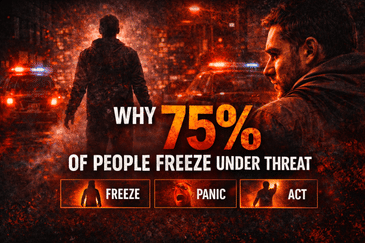

Most people assume they will rise to the moment in a crisis. The reality is that many freeze first.
In this episode of Red Dot Mindset, we examine the psychology of survival under stress and why freezing is such a common response to sudden danger. Drawing from Deadly Force Encounters by Alexis Artwohl and Loren Christensen, we explore how extreme stress changes perception, memory, and decision-making, and why preparation can improve performance when it matters most.
Inside this episode, we explore:
why freezing happens under threat
how stress distorts what you see, hear, and remember
why procedural memory matters under pressure
how stress inoculation builds resilience
what everyday citizens can learn from high-risk professions
If you care about situational awareness, personal safety, and practical mindset development, this episode offers a stronger foundation for everyday readiness and a clearer understanding of how to become harder to surprise.
Listen to the episode and explore more Red Dot Mindset content throughout the site.
Awareness is Armour™. Strength starts in the mind.
Tactical Brief
Mindset Under Fire: What Deadly Force Encounters Teaches Us About Survival
Developed by: Mickey Middaugh — Founder, Grey Matter Ops™ | Tactical Mindset & Civilian Preparedness
Series: Red Dot Mindset™ Podcast Deep Dive
Mission Motto: Train the Mind. Stay Grey. Stay Ready.
Mission Objective
Extract practical survival lessons from Deadly Force Encounters by Alexis Artwohl and Loren Christensen, with emphasis on human stress response, mental conditioning, and the role realistic preparation plays in improving performance under pressure.
This brief is designed to translate high-risk professional lessons into clear, usable principles for civilians, protectors, leaders, and anyone serious about awareness and readiness.
Why This Matters
Most people assume they will rise to the moment in a crisis. The reality is more complicated.
Artwohl and Christensen’s work explores what actually happens when human beings encounter sudden, extreme danger: perception changes, memory degrades, decision-making narrows, and many people freeze in the opening moments of the event. The lesson is not that people are weak. The lesson is that the brain and body respond to threat in predictable ways, and those reactions can be shaped through preparation.
Survival is not rooted in bravado. It is rooted in awareness, mental readiness, and trained action under stress.
Threat Picture
Several core ideas from the source material shape this discussion:
A large percentage of people initially freeze under sudden threat.
A much smaller percentage respond proactively in the opening moments.
The gap between freezing and functioning is not explained by courage alone.
Training, visualization, repetition, and stress exposure can improve the speed and quality of response.
Survival is not about panic or paranoia. It is about staying functional in chaos.
For Grey Matter Ops, that means one thing: becoming harder to surprise.
Core Doctrine: The Survival Mindset
A survival mindset is not fear-based living. It is disciplined, quiet readiness.
Alertness
Stay mentally present. Avoid MAWIL — Mentally Absent Without Leave.
The distracted mind is the vulnerable mind.
Preparedness
Accept that danger is possible without becoming consumed by it.
Plan routes. Note exits. Watch hands. Read the room. Run mental “what if” drills before reality forces the issue.
Resilience
Build calm through repetition and controlled exposure.
Composure is not a personality trait. It is a trained performance advantage.
Adaptability
Apply Boyd’s OODA Loop: observe, orient, decide, act.
Keep cycling. Keep adjusting. Keep moving.
Understanding the Brain Under Fire
Critical incidents are not experienced in a calm, rational vacuum. They are filtered through a nervous system designed for survival, not comfort.
Sympathetic vs. Parasympathetic Response
Under threat, the sympathetic nervous system takes over. Fight, flight, or freeze responses can activate rapidly and automatically. The goal of training is not to prevent the body’s alarm response. The goal is to recover function faster once that alarm is triggered.
Auditory Exclusion
The brain may prioritize visual input over sound during a lethal or perceived-lethal event. People may not hear commands, gunfire, or surrounding noise the way they expect.
Tunnel Vision
Attention can lock onto the threat itself, reducing awareness of the broader environment. This can create dangerous blind spots in movement, escape planning, and threat recognition.
Memory Distortion
Stress can disrupt recall. Time may feel compressed or stretched. Memory may come back in fragments. This matters both during the event and afterward.
Declarative vs. Procedural Access
Under stress, conscious recall of facts and steps often degrades. Trained actions remain more accessible. That is why repetition matters. When the mind is overloaded, the body defaults to what it knows best.
The Freeze Response
Freezing is one of the most misunderstood human reactions to danger.
It is often interpreted as weakness, indecision, or lack of will. In reality, it is a deeply human stress response. Novelty, shock, sensory overload, and uncertainty can all drive a temporary pause in action. The person is not choosing to fail. Their system is trying to process an event it was not prepared to manage.
This is why preparation matters.
The more familiar the mind is with a problem, the less likely it is to stall completely when that problem appears. Visualization, scenario walkthroughs, mental rehearsal, and realistic practice all reduce novelty. Reduced novelty improves function.
Pre-decision also matters. A decision made in advance is easier to execute under pressure than one invented from scratch in the middle of chaos.
Reality Based Training
Reality Based Training, or RBT, helps bridge the gap between knowledge and performance.
Reading, talking, and understanding are useful. They are not enough. If the first time your heart rate spikes, your hands shake, and your decision-making compresses is during the real event, you are already behind.
RBT introduces controlled stress in training so the student learns to function despite pressure.
Principles of Effective RBT
Simulate realistic stressors without creating unnecessary trauma.
Increase challenge progressively rather than all at once.
Use time pressure, noise, movement, uncertainty, and decision-making demands.
Match the intensity to the individual’s skill level and training history.
Build confidence and function, not ego.
The purpose is not theatrics. The purpose is familiarity. Familiarity reduces hesitation.
Stress Inoculation Framework
A useful way to think about this process:
1. Identify manageable stressors
Choose stressors that challenge performance without overwhelming the trainee.
2. Experience the reaction
Observe breathing, speed, tension, perception, and decision-making under pressure.
3. Adjust for control
Refine posture, pacing, breathing, communication, movement, and sequencing.
4. Repeat with progression
Increase complexity gradually. Let adaptation compound.
Outcome: improved tolerance, faster recovery, better clarity, and more functional action.
Procedural Performance: What Shows Up Under Pressure
High stress punishes complexity and rewards what has been deeply practiced.
Procedural Performance
These are trained actions encoded through repetition:
movement patterns
verbal commands
emergency steps
weapons handling
communication under pressure
response sequences
Declarative Performance
These are facts, explanations, checklists, and conscious step-by-step thought.
Both matter, but under stress, procedural performance tends to outlast declarative recall.
That is the takeaway: do not rely on perfect thinking in an imperfect moment. Train until correct action becomes the path of least resistance.
The Will to Survive
Mindset is not motivational wallpaper. It is operational.
Artwohl and Christensen draw on professional experience, case study analysis, and discussion of law enforcement survival data to reinforce a consistent lesson: the decision to continue functioning matters. People who keep thinking, moving, solving, and resisting collapse often create survival opportunities that would otherwise be lost.
That does not guarantee victory. It does not erase injury. It does not make people invincible.
It does mean this: when the event gets ugly, the refusal to mentally quit can preserve options.
Whether the outcome is compliance, escape, or stopping the threat, mental determination affects speed, clarity, persistence, and follow-through.
Civilian Application
These lessons are not reserved for law enforcement or military professionals.
The underlying psychology applies to:
parking lots
home invasions
road rage events
assaults
robberies
active threat incidents
chaotic emergencies where rapid judgment matters
Most civilians do not need a warrior fantasy. They need a workable framework.
That framework includes:
better awareness before the problem
fewer surprises at the point of contact
faster recognition when something is wrong
more deliberate action once the event begins
Preparedness is not paranoia. It is friction reduction for bad days.
Key Takeaways
Freezing under threat is a real and common human response.
The brain and body distort perception under stress in predictable ways.
Procedural memory is more reliable than conscious recall when pressure spikes.
Visualization, repetition, and realistic training reduce novelty and improve action.
Stress inoculation builds tolerance, resilience, and faster recovery.
A survival mindset is not aggression. It is functional awareness under pressure.
The will to continue can preserve options when seconds matter.
The civilian world is not exempt from these lessons. It is where many of them matter most.
Resources for Further Study
Primary Source
Deadly Force Encounters — Alexis Artwohl and Loren Christensen
Related Reference Area
FBI LEOKA data and associated officer-survival discussions referenced in professional training literature
Grey Matter Ops Frameworks
SLAM-A™
Awareness Continuum
Other Grey Matter Ops readiness models for civilian resilience and threat recognition
Closing Assessment
The central lesson of Deadly Force Encounters is not that danger is everywhere. It is that the human response to danger is trainable.
If you understand how stress reshapes perception, if you train actions instead of hoping for them, and if you build awareness before the crisis, you improve your odds of staying functional when it matters most.
That is the mission.
Not panic.
Not bravado.
Not fantasy.
Prepared minds. Clear decisions. Stronger everyday readiness.
Grey Matter Ops™
Train the Mind. Stay Grey. Stay Ready.™
Awareness Is Armour.™
Educational briefing for civilian readiness. This material is not legal advice and is not a substitute for qualified training. Adapt all tactics, tools, and responses to your local laws, environment, venue policies, and current skill level.