
🎙️ Episode Brief
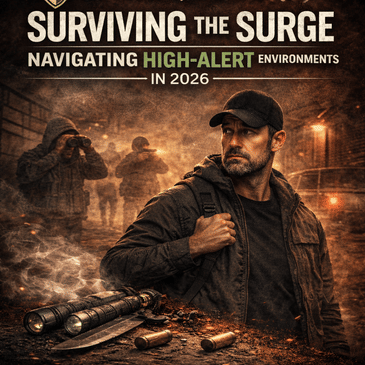
Surviving the Surge: Navigating High-Alert Environments in 2026
Imagine standing in a packed stadium with seventy thousand people. The energy is electric. The noise is deafening. Then, without warning, an entire section of the crowd suddenly goes silent.
Most people will pause.
They’ll look around.
They’ll wait for someone else to react first.
In real emergencies, that hesitation can cost lives.
This episode of Red Dot Mindset takes listeners through a civilian awareness briefing developed by Grey Matter Ops, focused on one simple reality: in high-density public environments, the person who moves a few seconds earlier often has the advantage.
The goal of this briefing is not to create fear or paranoia. It is to provide civilians with a professional framework for situational awareness—the same type of thinking used by security professionals, emergency planners, and protective teams. When you understand how crowds behave, how environments are designed, and how the human brain reacts under stress, you can navigate public spaces with calm confidence instead of uncertainty.
Throughout the episode, we explore how modern venues—from stadiums and shopping centers to transit hubs and large festivals—are engineered for maximum convenience and maximum flow. Those design priorities make everyday life easier, but they also create predictable vulnerabilities when thousands of people suddenly try to move at once. Recognizing those dynamics allows civilians to think ahead of the crowd rather than react with it.
You’ll also learn how professionals approach awareness using the concept of “Left of Bang”—the window of observation, positioning, and preparation that exists before a crisis unfolds. Most incidents do not appear without warning. They are often preceded by subtle behavioral anomalies, shifts in crowd movement, or environmental changes that attentive observers can detect seconds before others recognize what is happening.
This episode breaks down practical awareness concepts civilians can use immediately, including how to recognize behavioral baselines in crowded environments, how to identify anomalies that break that baseline, and how to position yourself within a venue to maintain mobility rather than becoming trapped in dense crowd compression zones. These insights are not about profiling people or confronting threats—they are about understanding patterns of human behavior and environmental design.
The briefing also explores how the human brain reacts to sudden danger. Many people assume they will instantly act during a crisis, but research and real-world incidents show that most individuals experience some form of freeze response—physiological, cognitive, or social. Learning how to recognize and break that freeze response can restore movement and decision-making in the critical first seconds of an emergency.
Just as important, the episode discusses what happens after an incident. Once people reach safety, the body is still flooded with adrenaline, and the mind is often overwhelmed by the shock of what just occurred. Understanding how to reset your nervous system, check for injuries, and provide clear information to first responders can make a significant difference during the aftermath of a crisis.
At its core, this episode reinforces a principle that sits at the heart of the Grey Matter Ops philosophy:
Preparedness should not make life smaller.
It should make life freer.
When situational awareness becomes a habit, public spaces become easier to navigate—not harder. Instead of constantly worrying about “what if,” you learn to observe your environment, recognize normal patterns, and respond calmly when something changes.
In this episode, we break down the mindset, awareness tools, and practical tactics that help civilians move through high-alert environments with clarity, confidence, and control.
If you spend time in crowded venues, attend large events, travel frequently, or simply want to sharpen your situational awareness, this briefing provides a practical starting point.
Listen in—and learn how a few seconds of awareness can change everything.
TACTICAL BRIEF
Surviving the Surge: Navigating High-Alert Environments in 2026
Mission:
Provide civilians with a practical awareness framework for navigating crowded public spaces during heightened security environments—without panic, paranoia, or paralysis.
The objective is simple:
Move earlier. Move smarter. Move with margin.
🎯 THE PROFESSIONAL MIDDLE GROUND
When security alerts rise, civilians tend to swing toward two extremes:
Extreme | Result |
|---|---|
Total denial | “Nothing will happen to me.” |
Paralyzing fear | “I should avoid all public spaces.” |
Neither improves safety.
Grey Matter Ops doctrine emphasizes the Professional Middle Ground:
Preparedness without fear.
Situational awareness becomes a habit, not a burden.
⏱ LEFT OF BANG MINDSET
Security professionals think in terms of time relative to the incident.
Phase | Description |
|---|---|
Left of Bang | Preparation, observation, positioning |
Bang | Incident occurs |
Right of Bang | Reaction and survival |
Goal:
Extend the Left of Bang window as long as possible.
Early awareness equals time, space, and options.
🌎 HIGH-ALERT ENVIRONMENTS (WHAT IT REALLY MEANS)
A “high alert” environment does not mean an attack is imminent.
It means:
• Security posture is elevated
• Intelligence sharing increases
• Patrol visibility rises
• Agencies are in a heightened readiness state
Think of it like a weather forecast.
When storms are possible, you carry an umbrella.
You don’t hide in the basement.
⚠️ THE CONVENIENCE TRAP
Modern venues are designed for maximum convenience and maximum flow.
Examples:
• Stadiums
• Shopping malls
• Festivals
• Transit hubs
• Airports
These environments prioritize movement and commerce, not defense.
That creates vulnerabilities.
⏳ THE 72-HOUR COPYCAT WINDOW
After highly publicized events, there is often a temporary spike in imitation attempts.
During these periods:
Increase awareness from baseline 5 → 8
This means:
• Eyes up
• Phones down
• Observe behavioral anomalies
Awareness is temporary and proportional, not permanent anxiety.
👁 BECOMING A CIVILIAN SENSOR
Your role is not confrontation.
Your role is observation and reporting.
You become an additional sensor in the environment.
Focus on behavior, not identity.
📊 BASELINE VS ANOMALY
Every environment has a behavioral baseline.
Example:
Environment | Baseline |
|---|---|
Music festival | Loud, relaxed, fluid movement |
Museum | Quiet, slow movement |
Sporting event | Excited, high energy |
You do not analyze every person.
You identify what breaks the baseline.
🚩 COMMON PRE-INCIDENT INDICATORS
Concealment Anomaly
Clothing inconsistent with environment.
Example:
Heavy coat in summer.
Security Rub
Repeated touching of concealed area.
Humans subconsciously check objects they are protecting.
Scanning Behavior
Looking behind frequently or watching security instead of the event.
Predator mindset focuses on authority locations.
Anti-Freeze Tell
One person appears emotionally disconnected from the crowd.
Rigid posture
No engagement with environment
Hyper-focused behavior
🗺 PRE-EVENT RECON
Preparation begins before leaving home.
Virtual Recon
Check venue maps for:
• Stairwells
• Secondary exits
• Medical areas
• Perimeter access routes
Elevators often fail during emergencies.
Stairs remain functional.
🚗 PARKING STRATEGY
Convenience parking is often the worst tactical choice.
Avoid:
Parking directly near the main entrance.
Instead:
• Park on perimeter
• Back into parking space
• Face exit route toward main road
Goal:
Leave first, not last.
🧭 ENVIRONMENTAL GEOMETRY
Space dictates risk.
Compression Trap
The center of a dense crowd eliminates mobility.
Example:
Concert pit
Packed concourse
Perimeter Advantage
Edges of a space allow:
• Lateral movement
• Escape routes
• Reduced crowd pressure
Professionals instinctively move toward perimeters.
🚪 THE TWO-EXIT RULE
The moment you enter any building:
Identify:
1️⃣ Primary exit
2️⃣ Secondary exit
Humans default to the door they entered through.
This is called the Known Door Trap.
Pre-loading an alternate route breaks that habit.
📍 THE BIG BLUE CLOCK PROTOCOL
For families or groups:
Immediately establish a rally point.
Example:
“Meet at the blue clock above Section 104.”
Cell networks often fail during major incidents.
Physical landmarks never do.
🌊 CROWD SURGE SURVIVAL
If caught in a moving crowd:
Do not fight directly against the flow.
Instead apply the 45° Rule.
Move diagonally toward the perimeter of movement.
This reduces pressure and restores mobility.
🧒 PROTECTOR GRIP
During a surge:
Do not hold hands.
Finger locks break easily.
Instead grip:
• Wrist
• Lower forearm
This creates a structural hold that resists separation.
⚡ THE VIBE SHIFT
Before incidents occur, environments often change.
Indicators include:
• Sudden unnatural silence
• Rapid directional crowd movement
• Security posture changes
• Animal disturbance (birds scattering)
These signals often occur seconds before escalation.
🧠 THE FREEZE RESPONSE
Humans commonly experience three freezes.
Freeze Type | Description |
|---|---|
Physiological | Adrenaline causes body lock |
Mental | Denial loop (“That can't be happening”) |
Social | Waiting for others to react first |
The 3–5 second decision window is critical.
Early movement creates survival margin.
🧊 THE ANTI-FREEZE PROTOCOL
Step 1 — Recognize
Say internally: “I’m locked.”
Step 2 — Micro-Movement
Shift weight or move a foot.
Step 3 — Action
Commit to exit movement.
Step 4 — Flow
Re-enter observation loop while moving.
Motion breaks the freeze response.
🩺 POST-INCIDENT RESET PROTOCOL
After escaping danger:
1️⃣ Plug Sweep
Check yourself and others for injuries.
Adrenaline can mask pain.
2️⃣ Decompression Loop
Use 4-2-7 breathing:
• Inhale — 4 seconds
• Hold — 2 seconds
• Exhale — 7 seconds
Long exhale activates the vagus nerve, reducing adrenaline.
3️⃣ Grounding
Focus on sensory input:
• Temperature
• Sounds
• Physical surroundings
This stabilizes cognitive control.
📡 CIVILIAN REPORTING PROTOCOL
Use SALUTE-Lite reporting.
Element | Description |
|---|---|
Size | Number of individuals |
Activity | What they were doing |
Location | Exact place |
Uniform | Clothing or distinguishing features |
Time | When observed |
Report data, not feelings.
Example:
“Three individuals bypassed the ticket line and filmed emergency exit hinges at Gate 4 approximately three minutes ago.”
📵 TACTICAL DISCIPLINE
Avoid livestreaming incidents.
Filming chaos reduces:
• Peripheral awareness
• Escape mobility
• Decision speed
Priority order:
1️⃣ Create distance
2️⃣ Reach safety
3️⃣ Report information
🎯 CORE PRINCIPLE
Preparedness does not create fear.
Preparedness creates freedom.
When you know how to read a room and how to exit it:
You can relax and enjoy the event.
🧠 THE 30-SECOND DRILL
Tomorrow, practice this.
When entering any building:
1️⃣ Identify the door you entered
2️⃣ Locate a secondary exit
3️⃣ Visualize the path
You are not being paranoid.
You are removing surprise from the equation.
🛡 FINAL TAKEAWAY
Situational awareness is not about expecting danger.
It is about maintaining margin.
Keep your eyes up.
Stay fluid.
Move with intention.
Awareness is armour.