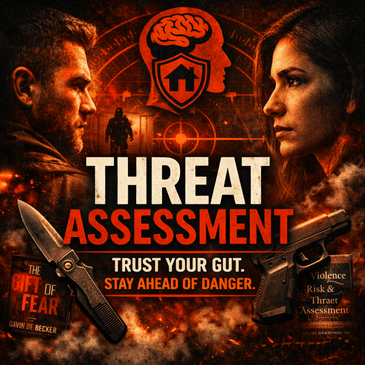

This episode of Red Dot Mindset™ cuts through surface-level safety tips and dives into the psychology of threat detection—where intuition meets awareness. You’ll learn how to recognize danger cues before they escalate, trust your instincts under pressure, and apply a mental framework that keeps you one move ahead in any environment.
🧠 Inside this episode, you’ll learn how to:
Build and refine your intuitive radar to detect subtle behavioral shifts.
Separate anxiety from genuine pre-threat perception signals.
Leverage subconscious pattern recognition to predict intent.
Stay alert in transitional zones—without slipping into paranoia.
Drawing from real-world experience and insights from experts like Gavin de Becker, Dr. J. Reid Meloy, Amanda Ripley, and Corson Security Group, this episode gives you the mindset tools to process information faster, make smarter decisions, and respond with purpose when seconds count.
Stay aware. Stay decisive. Train the Mind. Win the Fight.™.
🧠 Tactical Brief: Threat Assessment Beyond the Obvious — Developing Your Intuitive Radar
Developed by: Mickey Middaugh — Founder, Grey Matter Ops™ | Tactical Mindset & Civilian Preparedness
Series: Red Dot Mindset™ Podcast Deep Dive
Mission Motto: Train the Mind. Win the Fight.
🎯 Mission Objective
Build a portable, civilian-ready threat assessment process that sharpens intuition, speeds decisions, and prevents ambush—without slipping into paranoia.
🧪 Intuitive Radar — What It Is
Your “gut” = fast, subconscious pattern-matching built from lived experience.
It flags deviations from the norm before you can verbalize why.
Treat it as an early-warning sensor, then verify with observation.
⚖️ Intuition vs. Anxiety — Know the Difference
Intuition: present-moment signal tied to something you’re sensing now.
Anxiety: future-focused “what if” loops untethered from current cues.
Protocol: Feel → Look → Label → Act (identify the cue, not just the feeling).
📊 Baselines & Anomalies (Urban Patterning)
Establish baseline: flow, noise, typical attire, staff rhythms, entry/exit usage.
Flag anomalies: loitering with no purpose, clothing that conceals, boundary testing, fixation on security features, route-blocking behavior.
Action: elevate from Condition Yellow → Orange when a specific anomaly appears.
🟡 Condition Yellow (Sustainable Alertness)
Relaxed, curious, heads-up awareness; eyes up, hands free, ears available.
Scan for exits, cover, and transitional zones (doorways, parking lots, gas pumps, ATMs, rideshare curbs).
🚧 Safety Trap (Feeling Safe ≠ Being Safe)
Visible security (cameras, guards, gate codes) can lower vigilance.
Maintain your own standard: verify lighting, sightlines, concealment spots, and response options every time.
📱 Digital OPSEC (Intuition Online)
Delay posting trips and live locations; scrub old oversharing.
Audit profiles for exploitable details (routines, kids’ schools, vehicle shots).
Dating apps: vet in public, tell a third party, time-box the meet, abort on gut.
🧍 Positive Protective Posture
Confident gait, brief eye contact, squared shoulders, purposeful movement.
Project “aware and decisive,” not agitated or distracted.
🧠 Cognitive Framework — OODA in the Wild
Observe: heads-up scan; collect cues.
Orient: compare to baseline; name the anomaly.
Decide: pick the simplest safe option (create distance, change angle, disengage).
Act: move first; re-loop OODA as the picture updates.
🚩 Boundary Setting (Be Willingly “Disagreeable”)
Clear No, step-back, palm-out, broken-record phrasing.
Don’t negotiate with boundary testers; escalate to distance or help.
🧰 Micro-Drills (90–120 seconds)
Entry Scan: two exits + nearest cover.
Anomaly ID: name one thing that doesn’t fit; decide a pivot.
Transitional Zone Reps: from door to vehicle—eyes out, keys staged, path pre-cleared.
OPSEC Sweep: delete one overshare; tighten one privacy setting.
OODA Rehearsal: visualize a simple diversion and your route change.
📌 Key Takeaways
Intuition is data—treat it as a cue, then verify.
Baselines expose anomalies; anomalies trigger action.
Transitional zones are prime hunting ground—arrive and depart on purpose.
Boundaries are protective gear; use them early and clearly.
Simple reps > complex theory. Make awareness a habit, not a mood.
📚 Sources Acknowledged (by discussion in the episode)
Gavin de Becker (The Gift of Fear) • Dr. J. Reid Meloy (Affect Heuristic, Violence Risk) • Amanda Ripley (The Unthinkable) • Corson Security Group (Safety Trap, Protective Posture, OPSEC).
🛡️ Footer — Grey Matter Ops™
Train the Mind. Win the Fight.
Stay Grey. Stay Ready.™
Awareness Is Armour.™