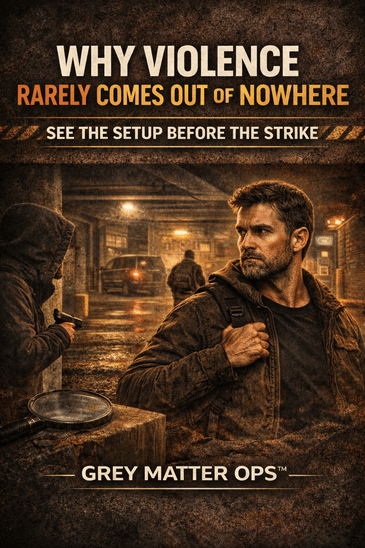

Most people think danger starts with the jump scare, footsteps behind you in a parking garage, a stranger getting too close, a moment that suddenly feels wrong. But by the time the threat is obvious, you may already be behind the curve.
In this episode, Red Dot Mindset breaks down the Grey Matter Ops Red Dot Mindset, a practical framework for recognizing danger before it turns physical. Instead of treating violence like it appears out of nowhere, this episode explains how threats often develop through a setup phase made up of subtle cues, shifting behavior, boundary testing, and positional advantage.
You will learn why situational awareness is not about paranoia, fear, or obsessively hunting for “bad guys.” It is about establishing a baseline, identifying anomalies, and making timely decisions before your options collapse. The episode also explores why intuition matters, not as emotion or guesswork, but as rapid threat processing your brain may register before your conscious mind can explain it.
At the center of this discussion is the Grey Loop, a six phase process designed to help civilians move from passive observation to deliberate action: See, Label, Assess, Decide, Move, Adapt. Whether you are walking to your car, leaving work, moving through a transit stop, or navigating any other transitional space, this framework gives you a calm, disciplined way to stay ahead of the problem.
This is not about living in fear. It is about learning to recognize the setup, break the script, and buy yourself the one thing that matters most in a dangerous encounter, time.
If you have ever wondered how to become more aware without becoming paranoid, this episode gives you a practical place to start. Prepared, not paranoid. Alert, not alarmed.
🎯 Tactical Brief: The Red Dot Mindset
How to Recognize the Setup Before the Threat Becomes Physical
🧭 Mission
This episode is built to shift the way you think about danger.
Most people imagine danger beginning at the moment of contact, the grab, the rush, the confrontation, the jump scare. But in the real world, danger usually begins much earlier. It starts in the setup, in the small details, subtle positioning, broken patterns, and behavioral cues most people miss until their options are already shrinking.
The mission of this episode is simple:
stop thinking of danger as a surprise event, and start recognizing it as a process.
⚠️ The Core Problem
Most people recognize danger too late
The average person tends to picture a threat as something that appears out of nowhere. That mindset creates a serious disadvantage because it trains the brain to react only when the danger is already obvious.
By then, the predator may already have:
closed distance
gained positional advantage
tested boundaries
chosen timing
identified distraction
confirmed hesitation
The lesson is clear:
if your mental movie starts at physical contact, you are starting too late.
🕵️ The Setup Phase
Violence usually leaks clues before it happens
This episode breaks down the idea that danger rarely appears without warning. Instead, it often develops through a setup phase.
The setup phase may include:
observation
pacing
angle changes
unnatural lingering
forced interaction
distraction attempts
boundary testing
closing the gap without drawing attention
A bad actor usually needs conditions to line up before acting. That means there is often a window, sometimes small, but still real, where the target can detect the pattern early enough to disrupt it.
Key principle
Predators need access, timing, and delayed recognition.
If you interrupt any one of those, you can break the script.
🎩 The Magic Trick Principle
The distraction is not the real move
One of the strongest concepts in this episode is the idea that danger can work like a magic trick.
A predator may use conversation, politeness, confusion, or a harmless question as the visible distraction. Meanwhile, the real move may be:
closing distance
cutting off your angle
forcing your attention downward
moving you into a weaker position
testing whether you will comply
Memory jogger
The question may not be the threat.
The movement behind the question may be.
👀 Baseline Before Threat
Do not hunt for bad guys, establish normal first
This episode makes an important distinction between threat hunting and baseline awareness.
Threat hunting burns energy. It leads to:
overanalysis
false alarms
fixation on appearance
mental fatigue
poor judgment
Baseline awareness is different. It starts with one question:
What does normal look like here, right now?
A baseline includes:
the normal pace of movement
the natural flow of people
the expected behavior in that location
the standard use of space
the ordinary rhythm of the environment
Once the baseline is established, you are no longer searching for a threat.
You are simply watching for what breaks the rhythm.
🚨 Anomalies
An anomaly is not automatically a threat, but it deserves attention
An anomaly is a deviation from what belongs in that environment.
Examples may include:
someone standing still where movement is expected
a vehicle positioned oddly
a person whose pace or direction does not match the flow
someone watching exits instead of their own task
someone closing distance without a clear reason
behavior that seems detached from the environment’s purpose
Quick pattern check
One anomaly = data
Two anomalies = attention
Three anomalies = pattern
When a pattern forms, it is time to make a decision.
🧠 Intuition
Intuition is often rapid threat processing
This episode reframes intuition in a disciplined way.
Intuition is not necessarily panic, fear, or irrationality. Often, it is the brain processing environmental disruptions faster than the conscious mind can explain them. Your system may register:
posture changes
odd spacing
tone shifts
unnatural attention
movement that does not fit
before you can put it into words.
Key principle
Your body may detect the problem before your language does.
That does not mean every uneasy feeling is a threat. It means the feeling may be a signal to pause, check the baseline, and reassess before dismissing it.
⏱️ The Cost of Hesitation
People are often defeated by delay, not lack of courage
One of the strongest takeaways in this episode is that people often negotiate away their own safety because they do not want to:
seem rude
overreact
look foolish
offend someone
make a scene
That hesitation can be costly.
Memory line
Embarrassment is recoverable. Lost initiative is expensive.
If something feels wrong, early movement and early decision making are usually far cheaper than waiting for certainty while the setup continues.
🔁 The Grey Loop
The decision cycle for breaking the setup
At the center of the episode is the Grey Loop, a six phase process for moving from passive awareness to deliberate action.
1. See 👀
Break autopilot.
This is the act of consciously reconnecting your attention to the environment. In transitional spaces, people often become task fixated, keys, phone, bags, thoughts, fatigue. Seeing means deliberately returning your awareness to the physical space around you.
Ask:
What is happening around me right now?
2. Label 🏷️
Name the disruption.
Do not label the person as “bad.” Label the behavior or environmental break.
Examples:
“That vehicle is idling in an odd place.”
“That person is moving against the flow.”
“That spacing does not look right.”
Labeling forces conscious thought to engage with what your instincts may already be catching.
Ask:
What exactly is breaking normal here?
3. Assess 🧭
Measure the problem against reality.
This is where you quickly evaluate:
distance
exits
barriers
angles
lighting
direction of travel
available cover or safety points
This is not deep analysis. It is a fast environmental snapshot.
Ask:
What are my options right now?
4. Decide ⚖️
Choose before the problem chooses for you.
Many people stall here because they want perfect clarity. But real-world safety often requires a clean option, not a perfect one.
A decision may be:
change direction
create distance
return to a populated area
move toward light
get behind a barrier
reposition before the gap closes
Ask:
What is my next best move?
5. Move 🚶
Act on the decision.
Movement is not panic. It is problem solving.
A simple angle change, reposition, or return to a safer area can disrupt a bad actor’s timing and force them to recalculate. When you move early, you often break the setup before it matures.
Key principle:
Movement changes the math.
6. Adapt 🔄
Reassess based on what happens next.
If the anomaly disengages, the loop may close. If the anomaly adjusts and continues, you now have updated information and a stronger basis for further action.
Adapt means the loop is continuous, not one and done.
Ask:
What changed when I moved?
🚗 Where This Applies Most
High-value transitional spaces
This episode emphasizes transitional spaces, places where people move between points of safety and often become distracted.
Common examples:
parking lots
parking garages
store exits
sidewalks between buildings
elevators
stairwells
transit stops
building entrances
hotel corridors
gas stations
These spaces are not automatically dangerous, but they often compress attention and increase task fixation, making them ideal for delayed recognition.
🧱 Behavior Over Identity
Do not profile people, profile behavior
A major strength of this framework is that it avoids lazy threat identification based on appearance.
The better question is not:
Who looks dangerous?
The better questions are:
Does this behavior fit the environment?
Does this movement match the baseline?
Does this positioning make sense here?
Is this person’s focus consistent with the setting?
Core rule
Behavior over identity. Physics over assumptions.
This keeps awareness disciplined and reduces bias, noise, and false confidence.
📌 Quick Reference
Three questions to run in any transitional space
When stepping into a parking lot, garage, store exit, or other transition point, ask:
1. What is the baseline right now?
What is normal here?
2. What is breaking that baseline?
What feels out of rhythm?
3. What is my next best move?
What keeps time, space, and initiative on my side?
These three questions alone can pull you out of autopilot and back into the decision cycle.
🛡️ Bottom Line
This episode is not about fear.
It is not about paranoia.
It is not about walking around looking for enemies.
It is about:
recognizing the setup early
spotting anomalies before they become threats
trusting disciplined intuition
interrupting predatory timing
keeping initiative
buying time
Final takeaway
Do not wait for the jump scare. Catch the setup.
⚡ Fast Memory Joggers
If you only remember a few things, remember these:
Danger usually starts before physical contact
The setup phase leaks clues
Establish the baseline before looking for trouble
Anomalies matter when they form a pattern
Intuition may be rapid threat processing
Hesitation costs options
The Grey Loop gives you a decision path
Movement can break the setup
Transitional spaces deserve more attention
Prepared, not paranoid. Alert, not alarmed.
🔻Signature Line
Prepared, not paranoid. Alert, not alarmed. Awareness is armour.