
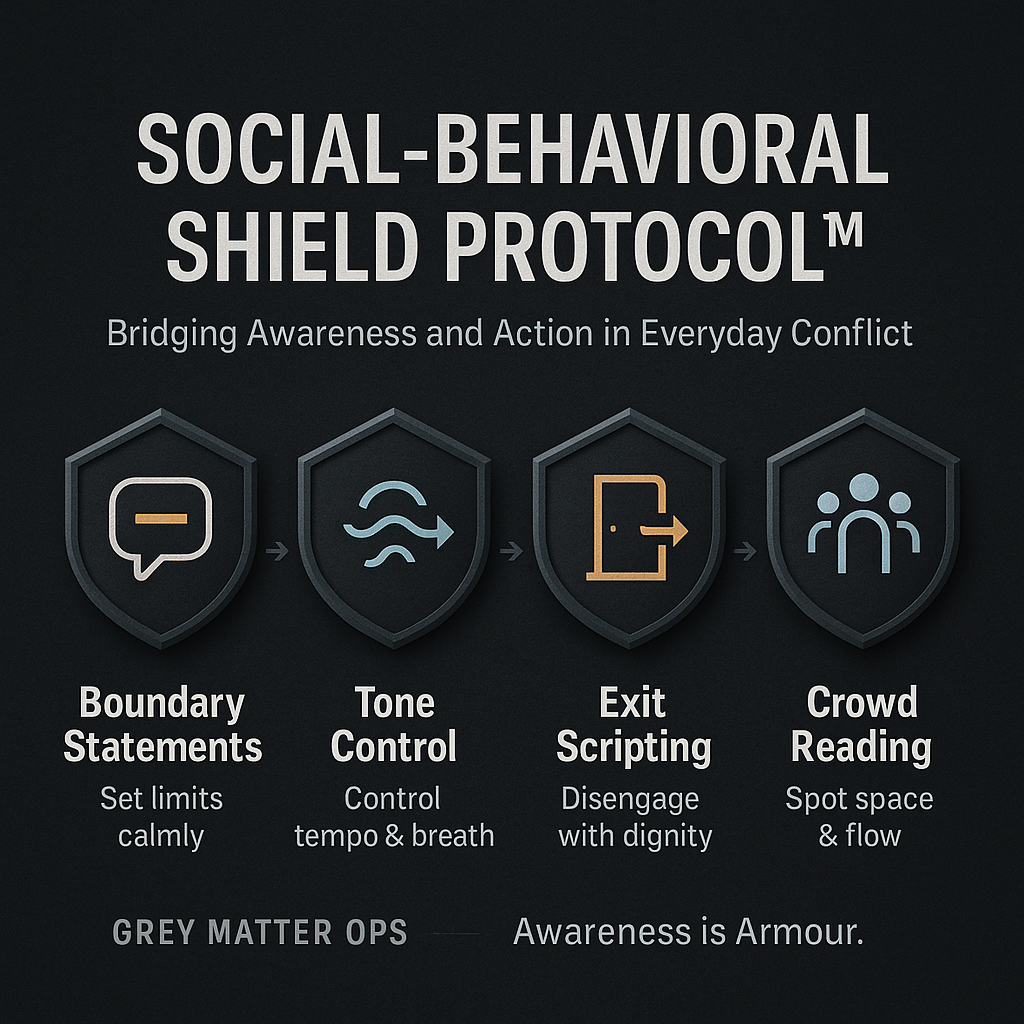
Bridging Awareness and Action in Everyday Conflict
Doctrine Origin: Grey Matter Ops™
Framework: R.A.D.A.R.™ — Red Dot Awareness and Decision Analysis Resource
Why SBSP Exists
Most civilian confrontations begin with tone, posture, and distance, not weapons.
Long before a threat becomes physical, it starts as a test — of your reaction, your confidence, and your ability to control the tempo.
Many civilians notice early warning signs through tools like the Avoidance Ladder™ (de Becker, 1997)…
…but freeze or hesitate the moment a situation becomes verbal.
The Social-Behavioral Shield Protocol™ (SBSP) fills that gap.
It provides the pre-conflict control layer — structured verbal cues, tone regulation, posture, and distance management — that protects you in the critical seconds before a situation turns physical.
SBSP forms the behavioral firewall between calm observation and decisive action, linking directly to:
The Avoidance Ladder™ — recognize & withdraw early
The Anti-Freeze Protocol™ — control your physiological response
The Grey Protocol™ — decisive movement & adaptation under threat
R.A.D.A.R.™ — the continuous loop of Recognize → Assess → Decide → Act → Reassess
Together, these unify into a complete civilian readiness system.
📏 The Proxemic Foundation of SBSP
SBSP is built on distance.
How close a person gets — and whether they respect space — determines which Shield you deploy.
Grey Matter Ops uses four distance “tripwires” based on proxemics research (Hall, 1990; Sorokowska et al., 2017):
Public Zone — 12+ feet
Low threat. Awareness only.
Social Zone — 4–12 feet
Most early interactions.
If tone, posture, or behavior feels off → SBSP activates here.
Personal Zone — 1.5–4 feet
Meaningful escalation.
Boundary Statements + Tone Control become mandatory.
Intimate Zone — 1.5 feet
A stranger breaching this zone is a threat trigger.
SBSP ends here → immediate transition to the Grey Protocol™.
These zones remove guesswork and give civilians objective, repeatable cues for escalation.
🛡️ The Four Shields of SBSP
1️⃣ Boundary Statements
Short. Neutral. Final.
Used the moment someone enters your personal zone or verbally tests your reaction
(Thompson & Jenkins, 2013).
Examples:
I’m not interested.
Step back, please.
Not today.
No — I’m leaving now.
Posture Fix:
Use a Squared-Ready stance — stable but mobile, weight balanced, feet angled for lateral movement.
Not rigid. Not flat-footed.
Ready to move.
2️⃣ Tone Control (Continuous Shield)
Tone is active from the very first word you speak.
Principles:
Lower your volume
Slow your tempo
Pause before responding
Speak on the exhale
Hands visible, palms soft but open
Physiological Purpose:
Exhaling activates the parasympathetic brake, lowering adrenaline.
A calm tone triggers mirror-neuron regulation in the aggressor.
Supported by ICAT findings showing 28% fewer use-of-force incidents after tone-control training
(Engel et al., 2020).
Tone Control is your tempo regulator.
3️⃣ Exit Scripting (Movement + Words)
Polite → Firm → Final.
Always delivered while moving.
Examples
Polite:
Not for me — have a good one.
I’ve got to get moving.
Firm:
I’m not staying here.
I said no — I’m leaving.
Final:
I’m done with this — I’m leaving now.
This stops here — I’m moving past you.
Escalation Rules — ONE trigger is enough:
They ignore your first boundary
They close distance
They block your exit
Their volume spikes
You see targeting glances or stance shifts
Exit Scripting = verbal disengagement + physical relocation.
Movement is primary.
Words support the movement.
If your exit is blocked or your Final Script fails →
SBSP is over → transition to The Grey Protocol™
(de Becker, 1997; ALERRT, 2018).
4️⃣ Crowd Reading (Predictive Awareness)
Crowds either help you escape or accelerate danger.
Look for:
Sudden compression or expansion
People avoiding eye contact
Rapid movement toward/away from a focal point
Staff repositioning
Bystanders checking phones, bags, or exits
Sharp drop in ambient noise
Crowd Reading is active, not passive.
It tells you where the safe vectors, cameras, and staffed zones are.
Based on proxemics and crowd-behavior science
(Hall, 1990; Sorokowska et al., 2017).
🧭 SBSP OPERATIONAL FLOW —
THE CIVILIAN ESCALATION PATHWAY
The Social-Behavioral Shield Protocol™ follows a predictable, repeatable sequence.
Use this flow as your mental map:
👁️ RECOGNIZE
Anti-Freeze breath
Proxemic scan (Social → Personal)
Spot anomalies in tone, posture, or pacing
🔍 Physiological Escalation Indicators (Confirmation Layer)
When social pressure increases, the body begins preparing for action before conscious commitment.
These involuntary changes confirm when an interaction is shifting from social testing toward physical readiness.
Physiological Confirmation Cues
(Any single cue is sufficient when distance is closing):
Bladed stance — dominant shoulder or hip angles away
Dominant leg retreat — foot draws back without a full fight stance
90-degree arm angles — preparatory access to tools or weapons
Oxygen spike — nostril flare, rapid blinking, shallow breathing
Adrenaline bleed — sudden fidgeting, bouncing, hand activity near legs
Commitment cascade — fingers slowly curling into the palm
Targeting behavior — peripheral gaze replacing direct eye contact
Time Compression Rule:
As escalation cues cluster closer together in time, decision windows shrink.
When physiological indicators appear alongside distance violations, disengagement becomes the priority.
This layer confirms escalation — it does not replace SBSP action.
🛡️ BOUNDARY + TONE CONTROL
Calm voice, low volume
Clear statements
Visible hands, stable posture
❓ COMPLIANCE CHECK
✔ If yes: disengage and create distance
✘ If no: treat it as escalation
⚠️ ESCALATION DETECTED
Distance closes
Exit blocked
Volume spikes
Targeting glance or stance shift
Any single cue is enough
🚶 EXIT SCRIPTING + MOVEMENT
Move first, talk second
Shift angles, step toward staffed or visible zones
Deliver polite → firm → final messaging while relocating
❓ SECOND COMPLIANCE CHECK
✔ If yes: break contact and leave
✘ If no: prepare for a threat shift
🔴 SBSP ENDS HERE — FIREWALL BREACH
→ Switch to The Grey Protocol™ (Decide → Act → Adapt)
When distance collapses, pursuit begins, or a weapon cue appears,
behavioral shields end and the survival protocol takes over.
🔄 RECOVERY
Anti-Freeze reset
Document / report
Restore baseline for the next R.A.D.A.R.™ cycle
📏 Proxemic Zones (Tripwires for Activation)
Public Zone — 12+ ft
Social Zone — 4–12 ft
Personal Zone — 1.5–4 ft
Intimate Zone — 0–1.5 ft
(A stranger in the Intimate Zone = Threat Shift.)
🔗 How SBSP Fits Into the Chain of Survival
1️⃣ Recognition (Anomaly Detected)
Activate:
Boundary Statements
Tone Control
Anti-Freeze breathing
Ties directly to the Avoidance Ladder™ (de Becker, 1997).
2️⃣ Escalation Signs (Boundaries Ignored)
Activate:
Exit Scripting
Lateral movement
Crowd Reading
3️⃣ Threat Shift
Weapon cues, pursuit, flanking, or an intimate-zone breach.
SBSP ends → Grey Protocol™ begins.
4️⃣ Recovery
Anti-Freeze breathing → document → reset baseline.
🏋️ 4-Week SBSP Training Program (Success Standards)
Week 1 — Voice Discipline
Success Standard: 3 controlled statements below 70–75 dB.
Week 2 — Space Mapping
Success Standard: Complete scan in 15 seconds.
Week 3 — Exit Scripting
Success Standard: Correctly escalate 4/6 triggers.
Week 4 — Scenario Loop
Success Standard: 80%+ protocol adherence under distraction.
Automaticity is the antidote to hesitation.
⚠️ Common Failures to Avoid
Over-apologizing
Over-explaining
Matching their volume
Backing straight up
Waiting for permission
Prioritizing politeness over survival
Awkwardness is survivable. Violence is not.
📌 Why SBSP Matters
Predators read hesitation.
SBSP replaces hesitation with structure.
Distance is data.
Calm is contagious.
Ethics stay central.
🏁 Closing Line
The Social-Behavioral Shield Protocol™ gives civilians command presence without conflict — the discipline to regulate tone, control space, and disengage with authority.
It’s not about being louder.
It’s about being first to control the tempo.
Train the Mind. Win the Fight.
Remember: Awareness is Armour.
For more tactical insights, subscribe to Red Dot Mindset.
📚 References
ALERRT Center. (2018). Avoid | Deny | Defend™ Civilian Response Guidance. Texas State University.
de Becker, G. (1997). The Gift of Fear. Little, Brown & Co.
DHS. (2013). Active Shooter: How to Respond. U.S. Department of Homeland Security.
Engel, R. S., et al. (2020). Examining the Impact of ICAT De-Escalation Training. National Policing Institute / IACP.
Hall, E. T. (1990). The Hidden Dimension. Anchor Books.
Sorokowska, A., et al. (2017). “Preferred Interpersonal Distances: A Global Comparison.” Journal of Cross-Cultural Psychology, 48(4), 577–592.
Thompson, G. J., & Jenkins, J. B. (2013). Verbal Judo: The Gentle Art of Persuasion. HarperCollins.
Remember: Awareness is Armour. For more tactical insights, subscribe to Red Dot Mindset.