

🎙️ Move Like a Protector: The Five Pillars of Environmental Geometry
Most people look at their environment.
Protectors learn to read it.
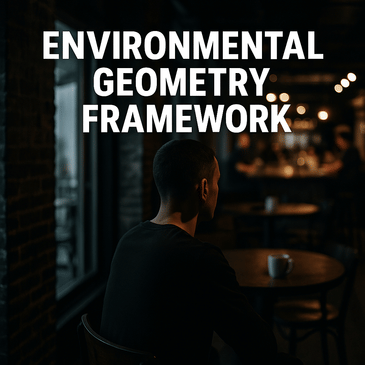
In this episode of Red Dot Mindset™, we dive into one of the most transformative skills any civilian can develop: the Environmental Geometry Framework™ (EGF) — a system that teaches you how to interpret the terrain around you the way trained protectors do.
EGF reveals how your surroundings silently influence your safety through three ever-present conditions:
Compression — where movement bottlenecks
Isolation — where you can’t be seen or heard
Exposure — where you’re fully visible or silhouetted
When you understand these geometric forces, you begin to see the world the way protectors see it: as a dynamic map of risk and opportunity. 🌐
🔍 What You’ll Learn in This Episode
1. Choke Points & Funnel Zones
Why these everyday architectural features restrict your movement — and how to spot the geometric traps that reduce your options before danger appears.
2. Escape Vectors
How to preload a plan (instead of relying on luck) and identify primary and secondary escape routes in restaurants, parking garages, office buildings, and transitional spaces.
3. Light Discipline
How illumination, shadows, and contrast expose or conceal you — and how to use lighting to your advantage when moving through unfamiliar environments.
4. Sound Cover
Why sound can betray your position or hide an adversary’s approach — and how to protect your auditory awareness in noisy or echo-prone spaces.
5. Geometry of Position
How to position yourself for maximum visibility and mobility using protector principles like staying off the X, maintaining vantage points, and choosing “safe geometry.”
🧠 Why This Matters
Environmental geometry influences your safety long before a threat becomes visible.
EGF gives you a way to stay:
Ahead of problems
Out of predictable danger zones
In control of your movement
Firmly left of bang
This isn’t about fear — it’s about spatial intelligence.
It’s about moving through the world with purpose, awareness, and tactical advantage.
🛡️ The Protector Mindset
Every hallway, stairwell, lobby, parking garage, or public venue has a geometry that shapes behavior. Once you learn to see it, you can navigate your daily life with:
More confidence
More clarity
More control
More options when it matters most
Your environment is always speaking.
In this episode, you’ll finally learn its language.
🎧 Listen now and learn how to move like a protector.
🛡️ TACTICAL BRIEF: Environmental Geometry Framework™ (EGF)
Reading the Terrain Before Trouble Starts
⚠️ Purpose
EGF teaches you to interpret physical environments the way trained protectors do — identifying compression, isolation, and exposure long before a threat appears.
The goal: Move with intelligence, avoid entrapment, and stay left of bang.
1️⃣ Choke Points & Funnel Zones
Choke Point: Restricts individual movement.
Funnel Zone: Compresses crowd movement.
Indicators
Single-file pathways
Stairwells, elevators, narrow walkways
Doorways, vestibules, construction barricades
Risks
Reduced lateral movement
Predictable movement pattern
High vulnerability during pauses or transitions
Actions
Identify before entering
Pre-plan two exit paths
Move along perimeter lines
Do not stop inside compression zones
2️⃣ Escape Vectors
A plan must be preloaded. Luck is not a tactic.
Indicators
Entrances, corridors, stairwells
Obstacles (furniture, vehicles, crowds)
Distance to secondary exits
Risks
Decision paralysis under stress
Congestion or blocked primary exits
Isolation during retreat
Actions
Identify a primary + alternate exit
Position yourself with mobility, not comfort
Establish family regroup points in advance
Verify accessible routes for children/elders
3️⃣ Light Discipline
Light can conceal or expose you.
Indicators
Bright doorways
Deep shadows
Backlighting
Inconsistent illumination (garages, alleys)
Risks
Silhouetting (you become a clean target outline)
Low visibility entering/exiting bright zones
Lost contrast in transitional spaces
Actions
Avoid standing backlit
Stay in moderate light, not extremes
Use a low-angled light to disrupt an aggressor’s vision
Memorize daytime routes for nighttime safety
4️⃣ Sound Cover
Sound reveals presence and intent.
Indicators
Loud HVAC, traffic, echo chambers
Footsteps, breathing, movement anomalies
Sudden silence in normally noisy spaces
Risks
Reduced auditory detection
Concealed approach by adversaries
False sense of security
Actions
Never wear earbuds in transitional zones
Secure noisy gear (keys, bags, accessories)
Increase visual scanning when sound intelligence drops
Use ambient noise to mask movement when disengaging
5️⃣ Geometry of Position
Where you stand determines what you can see — and how fast you can move.
Indicators
Entrances and exits
Blind corners
Areas with 360° visibility
Fixed seating vs. freestanding seating
Risks
Being on the X (primary entrance)
Restricted mobility in booths or corners
Back exposed to open space
Actions
Avoid primary entrance vectors
Choose freestanding tables, not fixed seating
Maintain 18" from walls to keep mobility
Seek vantage points with panoramic visibility
Integration: EGF → OER → Anti-Freeze → Grey Protocol™
EGF provides:
Spatial data
↓
OER provides:
Observe → Effect → Recognition → Absence
↓
Anti-Freeze Protocol:
Breaks the freeze and loads your next action
↓
Grey Protocol™:
Move. Escape. Adapt.
Use safe geometry to disengage and reach your exit vector.
KEY QUESTIONS TO ASK YOURSELF RIGHT NOW
Am I in compression, isolation, or exposure?
What are my primary and secondary exits?
Where is the X, and how far am I from it?
What geometry favors my escape, not theirs?
ONE-LINE TAKEAWAY
Geometry dictates opportunity. Your position decides the outcome.